Request a Demo
Measures for the Environmental Management Registration of Hazardous Chemicals (Trial) (a.k.a. MEP Order 22) came into force from Mar 1st, 2013, with the goal of improving China’s environmental management of hazardous chemicals.
Since MEP Order 22 has not yet been put into full scale implementation, many enterprises are uncertain how they will be affected, what they should do to comply with the regulation and what they should do to get fully prepared. This article introduces the progress of enforcement and development of the management system under MEP Order 22.
Regulated substances:
MEP Order 22 regulates all chemicals included in China’s Inventory of Hazardous Chemicals, based on which the Ministry of Environmental Protection (MEP) has nominated two groups of substance subject to more stringent supervision, namely hazardous substances of priority environmental concern (HCPEC) in terms of production and processing, and toxic chemicals severely restricted for import and export (hereinafter referred as “restricted toxic chemicals”).
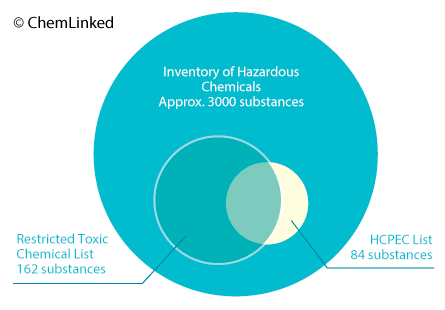
Figure 1 - Chemical substances regulated under MEP Order 22
The HCPEC List and restricted toxic chemical list will be adjusted from time to time solely by MEP, based on acquired hazard information of existing chemicals currently circulating in the market. When new chemical substances are identified to be hazardous and of priority environmental concerns, they are regulated by MEP Order 7 and may be future candidates for the HCPEC.
Industrial obligations and purposes
Under MEP Order 22, industry can be roughly classified into two groups namely manufacturer/user and importer/exporter. Supervision of manufacturers and users is vitally important to enable control over environmental risks posed by chemicals throughout their lifecycle. As a result, while HCPEC manufacturers and users face the heaviest compliance burden and technical challenges, importers and exporters are only required to carry out environmental management registration for restricted toxic chemicals which requires submission of supporting documentation such as company details and scope of business activities. This is necessary to comply with the Rotterdam Convention on acquisition of prior consent for trade of certain hazardous chemicals, the Stockholm Convention on controlling persistent organic pollutants (POPs), etc.
Table 1 – Obligations of different roles under MEP Order 22
| Manufacturer / User | Importer / Exporter |
HC |
| N/A |
HCPEC |
| N/A |
Restricted toxic chemicals | N/A |
|
HCPEC manufacturers/users are specifically required to conduct environmental risk assessment by outsourcing it to accredited third parties. The assessment report will be reviewed during the environmental management registration process. Industrial compliance obligations are subject to tiered environmental risk management based on the assessment result. This serves as the primary regulatory mechanism to restrict the access of HCPEC. The primary mechanism for post registration regulation is the annual pollutants release and transfer register (PRTR).
Implementation status quo
Trial Implementation of MEP Order 22 has started in Guangdong Province and Hebei Province. The official work focus is in the manufacturing and processing sector, so the import/ export issues will not be discussed in the following section. According to the government surveys, many enterprises are not capable of completing the PRTR report or the environmental risk prevention and control scheme (materials required for the environmental management registration) on their own at the current stage. The same situation also applies to environmental risk assessment. The fact is that the Solid Waste and Chemicals Management Center (SCC, the former CRC) just launched the first training and qualification program this July. Currently China has a shortage of qualified professionals to keep pace with the demand from industry
Government must also work closely with industry to ensure the feasibility and efficacy of regulations and guidance documents. For example, investigation on the material flow of Hazchems in an acrylonitrile processing factory was carried out to gather data on the industry’s environmental risk control capabilities, as well as to measure and calculate the amount of pollutants transferred or emitted to the environment by applying the method provided in the guidance. The investigation report indicated that more study on the technical processes is necessary, and the Guidance on the Compilation of Environmental Risk Assessment needs to be more detailed and practical.
Given the technical difficulties and potentially high costs, many HCPEC manufactures and users are reluctant to comply with the regulation. Environmental impact assessment and risk assessment of chemicals will be carried out for new constructions and expansions, otherwise, the projects won’t be approved for production. However this is not the case for existing industrial facilities and many would rather take the risks of not complying with regulations than spend the necessary money to comply with regulations. According to Director Sun Jinye of SCC, if the policy of “unlimited fines” in the revised Environmental Protection Law, (taking effect from 2015), is also applied to MEP Order 22, non-compliance will be unaffordable.
In conclusion, China is not yet prepared for the full implementation of MEP Order 22 on a national scale. From a broader perspective, the 12th Five-Year Plan (FYP) on chemical management and environmental protection is due to be concluded next year, with only a few goals achieved. An insider once joked that the 13th FYP could be compiled simply by deleting several lines of the 12th FYP. The pressure is on the government to improve the management system, enhance law enforcement, and remedy the lack of public trust.