Request a Demo
China MEP issued “Measures for the Environmental Management Registration of Hazardous Chemicals (trial version)”, aka MEP Order 22 in 2012. The Order then took effect from March 1st 2013. An essential step in the development of MEP involved gathering data on enterprises’ environmental risk control capabilities in order to better assess and reduce the potential harmful impacts the chemical industry has on the environment. Ms. Jinye Sun from SCC-MEP gave a comprehensive introduction of the overall progress, catalogue of HCPECs, and detailed requirements of the implementation of MEP Order 22 during her presentation at REACH24H’s Chemical Regulatory Annual Conference (CRAC 2014) which concluded in Shanghai on 14th of Oct.
As the head of Division of Chemical Management of SCC, Ms. Sun took part in the development of legislation and other regulations on chemical control and was the sole technical support of China’s negotiation on the Rotterdam Convention. She also directed several scientific research projects and was a member of China’s GHS Experts Council.
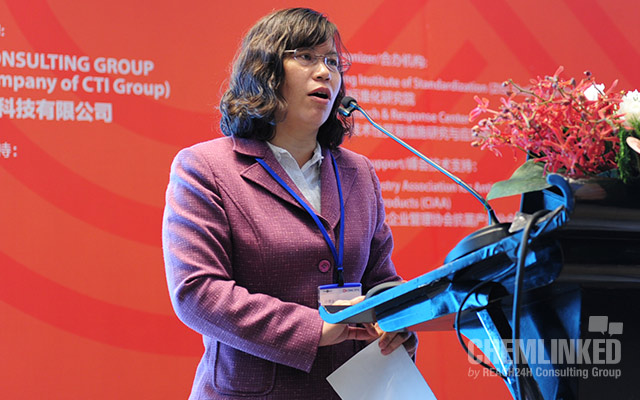
Ms. Jinye Sun, head of Division of Chemical Management of SCC, MEP
Ms. Sun admitted that the overall implementation progress of MEP Order 22 in most provinces has been relatively slow since its implementation. She attributed the reason as due to the uncertainty surrounding the release of the accompanying chemical inventories. On April 4th 2014, the MEP issued the final catalogue of Hazardous Chemicals of Priority Environmental Concern (HCPEC), including 84 chemicals that are persistent, bioaccumulative and toxic (PBT), or manufactured/used on a large scale, posing severe threat to the environment and human health. The Catalogue also includes chemicals under the control scheme of the Stockholm Convention, Minamata Convention, etc. More than 50 chemicals were cut off from the draft version of HCPEC because MEP tried to avoid over impacting the industries involved and over tasking local environment authorities.
MEP Order 22 applies to manufactures and users of HCPECs and other hazardous chemicals. Ms. Sun clarified some confusion that industry had during the implementation of MEP Order 22.
For registration of products (a mixture or solution made up of two or more substances) that contain HCPECs, manufacture should clearly represent the amount of the chemical and then complete registration.
Articles don’t fall under the scope of registration of MEP Order 22.
The term “Industrial Activity Unit” in Order 22 doesn’t include scientific research facilities.
The import, export, storage and transportation of HCPECs does not require to registration. They should comply with other relevant regulations.
The exemption list of 539 chemicals will be issued and open for public comments later.
For mixtures, manufacturers and users should convert the amount of HCPECs as pure chemicals and determine whether it should be registered.
If the company uses a hazardous chemical manufactured on its own as the raw material of another product, then this part of quantity shall be excluded in the calculation for registration.
The Order applies to manufactures and users of hazardous chemicals in China mainland, including bonded areas and export processing areas. It doesn’t apply to Hong Kong, Macau and Taiwan area.
Enterprises should submit the PRTR report to local authorities before Jan 31st every year.
Ms. Sun stated that MEP Order 22 is in its early stages so the first and primary target is to gather information and data. MEP can then begin to recognize major risks and then control and prevent the hazard through further legislation. She emphasized the importance of enterprises submitting comprehensive and accurate environmental reports to local environmental protection authorities. In the meantime, local authorities should have clear views on the production, storage and potential risk of hazardous chemicals in their administrative area. There is a long way to go before most enterprises realize their environmental obligation under MEP Order 22. In her presentation, Ms. Sun called upon the industry to pay more attention to environmental protection and create a safer and healthier future for our country.