Request a Demo
From a Chinese chemical regulatory perspective mixtures are categories of substances which are different from mono-constituent substances. There is no clear division of substance types described both in Measures on the Environmental Management of New Chemical Substance (hereinafter referred to as “Measures”) and New Chemical Substance Notification Guidance Document (hereinafter referred to as “Guidance”). Whereas, “Substance Type” in Part III of the application form are classified into three types, namely substance with unique molecular structure, substance without unique molecular structure and Polymers. Undoubtedly, mixture falls into the category of substance without unique molecular structure. In practice, to help choose appropriate notification strategy and testing method, we divide the mixtures into two groups, the multi-constituent substances and UVCB substances according to the Guidance for Identification and Naming of Substances under REACH and CLP.
1. Method of Distinguishing Multi-constituent Substance from UVCB Substance
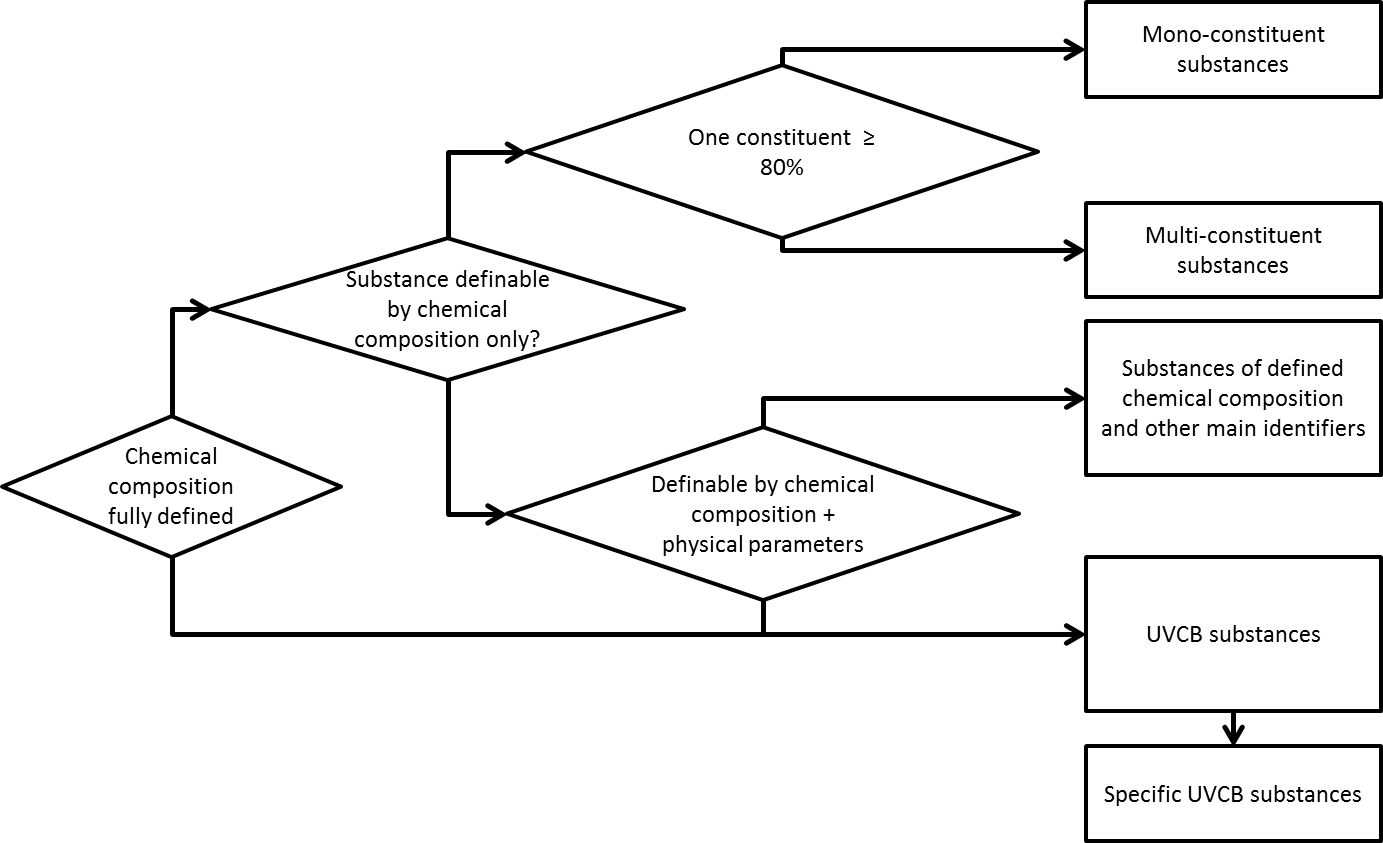
A multi-constituent substance is a substance, defined by its quantitative composition, in which more than one main constituent is present in a concentration ≥ 10% (w/w) and < 80% (w/w). Substances of Unknown or Variable composition, Complex reaction products or Biological Materials are called UVCB substances. UVCB substances cannot be sufficiently identified by their chemical composition. From a regulatory perspective for mixtures there is no practical difference between the terms constituents and impurities in UVCB substance, the terms “main constituents” and “impurities” should not apply to them. For more substance classification information, please see below procedures which were taken from Page 23 of Guidance for Identification and Naming of Substances under REACH and CLP. Substances of defined chemical composition and other main identifiers in the below chart are not discussed in this article, since these substances (e.g. inorganic minerals, kaolin) are mostly listed in the IECSC which are not within the regulatory scope of China new chemical substance notification (China NCSN).
Case Study
Q1: A product P is intentionally prepared by blending of substance A, substance B and water without chemical reaction, the composition of A, B and water are 30% (w/w), 40% (w/w) and 30% (w/w), respectively. A and B are both new chemical substances. Can P be notified as multi-constituent substance under China NCSN?
A1: No, a multi-constituent substance is the result of a manufacturing process. A mixture made from intentionally blending cannot be regarded as multi-constituent substance. In this case, A and B should be notified respectively.
Q2: Substance C and D are the only two constituents which are identified as new chemical substance in multi-constituent substance E. The content of C is 40% (w/w), while D is only 2% (w/w). In this case, is it acceptable if we consider D as impurity and only notify C?
A2: According to the Guidance, impurity is defined as “produced as an unintended constituent in a substance during manufacturing, likely originating from the starting raw material or the result of secondary or incomplete reactions during the manufacturing process. The content of single impurity is acceptable below 10% (w/w) but the total impurities shall not exceed 20% (w/w) of the chemical substance”. If D is not intentionally produced and doesn’t contribute to the function of substance E, it can be regarded as impurity.
2. Notification Strategy
2.1 Testing Principle
Generally, the testing sample shall be consistent with the substance to be notified. This provision applies well to mono-constituent substance, while for multi-constituent substance or UVCB substance, it is often the case that the notified part could not be technically separated or due to economic factor there is no need to separate them. In accordance with the Guidance, “For physico-chemical test data, if the testing sample is not at available at this level of purity (total impurity concentration<20% (w/w)), tests can be performed using a testing sample in the form of a preparation. The documentation explaining the lack of purity of the substance should be provided. Toxicological and eco-toxicological testing can be performed on either the pure substance or preparations of the substance, but the purity of the test sample should be indicated in the report”.
2.2 Naming Guidance
If a multi-constituent substance is imported or transferred to downstream users as a whole (without separation or refinement), and more than one component are identified as new chemical substance, considering the notification cost, notifying the substance as a whole is recommended. The generic naming format of multi-constituent substance is: “Reaction mass of [names of the main constituents]”. It should be noted that the chemicals in the above bracket is the main constituents of the substance, not the starting materials needed to produce the substance. Only main constituents typically ≥ 10% (w/w) contribute to the name. For example, a multi-constituent substance F is reacted from raw material G and H, and it finally composes of I (35%, w/w), J (60%, w/w) and K (5%, w/w). Then F could be named as “Reaction mass of I and J”. K is not listed in the name of F since its content is < 10%. In another situation, when there is only one separable constituent recognized as new substance in the multi-constituent substance, it is acceptable by just notifying this separable constituent.
For UVCB substance, due to its unknown or variable composition, it is also acceptable to notify them as a whole. The common UVCB substances include biological extracts, reaction products, etc. Generally, the name of a UVCB substance should indicate the source of the substance and the production process. Take plants extracts for example, the naming rule proposed in FAQ is “## tree, extract using water and 1,4- butanediol (1:1)”. When it is a reaction product, the name could be “Main starting material, reaction product(s) of other starting material(s)” or “Reaction product(s) of starting material(s)”.
Case study
REACH24H once helped a client to comply with China NCSN for a plant extract product, which composed of 99% octyldodecanol and 1% ## extract. The solvent octyldodecanol could not be eliminated or decreased as the plant extract is very sensitive and the purification process will cause denaturation of active ingredients in the plant extract. Since it is imported as a cosmetic ingredient with very low adding volume in finished products, the General Case of Simplified Notification (annual tonnage is < 1) was firstly proposed. As we described above, plant extract belongs to UVCB substance, and since the extract cannot be separated from the solvent (octyldodecanol), we will have to use the whole product (99% octyldodecanol + 1% ## extract) to perform ecotoxicological tests. Moreover, according to the testing principle “the test sample shall be consistent with the substance which is to be notified”, the whole product (99% octyldodecanol + 1% ## extract) should be the notified substance. Calculated from the maximum tonnage of the General Case of Simplified Notification (0.99 t), the actual imported amount of the plant extract would be 990 kg*0.01=9.9 kg at most. It is a relatively low volume. If this imported volume doesn’t meet demand, the Regular Notification with larger volume should apply.
In conclusion, it will be better to test purified or concentrated sample for biological extracts (The premise is that extract won’t get inactivated during purification process). Still taking the above case for example, if the testing sample could be concentrated to 50%, then although the final imported product remains to be “99% Octyldodecanol+1% ## Extract”, the existing form of the substance could be deemed as preparation by adding more Octyldodecanol and the importing volume of the plant extract could be extended to be 990 kg*0.5=495 kg。
3. Testing difficulties and Advice
1) The OECD Guidelines for some of the physiochemical endpoints are not applicable. The most typical case is water solubility, because OECD 105 only applies to determination of essentially pure substances which are stable in water and not volatile. But at the same time water solubility is very important to the ecotoxicological tests and it can also waive some of the endpoints depending on its value. For the General Case of Simplified Notification, China NCSN has no requirements on the origin of the physiochemical data, the notifier can submit the data generated by QSAR or excerpted from the preliminary exploring result of water solubility in aquatic organism test report. For Regular Notification, what domestic laboratory usually does is to issue a statement clarify that the method is not applicable. Since the definite value of water solubility could not be obtained, special care should be taken to other endpoints associate with it.
2) It will be more difficult to develop quantitative analysis method in mixtures comparing to mono-constituent substance, while quantitative analysis method is mandatorily required for water solubility, log Pow and some of the ecotoxicological tests. Based on our previous experience, there are three common approaches can be adopted to quantitatively analyze mixtures.
Approach 1: Chromatographic instrument, e.g. GC or HPLC was used to detect one of the main constituent in the mixture. This main component was assumed to be constant. By comparing the peak area of the main component in standard sample with that in the specific test solution, the concentration of the mixture will be calculated.
Approach 2: Chromatographic instrument, e.g. GC or HPLC was used to detect several main constituents in the mixture. By optimizing the testing condition, the main constituents present separated and clear peaks on the chromatogram. The concentration of the mixture was calculated by sum of the peak area of these main constituents.
Approach 3: TOC (Total Organic Carbon) measurement method will be adopted when other chromatographic methods are not applicable. A series of standard TOC solutions with certain concentration were measured by TOC analyzer. Based on the test result, a linear regression equation was obtained between the TOC concentration and the peak area. The concentration of the test substance could be figured up by the detected TOC value and the carbon content of the substance.
Case study
Please note that the TOC measurement method is not always effective. There was a case that a UVCB substance with carbon content of about 63.1% was served as test item in fish acute test. According to the results of preliminary test, the range between the maximum concentration causing no mortality and the minimum concentration causing 100 percent mortality was from 0.5 mg/L to 2 mg/L (nominal concentration). So five concentrations of 0.50 mg/L, 0.71 mg/L, 1.0 mg/L, 1.4 mg/L and 2.0 mg/L (nominal concentration) were set in the definitive test and the corresponding theoretical TOC concentrations was 0.32, 0.45, 0.63, 0.89 and 1.26 mg/L. As the TOC concentration of test water was likely to be 1–3 mg/L, so except the test concentration of 2.0 mg/L, other concentration groups would not be accurately detected, which means LC50 based on measured concentration could not been worked out from this test. Thus, to avoid the risk of being rejected by the expert evaluation committee, the lab has to go back to develop a suitable chromatographic analysis method.
4. Conclusion
According to MEP statistics, the majority of the substances which have obtained registration certificates are mono-constituent substances. The difficulties of notifying mixture lie in strategy choosing and testing method choice. The notification period of mixture is often prolonged if the notifier or the testing institution lacks experience. Herein, the corporations who need to notify mixtures are suggested to thoroughly understand your products first and then provide as accurate as possible information of the substance for making befitting notification plan.