Request a Demo
For better safety management of hazardous chemicals throughout their lifecycle, China is actively promoting the legislative process of the Law on Hazardous Chemicals Safety, establishing a solid legal foundation based on the national conditions. The draft of this law was prepared by the Ministry of Emergency Management (MEM) and has undergone multiple rounds of internal discussions and public consultations from 2017 to 2024. After incorporating feedback from various stakeholders, this draft law was submitted to the National People's Congress (NPC) for its first reading at the end of 2024, and public opinions were solicited until January 23, 2025.
During this consultation period, over 3,000 pieces of feedback were collected. According to China's legislative process, the draft will be revised based on the feedback and proceed to a second and third reading. Compared to the current regulation, State Council Decree 591, this draft proposes stricter safety management requirements for various aspects such as the production, storage, use, business operation and transportation of hazardous chemicals, reinforcing the primary responsibilities of the enterprises involved.
This article will interpret the draft law's key requirements and their impacts on relevant enterprises, providing compliance alerts.

#English Translations
Law on Hazardous Chemicals Safety (Draft)On December 26, 2024, the National People’s Congress (NPC) of the People’s Republic of China released the Law on Hazardous Chemicals Safety (Draft) for public comments. The consultation period will be due by January 23, 2025. The legislation is poised to replace the State Council Decree 591.Hazardous chemicals registration
The draft law requires establishing an inter-departmental information sharing mechanism, enabling relevant regulatory authorities (e.g., MIIT, MPS, MEE, MOT, GACC, etc.) to promptly monitor the registration information of hazardous chemicals. By accurately tracking the registration information, authorities can conduct better risk assessments and oversight, allowing for the timely identification and resolution of safety problems.
According to the current regulation Decree 591, manufacturers and importers of hazardous chemicals should register the quantity, hazards, storage site, and other required information with the national registration platform Hazardous Chemical Registration Comprehensive Service System launched by the National Registration Center of Chemicals (NRCC). In practice, more enterprises are required to report the aforementioned information via this platform, including:
Enterprises that have obtained the Hazardous Chemical Business Operation License,
Enterprises that have obtained the Hazardous Chemical Safe Use License,
Chemical enterprises (without Hazardous Chemical Safe Use License) and pharmaceutical enterprises that are classified into the category of “Manufacture (25 ~ 28)” according to ‘GB/T 4754 Industrial classification for national economic activities’, and
Certain enterprises that are designated by local authorities.
An upgrade of the national registration platform is in progress, targeting the determination of chemical enterprises falling under Item 3 and the hazard identification of chemicals not in China Inventory of Hazardous Chemicals (2015), shared by Mr. Chen Jinhe, an official from NRCC, at the offline seminar held by REACH24H and Shanghai Customs Brokers Association (SCBA) in Shanghai on March 27, 2025. This initiative aims to improve source control of hazardous chemicals and avoid compliance issues arising from inaccurate or outdated hazard information, especially when new hazards are found.

GHS and QR code requirements
In terms of GHS requirements, except for manufacturers, the draft law also requires importers of hazardous chemicals to provide the safety data sheet (SDS) and label. For chemicals to be manufactured or imported, if their hazards are not determined or classified, manufacturers and importers should carry out prior hazard identification, thereby generating compliant SDS and label. At an online seminar held by SCBA on March 25, 2025, the expert Mr. Lin Yikang stressed that the SDS and label should be prepared in Chinese, adopting UN GHS Rev.8, which meet the China GHS requirements following the national standards GB 30000 series, GB 15258, GB/T 16438 and GB/T 17519.
According to the draft law, use units and consignors of hazardous chemicals should transmit the compliant SDSs and labels to relevant personnel, ensuring the safety management in the process of use and transport. Heavy penalties will apply if there’s a violation. The hazard information communication is encouraged to be carried out in intelligent method, e.g., hazardous chemical safety information code (QR code). Although hazardous chemical QR code requirements have not been mandatory at the national level so far, the following initiatives show China’s ambition to push forward it nationwide.
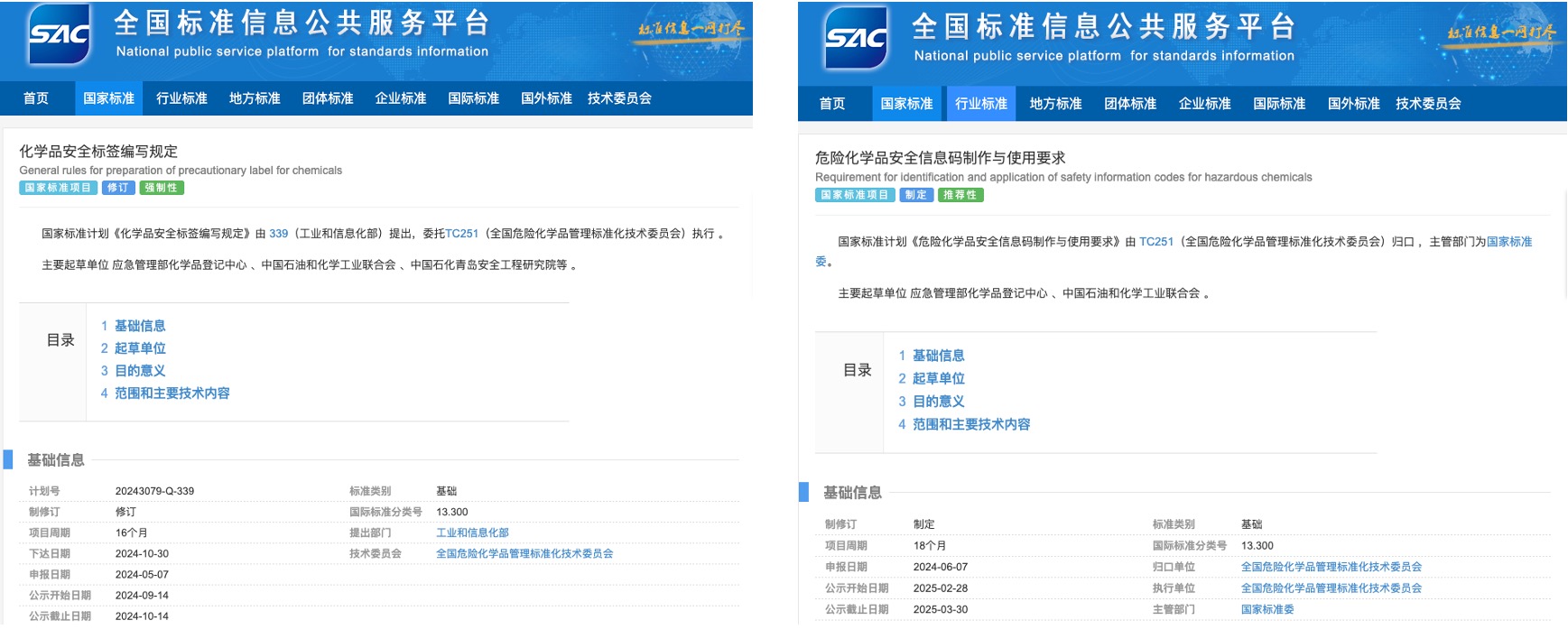
To support the digitalization of hazardous chemicals safety management, the National Standardization Administration of China proposed the project to revise the mandatory national standard GB 15258, incorporating the requirement of displaying hazardous chemical QR code on the GHS label (read more). Meanwhile, a new national standard, namely ‘Requirement for identification and application of safety information codes for hazardous chemical’ is under formulation, which is led by the NRCC.
Safety management of chemical park
The draft law introduces a dedicated chapter (Chapter 2, Articles 15~21) on the comprehensive planning and rational layout of the hazardous chemical production and storage. It's a topic absent in the current regulations, highlighting the importance of safety management of chemical parks. The draft law addresses existing challenges in the safety management of chemical parks and outlines several measures for improvement. It mandates the establishment and enhancement of safety management systems, the upgrading of safety infrastructure, and the strengthening of safety risk assessment and control processes.
Furthermore, it encourages the adoption of intelligent and digital solutions within chemical parks. A periodic risk assessment mechanism for chemical parks has also been introduced in the draft law, which implements threshold access management for hazardous chemical aggregation areas in China. Safety control distances and planning safety control lines will be established for storage facilities containing major hazard installations for hazardous chemicals, along with enhanced safety measures for transportation logistics.
The draft clearly states that the local municipal government’s industrial and information technology department, in collaboration with the emergency management department and other relevant authorities, should oversee corrective actions within a specified timeframe. The government reserves the right to mandate the conversion, suspension, relocation, or closure of non-compliant enterprises.
Safety management throughout lifecycle
In Chapters 3~6, the draft law introduces stricter requirements and responsibilities for enterprises, units, and individuals involved, enhancing overall safety and reducing accident risks in the industry. Stakeholders will need to invest in safety management improvements while ensuring compliance with new requirements.
Production and storage
The draft law proposes stricter safety requirements for hazardous chemical production enterprises based on existing regulations. The criteria for management personnel and workers in hazardous chemical production enterprises have been raised. New, renovated, or expanded construction projects for the production and storage of hazardous chemicals must undergo safety reviews by emergency management departments. Enterprises that manufacture and/or store hazardous chemicals shall establish a safety risk classification and control system, and the process safety management (PSM) system.
Further requirements have been proposed regarding the storage methods and conditions for hazardous chemicals, requiring enterprises to select appropriate storage locations and facilities based on the chemical hazard properties, implementing corresponding safety measures. Enterprises storing and handling hazardous chemicals in port areas must conduct safety evaluations in accordance with the requirements and file with the port administration or local emergency management departments.
Use and business operation
According to the draft law, before using hazardous chemicals, units must conduct a safety risk assessment to identify existing safety risks and implement tiered risk management. Both units and individuals are required to take necessary control measures to prevent the loss of hazardous chemicals.
The draft law strengthens the management of hazardous chemical operating enterprises, requiring them to have appropriate operational conditions and safety management systems, strictly adhering to hazardous chemical licensing requirements. The online sale of highly toxic chemicals and explosive precursor chemicals is prohibited.
Transport
The draft law sets stricter requirements for hazardous chemical transportation enterprises regarding qualifications, vehicles and containers, route planning, and monitoring during transport. For instance, transportation enterprises must have emergency response capabilities, and vehicles must be equipped with national standard-compliant location systems and safety devices. Responsibilities for shippers and receivers are also clarified in the draft law, stating that shippers must truthfully inform carriers of relevant hazardous chemical information, while receivers must promptly sign for and inspect the goods. Escort personnel must carry SDS and label for the transported hazardous chemicals.
Challenges in compliance work
To comply with the strengthened safety requirements outlined in the draft law, involved enterprises will need to invest more human and financial recourses. For instance, purchasing more advanced safety equipment, hiring professional safety management personnel, and enhancing employee training. Enterprises will have to accelerate the pace of technological innovation and upgrades, adopting advanced safety production technologies and processes, and improving automation control levels.
This will pose a challenge to the management capabilities and technical expertise of enterprises. Many small and medium-sized enterprises (SMEs) may encounter significant difficulties and need to accelerate their transformation and upgrading efforts to remain competitive. Given their limited resources and capabilities, SMEs might struggle to meet the high standards outlined in the draft law in the short term, facing challenges in their transformation and even the risk of being phased out. This situation could lead to social issues, including employee unemployment and debt disputes.
Summary
This law is currently in the deliberation stage, and the exact release date is not yet determined. Informed sources indicate that the law is expected to be promulged soon. Once enacted, there may be challenges in aligning it with existing laws, regulations, and policies during implementation. For example, some departmental rules and local provisions may require revision to ensure consistency and coordination within the legal framework. If these issues are not effectively addressed, they could impact the law's implementation success. While a transition period is inevitable as old and new laws align, it is anticipated that, once this adjustment is completed, China's hazardous chemical safety management will advance to a new phase.