Request a Demo
Contents
Background
On 1 December 2011, the revised Regulation on the Control over Safety of Hazardous Chemicals, also called Decree 591, came into force. The key piece of legislation on management of hazardous chemicals, it regulates them through the entire supply chain, from manufacture and importation to distribution and storage, transportation and use.
It is based on its earlier version, Decree 344, which came into effect in 2002. Prior to this, hazardous chemicals management had been governed by the 1987 Regulation on the management of hazardous goods.
The introduction of Decree 591 demonstrates the authorities' intention to strengthen the control over safety of hazardous chemicals in China, to prevent and reduce accidents, and to protect life, property and the environment. Enterprises involved in hazardous chemicals should be aware of the significance of this recently released regulation. Although Decree 591 does incorporate some ill-defined grounds, there have been no practical guidance documents released so far to help enterprises with clarification.
Hazardous chemicals are administrated through a complex regulatory network in China, with more than ten departments or ministries involved (see figure 1). As the key legal document, Decree 591 sits at the top of this structure. Below it there are numerous measures and national standards, which can be divided into three main classes, based on their corresponding obligations; national standards related to the UN Globally Harmonized System (GHS) of chemicals classification and labelling (e.g. "GB XXX"), measures on Registration, and measures on licenses for manufacturing, use or storage.
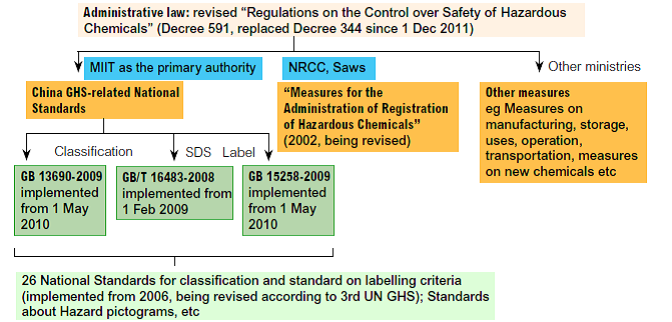
Figure 1. Standards and Measures under Decree 591
The main bodies responsible for the decree’s implementation include the Ministry of Information Technology (MIIT), the State Administration of Work Safety (Saws), the Ministry of Environmental Protection (MEP), the Ministry of Transport, the State Administration for Industry and Commerce, and the General Administration of Quality Supervision, Inspection and Quarantine (AQSIQ).
"C&L Inventory"
Under Decree 591, hazardous chemicals are defined as “highly toxic chemicals” or other chemicals of toxic, corrosive, explosive, flammable and other properties, which will do harm to human body, facilities and environment.
Generally, all chemicals included in the Catalog of Hazardous Chemicals", which is also known as the Chinese "C&L Inventory", are covered by Decree 591.
Originally issued in 2002, the Catalog is being revised and the new version is expected to contain around 7,000 chemicals, significantly more than at present (see figure 2). However, the scope of Decree 591 is not limited to the C&L inventory. According to Saws' NRCC), chemicals classified as hazardous under the country's standards on classification, which will be revised (see below), should also comply with Decree 591.
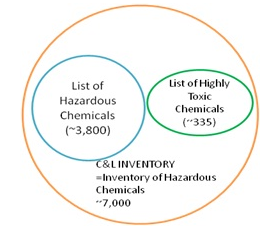
Figure 2. C&L Inventory
Since the Measures on the Environmental Management of New Chemical Substances fall under the scope of Decree 591, new chemicals are also regulated under the decree.
Development of China GHS
There is no single piece of legislation called "China GHS": instead, the UN GHS model is being implemented, under the aegis of Decree 591, through a series of national standards. In 2003 the Standardization Administration of China (Sac) launched a Program" to develop a National Standard System according to the first edition of the UN GHS. However, by the time the regulation implementing the new regime was issued in 2011, the two mandatory Chinese national standards that introduced the rules - GB 13690-2009 on the general rules for the classification and hazard communication of chemicals, and GB 12528-2009 on precautionary labelling - were in accordance with the second edition (CW 25 March 2011).
The implementation of China GHS is supported by Decree 591 and a series of supporting legal documents. For example, the regulation implementing the classification and labeling regime, the “Measures for the Administration of the Registration of Hazardous Chemicals”, state that companies must provide a safety data sheet (SDS) and label according to SDS standard GB/T 16483-2008, labeling standard GB 15258-2009, etc., in order to obtain a registration certificate from the NRCC.
Meanwhile, Chinese Customs are increasingly involved in the supervision of China GHS, with frequent cases of hazardous goods being withheld because of non-compliance.
China’s classification and labeling standards does not include some of the hazards, such as aspiration hazard or hazard to the ozone layer, which are included in the UN GHS. Recently, these difference have been recognized and the government is planning to update the full set of 26 related national standards to bring them in line with the third version of the UN GHS – which is also the basis of the revised hazard communication standard recently published by the US authorities. Whether China will subsequently move the fourth edition of the GHS, which was published last year, or the fifth, which is due in 2013, remains to be seen.
Articles 15 and 79 of Decree 591 state that companies handling hazardous chemicals must comply with China GHS obligations, including those related to classification, labelling and SDSs, according to the specific national standards. China has three types of national standards, each with different legal status; compulsory (GB), recommended (GB/T) and guiding ("GB/Z).
Registration
Under Decree 591, hazardous chemicals and the enterprises involved are identified through the hazardous chemicals registration system. Companies have to submit registrations to the NRCC, according to the provisions set out in the 2012 revised “Measures for the Administration of Registration of Hazardous Chemicals” (SAWS Order No. 53), which is recently released and will enter into force on Aug 1st, 2012. Unlike its predecessor, Decree 344, Decree 591 specifies that hazardous chemicals manufacturers and importer must apply for a registration certificate from the NRCC before the first manufacture import of the substance. Firms storing or using the substance remain exempt.
Potential registrants must provide more information under the new decree, including classification, labelling, physical and chemical properties, main uses, hazardous properties and the safety requirements of storage, use and, transport, plus emergency response measures.
According to the NRCC’s 2011 annual report on hazardous chemicals registration, the body had issued registration certificates to 22,447 hazardous chemical enterprises in 31 provinces or cities, with a first-time registration success rate of 99.3%.
License System
Decree 591 controls the various activities of hazardous chemicals through the supply chain by implementing a license system. Different actors in the supply chain must apply to different departments or ministries for different licenses (see figure 3).
Unfortunately, the exemption threshold for the safe use license is ill-defined; only 62 hazardous chemicals were defined in the "Usage quantities standard for the first batch of hazardous chemiclas".
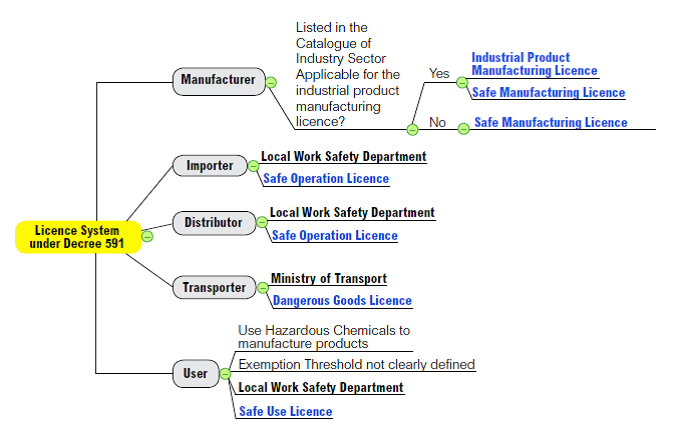
Figure 3. License System under Decree 591
With the release of Decree 591, it is expected that a raft of supporting documents ("Measures will be revised in the near future. Separate measures on the administration of operation licenses and safe use licenses for hazardous chemicals are currently being revised..Note that only domestic companies can apply for licenses application.
Entry/Exit Legal Inspection
Since 29 February 212, importers and exporters of hazardous goods must apply for legal inspection by the Administration of Quality Supervision, Inspection and Quarantine (AQSIQ) or the local China Entry-Exit Inspection of Quarantine Bureau (CIQ) if the hazardous goods are listed in the 2012 Catalog of Entry-Exit Goods. Since 29 February 2012 companies are required to produce a range of documents for such inspections (see figure 4). Chinese companies exporting hazardous goods overseas must have a hazard categories identification and classification report which has been produced by a Chinese accredited laboratory. The CIQ will also check the composition/constituent information, physical and chemical properties, hazard class etc.to confirm that they meet the requirements.
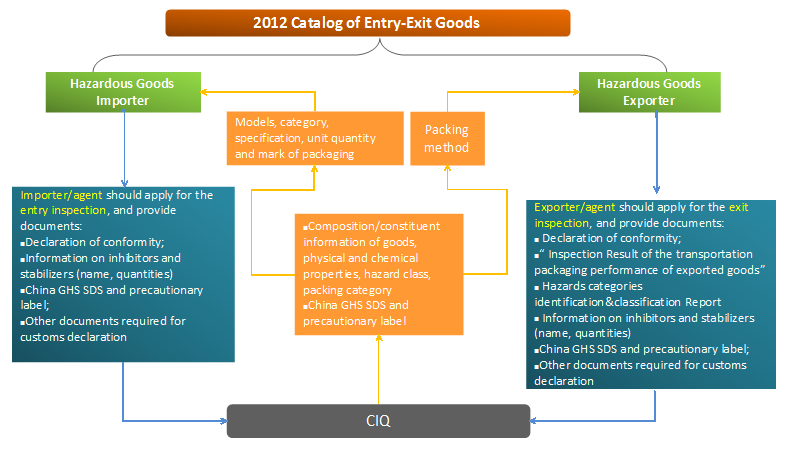
Figure 4. Entry-Exit Legal Inspection
Future Developments
The release of Decree 591 will bring about major changes in the management of hazardous chemicals in China. One should expect a lot more changes to come, with the revision of a series of supporting documents in the near future. Companies should try to keep abreast of future updates, including the:
Revised Chinese C&L Inventory (expected in 2012);
The updated China GHS which has been revised according to the third edition of the UN GHS;
Measures for the Registration of Environmental Administration of Hazardous Chemicals. Consultation on the draft, which proposed that manufacturers and firms that use hazardous chemicals to manufacture products in China, should submit an environmental registration to their local Environmental Protection Bureau, ended on 20 November 2011.