Request a Demo
In the previous article “Exemption Criteria under China Road Transport of Dangerous Goods Regulations- JT/617-2018: Small Quantity”, we learnt the transport exemptions and special provisions of dangerous goods in small quantity. Besides, dangerous goods transported in limited quantity and excepted quantity could also be exempt from a significant portion of overall transport compliance requirements.
Dangerous goods packed in limited quantity and excepted quantity refer to dangerous goods exempted from certain transport requirements as attained by decreasing/ eliminating the transport risks through a reduction in transported quantity/volume, and adherence to special packaging and marking stipulations.
Part One. Dangerous goods packed in limited quantity
1. Maximum Carriage Amount of Dangerous Goods Packed in Limited Quantity
The maximum carriage amount of dangerous goods in inner packaging applicable for limited quantity is indicated in column (7a), appendix A of JT/T617.3. Number “0” means dangerous goods are not eligible for limited quantity transportation exemptions.
Note: highly toxic chemicals, class 1 explosives and item6.2 infectious substances are not eligible for limited quantity transportation exemptions in China.
Example:
UN No. (1) | Chinese Name and description (2a) | English Name and description (2b) | Hazard category (3a) | Packaging category (4) | Limited quantity (7a) |
1824 | 氢氧化钠溶液 | Sodium hydroxide solution | 8 | II | 1L |
Sodium hydroxide solution | III | 5L | |||
1831 | 硫酸,发烟的 | Sulphuric acid, fuming | 8 | I | 0 |
Sodium hydroxide solution (8/PG (Packing Group) II) with inner packaging less than 1L is eligible for transport requirement exemptions if transported in limited quantity. Inner packaging that exceeds a 1L threshold requires compliance with all dangerous goods transport requirements.
Sodium hydroxide solution (8/PG III) with maximum inner packaging 5L is eligible for limited quantity transport exemptions. Inner packaging exceeding 5L requires full compliance.
Fuming sulphuric acid (8/PG I) is not eligible for limited quantity transport exemptions, which means, all transport requirements for dangerous goods should be complied with.
2. General requirements for dangerous goods packed in limited quantity
JT/T 617 | Criteria subject to of dangerous goods transport packed in limited quantity |
JT/T 617.1General Provisions | R Article 5 Exemptions of transport requirements R Article 6 Related requirements in international multimodal transport R Article 7 Personnel training requirements R Article 8 Safety requirements of all participants R Appendix A Terminology and definition related to road transport of dangerous goods |
JT/T 617.2 Classification | R All |
JT/T 617.3 Index of Dangerous goods name and transportation requirements | R Article 4 General requirements of product name R Article 5 Requirements index of road transport of dangerous goods R Article 6 Special provisions(Except provision 61, 178, 181, 220, 274, 625, 633 and 650(e)) R Article 7 Dangerous goods of limited quantity |
JT/T 617.4 Provisions for the use of transport packaging | R Article 4.1 General provisions of packaging, intermediate bulk container and large packaging(Except 4.1.3 and 4.1.10~4.1.18) |
JT/T 617.5 Consignment | R Article 5.1 Requirements of over pack(Except 5.1.1b), 5.1.1c) and 5.1.4) R Article 6.1.5 Orientation sign |
JT/T 617.6 Provisions concerning the conditions of carriage, loading, unloading and handling | R Article 4 General requirements R Article 5 Handling requirements of package transport(Except 5.3) R Article 8.1 General provisions(Except 8.1.4) R Article 8.5 Handling and stack R Article 8.6 Cleaning after unload R Article 8.7 No smoking |
JT/T 617.7 Transport conditions and operational requirements | R Appendix B Class specification and access restriction code of tunnel |
3. Packaging requirement for dangerous goods packed in limited quantity
Use combination packaging: In addition to the use of appropriate inner packaging, dangerous goods should also use appropriate outer packaging when transported in limited quantity. Use of an intermediate package between the inner and outer package is optional. Inner packaging is not required in transporting aerosol and other small gas containers. The total mass of the package (packaging included) shall not exceed 30kg.
Shrink-wrapped or stretch-wrapped trays meeting the prescribed conditions are acceptable as outer packaging except for 1.4S explosive. Fragile or breakable inner package made from glass, porcelain, stoneware or certain plastics, etc., should be used in conjunction with appropriate intermediate packaging. The total mass of the package (package included) shall not exceed 30kg.
Inner package of glass or ceramic for category 8 (PG II) liquid corrosives shall be put in compatibly hard intermediate package.
4. Mark requirement for dangerous goods transport packed in limited quantity
Mark of limited quantity
Packages containing limited quantity dangerous goods shall be marked as below (Picture 1 and 2): Mark should be clearly visible and durable. Shape is diamond, with minimum size of 100mm*100mm (scale down according to pack size but no less than 50mm*50mm). Minimum width of diamond edge line is 2mm (scale down according to pack size but no less than 1mm). Air freight marking requirements are stipulated in technical rules for safe transportation of dangerous goods by air. Mark in pic 1 is not necessary when mark in pic 2 is attached.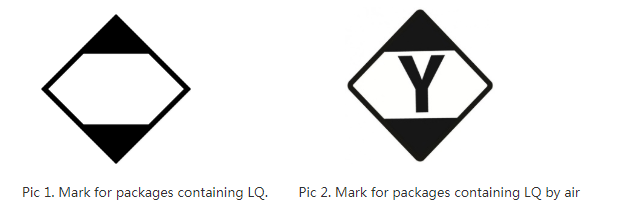
Mark of orientation and over-package
The orientation mark shall be pasted on the combination packaging with liquid dangerous goods in inner packaging, or unit packaging equipped with vent. The orientation mark shall be pasted on two vertical para-surfaces of the pack, with arrow pointing up.
Compliance with over-pack related requirements is mandatory when packaging of dangerous goods in limited quantity are wrapped in overpack: The over-pack shall be marked as “集合包装”. English version “OVERPACK” is optional. The height of the text shall be no less than 12mm.
In case the orientation mark in the inside pack cannot be clearly identified from the outside of the overpack, the orientation mark shall be pasted on two vertical para-surfaces of the overpack.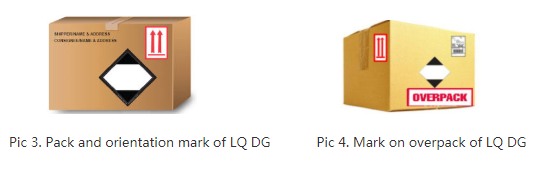
5. Load capacity requirements for vehicles transporting limited quantity of dangerous goods.
Markings of packages containing LQ are not required on the transport unit, if the total gross mass of consignment does not exceed 8 tons per transport unit. Transport units with a maximum mass exceeding 8 tons carrying dangerous goods packed in limited quantities shall be marked with the mark for packaging containing LQ (minimum size 250mm*250) at the front and at the rear except when the transport unit contains other dangerous goods for which orange-colored plate in accordance with article 7.2 in JT/T617.5-2018 is required. In this latter case, the transport unit may display the required orange-colored plate only, or both the orange-colored plate and the mark for packaging containing LQ.
Containers carrying dangerous goods packed in limited quantities, on transport units with a maximum mass exceeding 8 tons, shall be marked with the mark for packaging containing LQ on four sides (minimum size 250mm* 250mm) except when the container contains other dangerous goods for which placard in accordance with article 7.1 in JT/T617.5-2018 is required. In this latter case, the container may display the required placards only, or both the placards and the marks. The carrying transport unit needs not to be marked, except when the marks affixed to the containers are not visible from the outside of the transport unit. In this latter case, the same marks shall be affixed at the front and at the rear of the transport unit.
6. In advance of carriage, consignors of dangerous goods packed in limited quantities shall inform the carrier of the total gross mass of such goods to be consigned through transport documentation.
Part two. Dangerous goods packed in excepted quantities
1. Maximum Carriage Amount of Dangerous Goods Packed in Excepted quantities
Dangerous goods which may be carried as excepted quantities are shown in accordance with column (7b), appendix A.1 in JT/T 617.3 by means of an alphanumeric code as follows:
Code | Maximum net quantity per inner packaging | Maximum net quantity per outer packaging |
E0 | Not permitted as excepted quantity | |
E1 | 30 | 1000 |
E2 | 30 | 500 |
E3 | 30 | 300 |
E4 | 1 | 500 |
E5 | 1 | 300 |
For gases, the volume indicated for inner packaging refers to the water capacity of the inner receptacle and the volume indicated for outer packaging refers to the combined water capacity of all inner packagings within a single outer packaging. Unit is in grams for solids and ml for liquids and gases, or sum of grams and ml in the case of mixed packing. | ||
Note 1: Where dangerous goods in excepted quantities for which different codes are assigned are packaged together, the total quantity per outer packaging shall be limited to that corresponding to the most restrictive code.
Note 2: Highly toxic chemicals, class 1 explosives and class 6.2 infectious substances are not subject to transport in excepted quantities in China.
Example:
UN No. (1) | Chinese Name and Description (2a) | English Name and Description (2b) | Hazard category (3a) | Packing category (4) | Excepted quantity (7b) |
1824 | 氢氧化钠溶液 | Sodium hydroxide solution | 8 | II | E2 |
Sodium hydroxide solution | III | E1 | |||
1831 | 硫酸,发烟的 | Sulphuric acid, fuming | 8 | I | E0 |
Sodium hydroxide solution (8/PG (Packing Group) II) with inner packaging less than 30ml and outer packaging less than 500ml is eligible for transport requirement exemptions if transported in excepted quantity. Either one exceeds the designated amount threshold requires compliance with all dangerous goods transport requirements.
Sodium hydroxide solution (8/PG III) with inner packaging less than 30ml and outer packaging less than 1000ml is eligible for transport requirement exemptions if transported in excepted quantity. Either one exceeds the designated amount threshold requires compliance with all dangerous goods transport requirements.
Fuming sulphuric acid (8/PG I) is not eligible for excepted quantity transport exemptions, which means, all transport requirements for dangerous goods should be complied with.
2. General requirements for transport of dangerous goods packed in excepted quantity
JT/T 617 | Criteria subject to of dangerous goods transport packed in excepted quantity |
JT/T 617.1 General Provisions | R Article 7 Personnel training requirements |
JT/T 617.2 Classification | R All |
JT/T 617.3 Index of Dangerous goods name and transportation requirements | R Article 8 Dangerous goods packed in excepted quantity |
JT/T 617.4 Provisions for the use of transport packagings | R Provisions of 4.1.1, 4.1.2, 4.1.4 and 4.1.7 in Article 4.1 General provisions of packaging, intermediate bulk container and large packaging |
JT/T 617.5 Consignment | - |
JT/T 617.6 Provisions concerning the conditions of carriage, loading, unloading and handling | - |
JT/T 617.7 Transport conditions and operational requirements | - |
3. Packaging requirement for dangerous goods packed in excepted quantity
Requires inner, intermediate and outer packaging:
The inner packaging shall be constructed of plastic (with a minimum thickness of 0.2mm when used for liquids), or of glass, porcelain, stoneware, earthenware or metal. The closure of each inner packaging needs a second sealing, and shall be held securely in place with wire, tape or other positive means; any receptacle having a neck with molded screw threads shall have a leak proof threaded type cap. The closure shall be resistant to the contents.
Each inner packaging shall be securely packed in an intermediate packaging with cushioning material in such a way that, under normal conditions of carriage, they cannot break, be punctured or leak their contents. Regardless of its orientation, the intermediate package shall completely contain the contents in case of breakage or leakage. For liquid dangerous goods, the intermediate packaging shall contain sufficient absorbent materials to absorb the entire contents of the inner packaging. When placed in the intermediate packaging, the absorbent material may be the cushioning material.
The intermediate packaging shall be securely packed in a strong, rigid outer packaging.
Each package shall be of such a size that there is adequate space to apply all necessary marks
Overpacks may be used and may also contain packages of dangerous goods or goods not subject to the requirements of JT/T617
Every type of packages should meet two test requirements for packs: 1.8m drop test, 24h/3m stacking test.
4. Mark requirements for dangerous goods transported packed in excepted quantity
Mark of excepted quantity
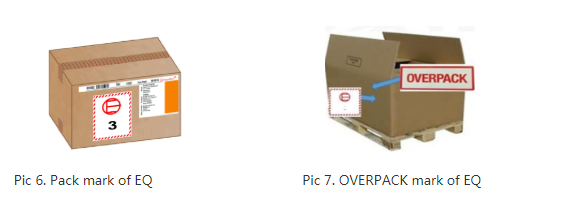
Packages containing excepted quantities of dangerous goods shall be durably and legibly marked with the mark shown in Pic 5. Different hazard categories of all dangerous goods packed in excepted quantity in one pack should be all listed in the mark. The mark shall be in a form of a square, with minimum dimension 100mm* 100mm. Where dimensions are not specified, all features shall be in approximate proportion to those shown.

Pic 5. Excepted quantities mark
The hatching and symbol shall be of the same color, black or red, on white or suitable contrasting background.
*: The first or only label number indicated in column (5) of Appendix A of JT/T 617.3 shall be shown in this location
**: The name of the consignor or of the consignee shall be shown in this location if not shown elsewhere on the package.
Overpack
For an overpack containing dangerous goods packed in excepted quantities, the mark of excepted quantities shall be shown on the overpack surface if the mark on the pack cannot be clearly seen from the overpack.
Though the regulation doesn’t require the “OVERPACK” mark on the dangerous goods packed in excepted quantities, it is still recommended to mark the “OVERPACK” in accordance with related requirements.
5. Maximum number of packages in vehicle
The number of packages in any vehicle or container shall not exceed 1,000.
6. Documentation
When the consignment inventory passes from consignor to carrier, it shall include the statement “Dangerous Goods in Excepted Quantities” and indicate the number of packages.
If other documents (such as a bill of lading or air waybill) states dangerous goods packed in excepted quantities, it shall include the statement “Dangerous Goods in Excepted Quantities” and indicate the number of packages.
Part Three. Comparison of LQ/EQ in European ADR and China JT/T 617
Although requirements for LQ/EQ in China’s JT/T 617 mainly refer to European ADR, differences still exist. Below table shows the discrepancies between 2 regulations from 7 aspects:
| European ADR(2015 version) | China JT/T 617.3-2018 | |
Out of scope | LQ |
|
|
EQ |
|
| |
MaximumCarriage Amount | LQ |
|
|
EQ |
|
| |
Packaging Requirement | LQ |
| |
EQ |
| ||
Mark Requirement | LQ |
| |
EQ |
| ||
Vehicle Requirement | LQ |
|
|
EQ |
| ||
Transport Document | LQ |
|
|
EQ |
| ||
Exemption | LQ |
| |
EQ |
|
| |
Stakeholders could make a comparison on the carriage amount and its requirements in case their dangerous goods meet the transport eligibility criteria of both limited quantity and excepted quantity.