Request a Demo
On Nov 9th, Taiwan’s Ministry of Labor (MoL) published the amendments of the Regulation of Labeling and Hazard Communication of Hazardous Chemicals (危害性化學品標示及通識規則, hereafter referred to as the “Regulation”) after consultation ended on Apr 27th, 2018. The updated provisions became effective immediately. However, the updated requirements of Attachment 4 (Content and Template for Safety Data Sheet) will take effect from Jan 1st, 2020.
The Regulation is the most important document for GHS implementation in Taiwan. Compared to the draft version, only minor changes were made in the promulgated revision.
The amendments are detailed as below, including Article 4, Article 5, Article 13, Article 18, Article 18-1, Article 23, Attachment 1 and Attachment 4. English translation of the Regulation is now available on ChemLinked E-translation Store.
Article 4:
“Industrial waste” is listed as beyond the scope of the regulation, rather than the previous “hazardous industrial waste”.
Article 5:
Employers shall conspicuously label containers containing hazardous chemicals in accordance with the classification and labelling items prescribed in Attachment 1. “Labelling items” include hazard pictograms, signal words and hazard statements, which is more appropriate than the previous “hazard pictograms”.
GHS has been fully implemented in Taiwan and all hazardous can be classified according to CNS 15030. Thus the original provision “containers containing hazardous chemicals that cannot be classified in accordance with Attachment 1 may label only the information specified in Paragraph 1 subparagraph 2” is deleted.
Article 13:
Manufacturers, importers, or suppliers shall provide SDSs prior to providing business entities or self-employed workers with hazardous chemicals. A provision is added which states that the requirements for content, format, and the language of SDS are the same as Article 12, namely SDS shall be prepared in accordance with Attachment 4. The text shall be primarily in Chinese characters, and if necessary, foreign language can be added to aid worker understanding.
Article 18:
To protect national security and confidential business information, data protection of the name, content, manufacturers, importers or suppliers of the hazard chemicals can be applied for prior to SDS compilation. After revision, CAS No. is added as one item applicable for CBI application.
It is newly added that for CBI application, if the submission is found unqualified or incomplete, the applicant would be ordered to correct and supplement materials. The re-submission is limited to 2 times within a 30 day period upon receiving the request for correction or supplementation. In addition, the central competent authority may revoke or annul the approval of CBI protection in SDS if false material is submitted or incompliance found against the approval details.
Article 18-1:
The ineligibility conditions for data protection in SDS are set as a new Article 18-1, including (1) chemicals listed in the Standards of Permissible Exposure Limits in the Workplace, (2) hazardous chemicals with the certain hazard classification according to the CNS 15030 (currently indicated in Article 18) and (3) chemicals designated and announced by the authority. Guidance and tools provided by the authority shall be referred to for CBI application in terms of eligible scope, labelling and SDS compilation after approval.
Article 23:
The updated provisions are effective immediately. However, the updated Attachment 4 (Content and Template for Safety Data Sheet) shall take effect from Jan 1st, 2020.
Attachment 1:
For hazard class including skin corrosion/irritation, germ cells mutagenicity, carcinogenicity and toxic to reproduction, hazard Category 1 shall be used if there is no sufficient data for further classification into sub-category such as Category 1A and Category 1B.
Attachment 4:
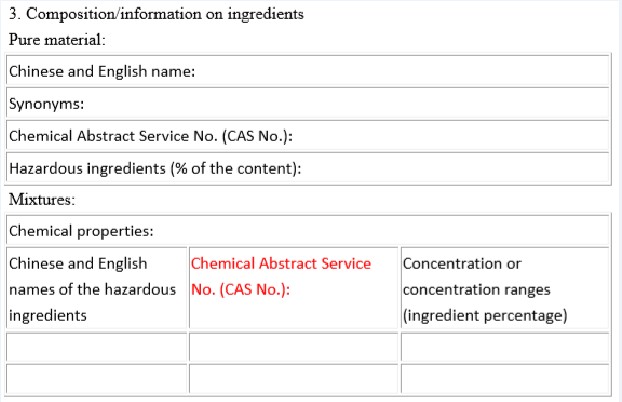
In section 3 of SDS (composition/information on ingredients) for mixtures, the CAS No. should also be indicated as below.