Request a Demo
Taiwan’s Environmental Protection Administration (EPA) issued the Guidance on Scientific Research and Development (SR&D) and Product and Process Orientated Research and Development (PPORD) on 27 August 2015. This document relates to the Taiwan REACH regulation “Regulation of New and Existing Chemical Substances Registration” (hereafter referred to as the “Regulation”), which aims to clarify the concepts of SR&D and PPORD and explain the tasks and obligations that manufacturers and importers of new substances for SR&D and PPORD have under the “Regulation”.
1. Definition:
The definitions of SR&D and PPORD have been stipulated in the “Regulation of New and Existing Chemical Substances Registration”. However, there has been confusion over the applicable scope and application process involved in the registration of new chemical substance under SR&D and PPORD.
1.1 SR&D
Scientific Research and Development refers to any scientific experimentation, education, analysis, or chemical research carried out under strictly controlled conditions.
The qualifying criteria for SR&D registration was previously extremely narrow. In the past the rules for qualification for SR&D activities stipulated that scientific research activities could only take place in academic institutes or universities/colleges. It means in-house labs in companies; testing institutes undertaking testing business, etc. could not apply for registration under SR&D. This requirement came under severe criticism by industry especially by those enterprise handling small quantities, below 1 tonne per year, which could be applicable for registration exemption if falling under the scope of SR&D. EPA finally acceded to sustained pressure by industry and has extended the SR&D scope.
SR&D can now include experimental research or analytical activities at an academic and laboratory scale such as synthesis and testing of applications of chemicals, etc. and can be conducted by in-house and external labs that manufacture or import new chemical substances that fall within the scope of SR&D registration or exemption.
1.2 PPORD
Product and Process Orientated Research and Development (PPORD) refers to scientific development processes involved in product development or the further chemical research and development of new substances, on its own, in mixtures or in articles in the course of which pilot plants are constructed or production trials are used to develop the production process or to test the fields of application of the substance.
Examples of PPORD may include campaigns for the development, scaling-up or improvement of a production process, or the investigation of substance application scope in pilot plant or production trials.
2. Registration
2.1 Registration Type
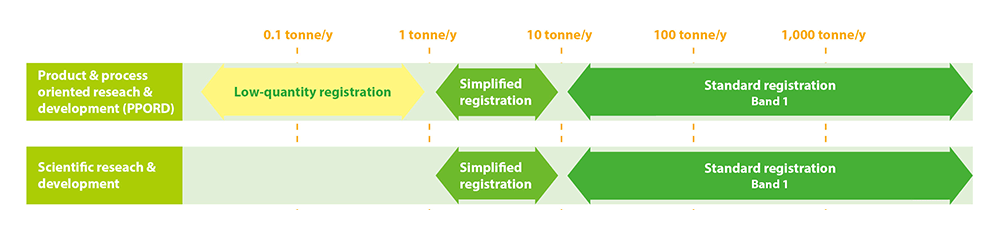
“Standard registration band 1” will be required for new substances manufactured or imported for scientific research and development or for product or process-oriented research and development in quantities of over 10 tonnes per year. Companies which import or manufacture more than 1 tonne but less than 10 tonnes for these two purposes can apply for “simplified registration”. Taiwan EPA further promotes innovation by also allowing new chemical substances used in SR&D to be exempt from registration if manufactured or imported below 1t/y. However, for PPORD those in volumes of less than 1 tonne will still be subject to a “small quantity registration” procedure.
2.2. SR&D Exemption
To benefit from the SR&D exemption, a company needs to (1) identify whether or not the definition of SR&D applies to the activities it is undertaking (2) whether or not a substance is manufactured/imported below 1 tonne per year, (3) whether or not direct exemption from registration is applicable.
If direct exemption is not applicable, the company needs to present relevant documents to the EPA to demonstrate exemption is applicable. The chart below gives guidance on what obligations apply to those applicable for exemptions and how to fulfill application procedures.
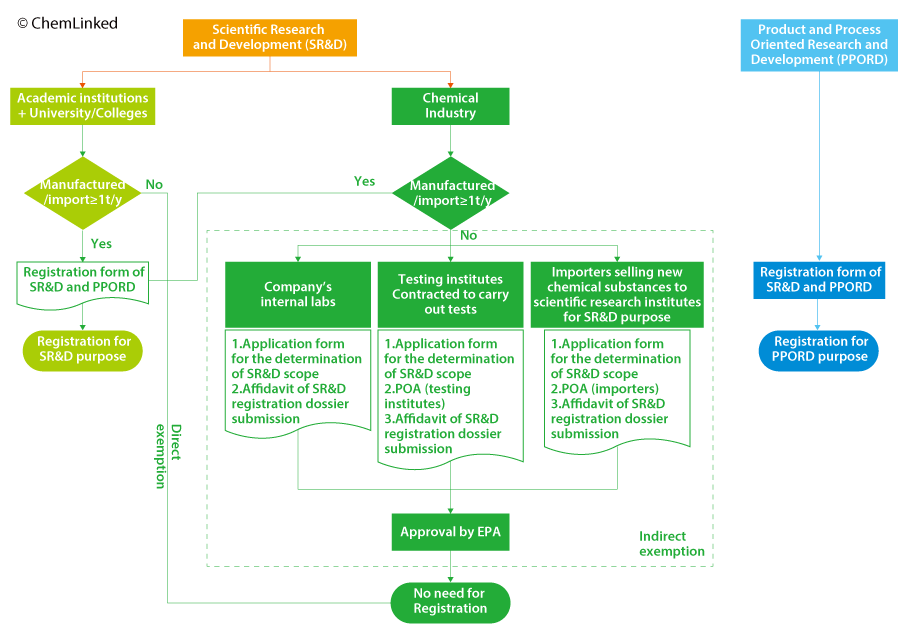
For the above mentioned three types of indirect exemption conditions, the exemption period is only 1 year. Re-application for exemption should be made before the end of exemption expiration.
2.3 Registration Data Requirements
Below is the data requirements correspond to the registration types for SR&D and PPORD.
| Data requirements | Low-quantity registration | Simplified registration | Band 1 standard registration | |
| Basic registrant & substance identification information | √ | √ | √ | |
| Substance manufacture & use information | √ | √ | √ | |
| Hazard classification & labeling element | √ | √ | ||
| Safe use information | √ | √ | ||
| Physicochemical properties | Physical state | √ | √ | |
| Melting/freezing point | √ | √ | ||
| Boiling point | √ | √ | ||
| Density | √ | √ | ||
| Partition coefficient: n-octanol/water | √ | √ | ||
| Water solubility | √ | √ | ||
| Vapor pressure | √ | |||
| Flash point | √ | |||
| Flammability | √ | |||
| Explosiveness | √ | |||
| Oxidation properties | √ | |||
| pH value | √ | |||
| Auto-ignition temperature | √ | |||
| Toxicological properties | Acute toxicity | √ | ||
| Skin corrosion/irritation | √ | |||
| Eye irritation | √ | |||
| Skin sensitization | √ | |||
| Gene toxicity | √ | |||
| Ecotoxicological properties | Short-term toxicity to invertebrate (daphnia) | √ | ||
| Toxicity to aquatic algae and cyanobacteria | √ | |||
| Biodegradation in water: screening tests | √ | |||
Low-quantity registration and simplified registration are valid for 2 years. Extension should be applied for within 3 months prior to the end of the 2-year period. For Band 1 standard registration, the registration certificate is valid for 5 years, after which the new chemical substance will be included into Taiwan’s Existing Chemical Substance Inventory (TCSI) as an existing chemical substances.
3. Registration Tool
The software for registration of new and existing chemical substances, known as CHEMIST, was launched by the EPA. A S&RD and PPORD registration dossier must be created using the off-line CHEMIST and submitted to EPA via the submission function in the official chemical registration website.
4. Registration Dossier Review
Upon receipt of a SR&D or PPORD registration dossier, a receipt number will be issued as well as an invoice for pending payment. When the payment is made, the EPA will start the review of the registration dossier. 7 working days are required for low-quantity registration, 14 working days for simplified registration and 45 working days for standard registration. Listed below are the corresponding fees required for dossier review work.
Registration type | SR&D | PPORD | SME Benefits |
Low-quantity registration | N/A | NT$2,000 | 25% off |
Simplified registration | NT$20,000 | NT$20,000 | |
Standards registration (Band 1) | NT$50,000 | NT$50,000 |