Request a Demo
Coauthored by Shawn Xiang from REACH24H's Industrial Chemical Division
In order to ensure the scientific accuracy and fairness of new chemical substance evaluation, China MEP formulated the Expert Management Measures for the Environmental Management of New Chemical Substances (hereinafter “Expert Management Measures”). It stipulates the requirements for expert databases, the selection of experts, the responsibility of experts in the evaluation of new chemical substances, etc.
The Evaluation Committee consists of professional experts from the fields of chemistry, engineering, health, safety and environment, etc. Experts are recommended by institutions, and the MEP will judge the competency and suitability of each expert before including them into the expert database.
Currently experts include heads of testing and academic institutes, professors from well-known universities, senior engineers from enterprises with years of professional experience, experienced management personnel from local environmental protection departments, etc.
The evaluation work generally focuses on substance identification, physico-chemical assessment, human health and environmental hazard properties, exposure, risks to human health and environment and the appropriateness of risk control measures, etc. After evaluation, the evaluation finding relating to risk and risk control measures will be submitted. The evaluation committee will put forward suggestions to approve (or disapprove) the notification, as well as environmental management categorization suggestions specifically speaking the division of notified new substances into categories such as "general chemical substance", "hazardous chemical substance" and "hazardous chemical substance of priority environmental concern" respectively.
Some interesting facts:
The experts are employed on a three-year term, and are eligible for re-election.
So far the evaluation committee has been convened for a total of four sessions. The first session was in 2004 and consisted of 40 experts. 56 experts were employed for the second session in 2007. Since the third session, the total number of experts has been fixed at 100. The third and fourth session was held in 2010 and 2013 respectively.
The experts allocated for the review of each dossier is not fixed. It is also based on the actual engagement of the experts in their spare time. Basically more than twenty experts will be involved.
The experts will be divided into five sub-committees to review the different parts of the notification dossiers.
The expert evaluation time limit for the Regular Notification can take up to 60 days and for the General Case of Simplified Notification can take up to 30 days.
1. Responsibilities of Each Sub-Committees:
Experts are divided into sub-committees to review and comment on notification dossiers. There were originally six sub-committees for dossier review, while in 2014 they were regrouped into five sub-committees as below.
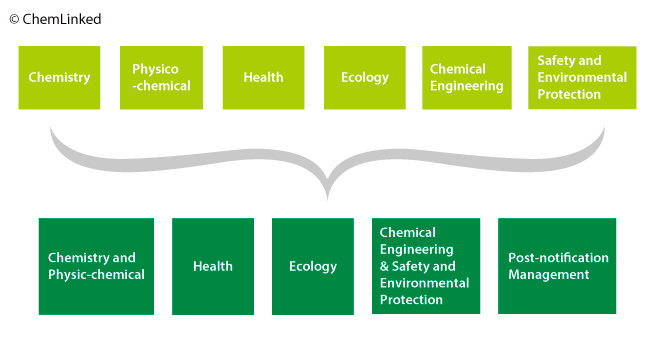
Sub-committee 1: Chemistry and physic-chemical
The chemistry team will focus on:
Chemical name in Chinese and English
Substance type: with/without unique and defined molecular structure, or polymer
Generic name in Chinese and English
Molecular formula
CAS No.
Structural formula
Spectrographic data
Detection method in environmental media
The Physical-chemical team will focus on:
Intrinsic properties of the notified substances → Physical-chemical properties
Hazard Classification Sheet → Physical hazards
Risk assessment report → physical-chemical hazard evaluation
Environmental management category
Sub-committee 2: Health
Credibility of toxicology data, the reliability of the testing report and consistency with the content in notification application form
Whether it belongs to a serial notification
Appropriateness of hazard classification
Scientific basis of risk assessment report and appropriateness of health risk control measures
Consistency of administrative requirements with environmental management category
Sub-committee 3: Ecology
Credibility of eco-toxicology data, the reliability of the testing report
Consistency with the content in the notification application form; appropriateness of hazard classification
For serial notification, to judge whether the substances are of consistent test results and subject to serial notification
If the notified substance poses environmental hazards based on the notified tonnage band and usage, the scientific basis of the risk assessment report should be further reviewed, as well as the appropriateness of environmental risk control measures. Suggestions for categorization of environmental management categories and post-notification management measures will be put forward.
Sub-committee 4: Chemical engineering & safety and environmental protection
Accuracy of the information supplied in the notification application form, including release and exposure information, usage information, operation & storage & transportation issues needing attention, personnel protection information, accident emergency measures, wastes disposal measures, leakage collection & disposal measures, environmental restoration measures after accidents, pollutant prevention measures, environmentally friendly statement, labeling, SDS, etc.
Advancement of production & use process, appropriateness of process flow diagram, Material Balance (MB), concentration of the notified substance in “three wastes”, their quantities and emissions, etc.
Substances exposure classification and the exposure assessment in the risk assessment report, risk characterization, disposal measures for “three wastes”, safety and environmental protection measures, etc.
If the substance is categorized as “hazardous of priority environmental concern”, the potential for substitution in the environmental friendly statement should be reviewed, with administrative management requirements put forward.
Sub-committee 5: Post-notification management
Supervision on information communication in supply chain
Registration certificate modification
Submission of new hazard properties to Evaluation Committee for review
On-site inspection
Inclusion of notified new chemical substances into the IECSC
Cancellation and revocation of registration certificate
2. Review Process of Evaluation Committee
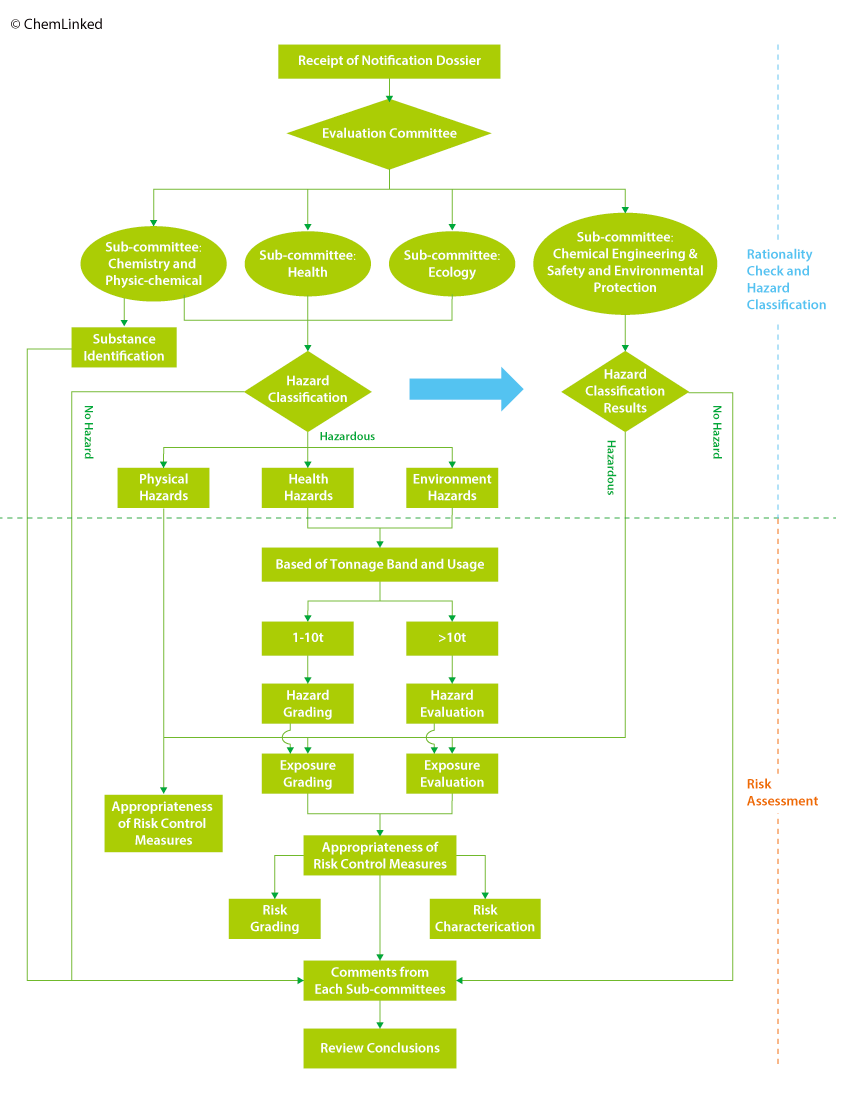
Upon the receipt of a notification dossier, each sub-committee will evaluate their corresponding part, give comments and finally issue conclusions. As previously specified the focus of the chemistry and physico-chemical, health and ecology committee are all standardized. However for the chemical engineering & safety and environmental protection sub-committee the evaluation criteria are more complicated and associated with usage details. More individualized treatment is necessary and the committee often requires data supplementation and correction from notifiers. The details are specified as below.
The review requirements of the sub-committee of chemical engineering & safety and environmental protection differ for notified new substances based on the inherent hazard the substance poses. According to the GB 30000 series standards (Rules for Classification and Labelling of Chemicals), if the notified substance is not hazardous, it does not require complete exposure evaluation. Instead it is sufficient to provide exposure descriptions based on the notified tonnage band. However, if the notified substance is classified as hazardous, irrespective of its corresponding physical hazards, health hazards or environment hazards, a complete exposure evaluation and risk characterization process is essential. The exposure evaluation methods vary according to different tonnage bands. For substances notified in amounts of 1-10 tonnes per year, the exposure evaluation process consists of simple exposure description and qualitative exposure grading, followed by risk grading. For substances notified above 10 tonnes per year, the exposure evaluation process consists of detailed exposure description and quantitative exposure concentration calculation (namely Predicted Environmental Concentration, PEC), followed by risk characterization. The sub-committee will review the adequacy of exposure information, rationality of exposure grading and the exposure concentration calculation in addition to assessing the accuracy of risk grading and risk characterization. The sub-committee of chemical engineering & safety and environmental protection will also review the appropriateness of risk control measures, the wastes generated during the manufacture/usage process, the specific disposal for wastes, the substances released into the environment and their concentration.
3. Communication with Experts
So far there is no good platform or method for notifiers to directly communicate with the evaluation experts. Notifiers are compelled to supplement or revise their dossiers in accordance with expert’s opinions which in many cases lack enough detail. Through SCC-MEP, the ideas from notifiers can be passed to the experts in written form. However the use of an intermediary, compounded by the obvious expression obstacles in written form often means that the minutiae of certain nuanced situations are often lost in delivery, requiring multiple rounds of time consuming communication. At present, there is no time limit for expert review of the supplemental data, in certain extreme cases data supplementation has taken a half a year. The list of evaluation committee members is also confidential leading to almost zero accountability in such instances.
To ensure the notification and review run smoothly, effective interactions with the review experts need to be established. The proposal for setting up direct communication channels between notifiers and experts from the Evaluation Committee through email or teleconference, or even face-to face has been deliberated on. The feasibility of this proposal is still being assessed and hopefully we will see some progress in this area very soon.
4. Improvements
The establishment of the Evaluation Committee plays an understated role in China’s new chemical substance notification system. However, with the implementation of China NCSN, the shortcomings of the evaluation system have come to light.
The latest committee members were called upon in 2013 and finalized in early 2014. The fourth Evaluation Committee consists of an additional 26 new experts the majority of whom come from local environmental protection departments. These experts will provide crucial support in evaluating compliance with post-notification requirements related to hazard assessment and will balance the previous emphasis on notification with a new focus on post-notification.
In addition, the method of expert reviewing is changed from “external expert review” to “external + internal expert review”. Previously, the notification dossiers were all assigned to the external experts from the Evaluation Committee. However, the SCC-MEP is now cultivating their own experts, namely the internal experts, which will improve communication between notifiers and experts. So far, the new reviewing method has been piloted on the General Case of Simplified Notification under China NCSN.