Request a Demo
Australia’s National Transport Commission (NTC) is consulting on the changes in classification information for dangerous goods under the Australian Code for the Transport of Dangerous Goods by Road & Rail (ADG Code). Comments are welcome before March 17, 2023.
Background
The ADG Code is updated every two years, with a one-year transitional period for each new edition. Edition 7.8 of the ADG Code published in December 2022 is the current edition with updates to align with the 22nd revised edition of the United Nations Recommendations on the Transport of Dangerous Goods Model Regulations (UN Model Regulations). As scheduled, Edition 7.8 will be mandatory from April 1, 2024. However, the industry and regulators noted that many Australian-specific chapters in the ADG Code were carried over from Edition 6 without critical review. They are now outdated. Most of all, in practice, dangerous goods classification under the ADG Code is incomplete and lacks clarity.
Given that the correct classification of dangerous goods forms the starting point for all requirements relating to safe transport, the NTC published on January 23 of 2023 the draft version of Part 2 Classification in the ADG Code (hereinafter referred to as the Draft DG Classification) for public consultation. A corresponding discussion paper, which examines the structure and benefits of the Draft DG Classification, was also issued to help conduct a comprehensive review. It should be noted that the Draft DG Classification does not provide different information to the current ADG Code, it simply provides additional information. Modifications to the procedures and criteria for classification are out of the scope of the review as they are set at the UN level.
Highlights
Subdivisions of classification codes
While the current content of dangerous goods classification in the ADG Code aligns with the international regulations*, it does not provide additional classification information about the assignment of classification codes** or the application of special provisions relating to classification. This may increase the risk of goods otherwise considered too dangerous to transport entering the transport network.
*International regulations include the UN Model Regulations, the International Maritime Dangerous Goods Code (IMDG Code), the Agreement for the International Transport of Dangerous Goods by Road (ADR), the Agreement for the International Transport of Dangerous Goods by Rail (RID), etc. ** The classification codes communicate hazard information, including additional information not readily ascertained from the Class or Division, Subsidiary Hazards and Packing Group. A classification code consists of the division number and the compatibility group letter, e.g., 1.1A, 1.1B, 1.1C, C1, C2, CS1, CF2, etc. |
The Draft DG Classification proposes to incorporate new information about classification code assignment. The proposed subdivisions of classification codes and additional information will make it easy to identify key attributes of dangerous goods. With the classification codes, stakeholders can readily grasp physical descriptions and compatibility information of specific dangerous goods, e.g., whether a substance is liquid or solid, acid or alkali, or the physical state of a gas (liquified, refrigerated, compressed, dissolved, etc.).
Further classification for specific goods
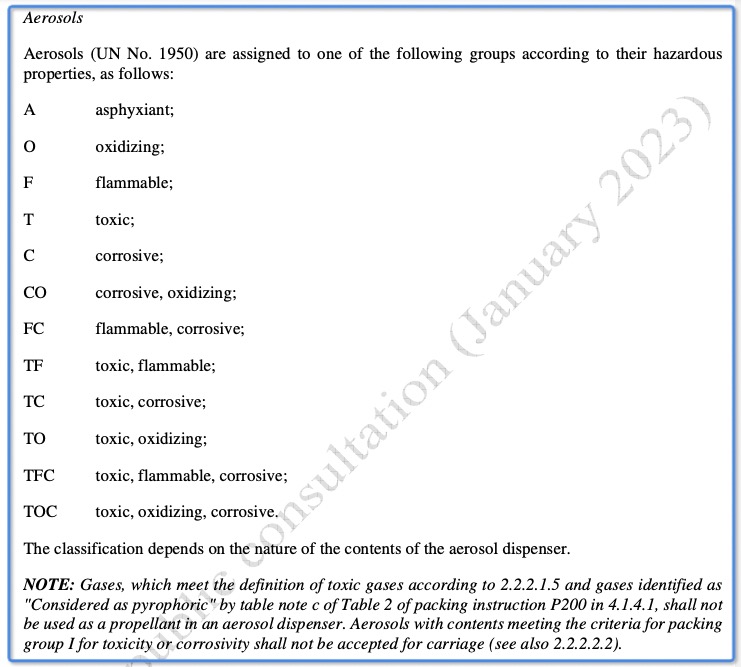
It’s proposed in the Draft DG Classification that additional classification should be undertaken for specific goods, such as UN 1950 and UN 2037. All possible outcomes should be listed as separate entries in the dangerous goods list.
Take ‘aerosols (UN 1950)’ for example, based on its contents, all 12 possible classification outcomes (see the screenshot of 2.2.2.1.6 below) are proposed to be listed.
Additional warning labels for specific goods
For UN 0015, UN 0016 and UN 0303, additional warning labels will be required depending on additional hazards the dangerous goods present, i.e.,
Articles containing smoke-producing substance(s) corrosive according to the criteria for Class 8 must be labeled with a “CORROSIVE” subsidiary hazard label.
Articles containing smoke-producing substance(s) toxic by inhalation according to the criteria for Division 6.1 shall be labeled with a “TOXIC" subsidiary hazard label, except that those manufactured before December 31 of 2016 may be transported until January 1 of 2019 without a “TOXIC” subsidiary hazard label.
The NTC highlighted that additional hazard information would be valuable in determining how dangerous goods should be placed and loaded on to vehicles and rolling stock and ensuring transport safety.
Inclusion of ‘Class 1 Explosives’
The NTC considered including explosives as regulated dangerous goods - “Class 1 Explosives” under the ADG Code, and repealing the Australian Explosives Code as it's outdated and has no responsible authority.
Next steps
The period for comments on the Draft DG Classification is due by March 17, 2023. Feedback received will help the authority inform how classification codes and information may be redrafted in the ADG Code. Opportunities to submit comments on draft amendments to other parts of the ADG Code will be provided over the following 12 months. The following topics may be covered.
Tanks and vehicles-related provisions
Rail-related provisions
Dangerous goods list and special provisions
Training related provisions
Safety and emergency (fire) equipment
Thresholds (small loads and placard loads)
Exemptions and scope
A complete draft ADG Code will be released for public comment in early 2024.