Request a Demo
Recently, Canada released the Consultation Document on Phase I of the Risk Management of Per- and Polyfluoroalkyl Substances (PFAS), Excluding Fluoropolymers, aiming to prohibit the manufacture, import, use and sale of currently unregulated PFAS in firefighting foams.
Additionally, it invites comments regarding concentration thresholds for the incidental presence of PFAS in Class B firefighting foams being sold and those contaminated by PFAS that originate from and are present in firefighting systems that have undergone decontamination.
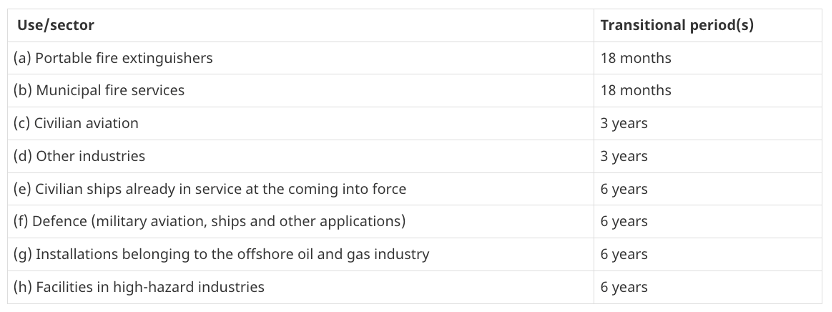
Transitional Periods
The Government of Canada is proposing specific transitional periods for certain uses following the regulation's enactment, tailored by type of use or sector.
 Disclosure and Labeling
The Government is considering requiring manufacturers and sellers of AFFF to disclose in writing the types and concentrations of intentionally added PFAS in each product within 6 months after the coming into force of the regulations.
Aqueous film-forming foams (AFFF) in firefighting systems and in stocks, as well as any PFAS-containing wastewater and firewater would be required to bear a label that warns of the presence of PFAS with a concentration equal to or greater than 1 mg/L for the sum of all PFAS, and indicate the category of AFFF27 (if applicable). In addition, fluorine-free firefighting foams originating from decontaminated firefighting systems must be labeled to indicate PFAS cross-contamination with a concentration equal to or lower than 50 mg/L for the sum of all PFAS. Compliance with the labeling requirement is expected no later than 18 months after the regulations take effect.
Moreover, the government plans to impose specific conditions to ensure proper handling of PFAS in AFFF throughout its lifecycle, and may issue time-limited permits to allow continued use of C6 AFFF under certain circumstances.
Next Steps
This consultation document seeks comments to inform the development of a risk management instrument. Comments on this consultation document must be submitted by November 25, 2025.
The instrument is expected to be published in the Canada Gazette, Part I in spring 2027, with a minimum 60-day public consultation period. The final instrument is anticipated to be published within 18 months after the proposal, with an expected effective date six months thereafter.