Request a Demo
Editor's Note: This article was originally published in May 2025 to analyze the Draft of Ecological and Environmental Code, and was updated on 12 September 2025 to introduce the updates.
On September 8, 2025, three sections of the Ecological and Environmental Code (Draft), i.e., general principles, ecological protection, and green and low-carbon development, were submitted for second reading by the Standing Committee of the National People's Congress (NPC). On September 12, 2025, these drafts were published in the consultation hub to seek feedback by October 11, 2025.
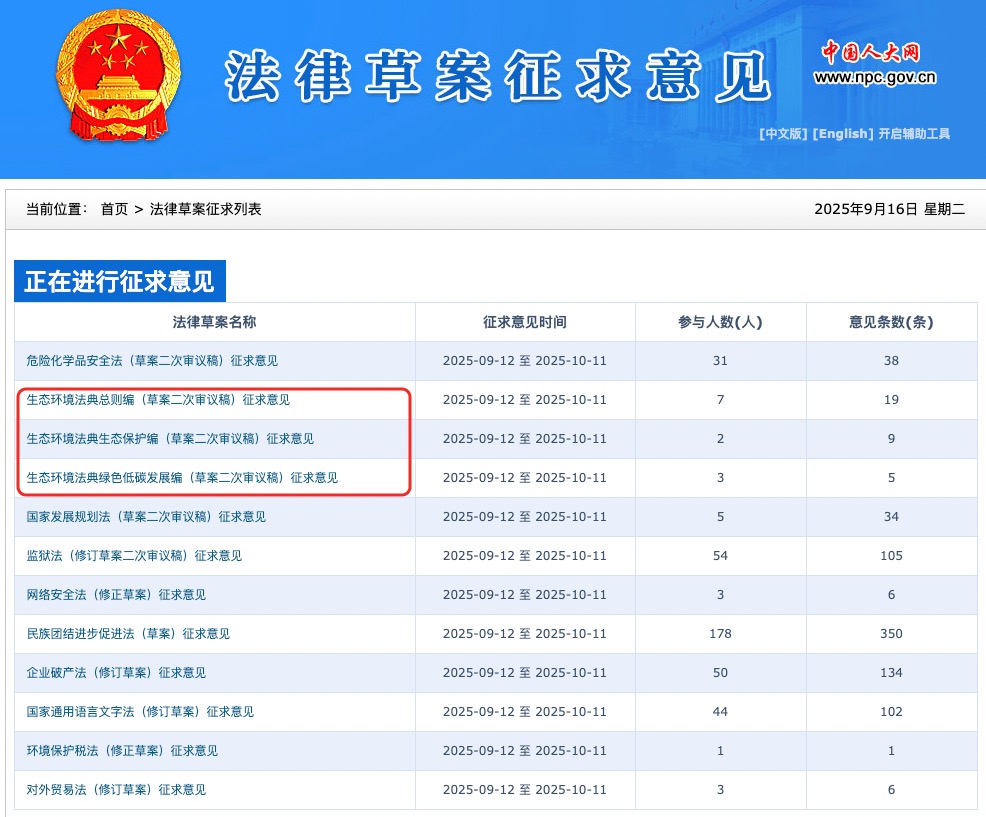
Ecological and Environmental Code - General Principles (Second Draft)
Ecological and Environmental Code - Ecological Protection (Second Draft)
Ecological and Environmental Code - Green and Low-carbon Development (Second Draft)
One of the adjustments to the Draft Code that has attracted attention is the extension of producer responsibility from automotive power batteries to all power batteries. The Draft Code also adds relevant provisions to encourage the promotion and application of recycled materials, and clarifies the legal basis for the standardization and supervision of the carbon emission trading market.
Speaking at the 17th Chemical Regulatory Annual Conference (CRAC) held on September 11, 2025, Mr. Bie Tao, the Chief Legal Counsel of the Ministry of Ecology and Environment, highlighted that the second reading for the other two sections of the Draft Code may be in October. Although Chinese legislation generally undergoes three readings, the Code may undergo a fourth reading, shared by Mr. Bie Tao. If passed by all the parties, this Code will be released as early as March next year. However, the code is relatively important and may need to go through more review and synthesis procedures. It may not be passed so quickly. It deserves public attention.
Previous article issued on May 29, 2025:
On May 27, 2025, the Ministry of Ecology and Environment (MEE) of China held its May regular press conference. Zhao Ke, Director of the Department of Regulations and Standards of the MEE, attended the press conference to introduce the progress of legislative work related to Ecological and Environmental Code (Draft). During the "Q&A" session, Director Zhao gave detailed answers to the most concerned questions about the Draft Code.
Background
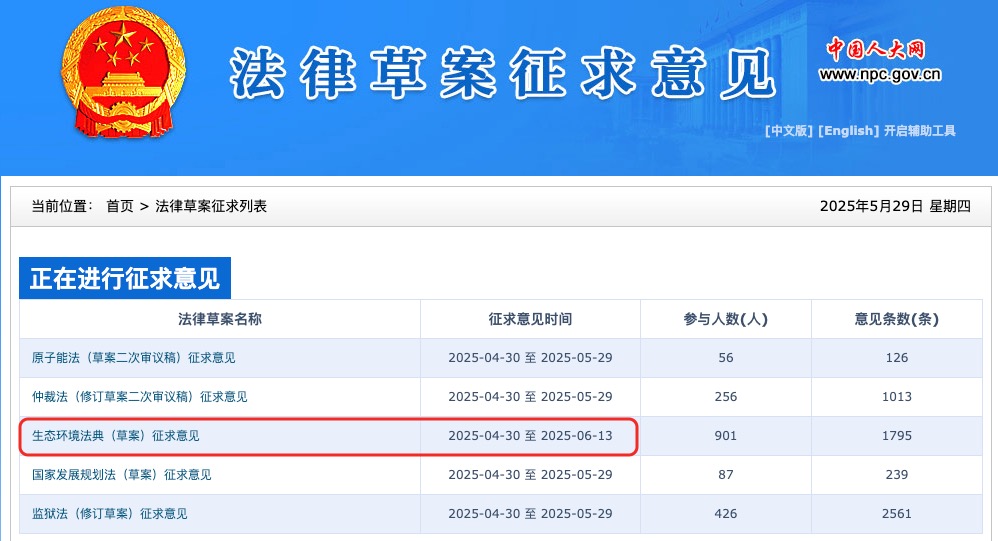
This Draft Code was publicly released on April 30 by the National People's Congress of China for public consultation. The comment period will last for 45 days and will conclude on June 13, 2025. As China's first code concerning ecological and environmental management, this Draft Code represents a significant milestone in the country's legislative history. It consists of five sections: general principles, pollution prevention, ecological protection, green and low-carbon development, legal responsibilities, and supplementary provisions, totaling 1,188 articles. Once adopted, it will become China's second formal statutory code, following the Civil Code, which was enacted in 2020.
Director Zhao Ke stated at the press conference that once implemented, this new code will repeal ten existing laws, including the laws on environmental protection, environmental impact assessment, marine environment protection, and various pollution prevention laws related to air, water, soil, solid waste, noise, and radiation, as well as the law on promoting clean production.
Provisions concerning chemical environmental management
This Draft Code formally addresses the registration system for the environmental management of new chemical substances. The Measures for the Environmental Management Registration of New Chemical Substances (MEE Order No. 12) has long lacked support from higher-level laws, resulting in limited penalties for violations. This has led many companies to maintain a sense of complacency and not take compliance with new chemical substances seriously. The Draft Code specifies that the production, import, and use of new chemical substances must all be registered. Any instance of failure to report or register as required constitutes a legal violation. Accompanying penalties will significantly increase, with fines reaching up to two million Chinese Yuan, and violators may face orders to suspend operations or close down.
The Draft Code also establishes a legal foundation for managing new pollutants. The MEE, in collaboration with relevant departments under the State Council, will conduct risk assessments for chemical pollution and publish a list of key controlled new pollutants, specifying measures for environmental risk management, including prohibitions and restrictions. Entities producing or importing the key controlled new pollutants, as well as those using them in their products, must comply with the specified environmental risk management measures.
Look ahead
During the Q&A session, Director Zhao Ke responded to many public concerns regarding the Draft Code's chemical management provisions. Following its official issuance, the MEE will further enhance the legal and regulatory framework, particularly in environmental risk management for chemicals, as shared by Director Zhao. The MEE will expedite research and consultation to develop a more mature draft proposal, which will be submitted to the State Council following the legislation procedures, while actively supporting subsequent legislative processes.
It is expected that the release and implementation of the code will significantly change and support legislation on environmental risk management for chemicals. ChemLinked will continue to monitor legislative progress and provide timely updates.