Request a Demo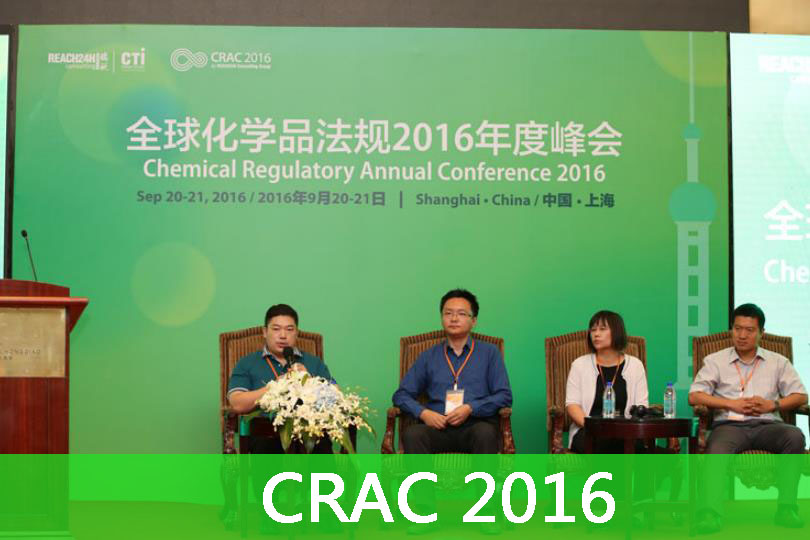
Under China’s convoluted regulatory system, inexperienced companies which try to import chemical products to China are often confused by the roles of China’s Customs and China Inspection and Quarantine (CIQ) Administrations and their respective requirements on chemical imports. On CRAC 2016, Mr. Jiesong Chen from Shanghai CIQ and Mr. Yexin Wang from Shanghai Customs were invited to introduce on behalf of the two authorities their respective responsibilities and the major problems identified in law enforcement and inspections.
CIQ
In accordance with Decree 591 and more specifically AQSIQ Announcement 30 of 2012, chemicals listed in China Inventory of Hazardous Chemicals (2015) and their packaging are subject to compulsory inspection by CIQ. Before the on-site inspection is carried out at the first port of entry when the commodities arrive in China, declaration should be made in advance with submission of company’s statement of conformity, GHS label and SDS, and fact sheet containing information of inhibitors or stabilizers (if any). Lab testing may be further required according to the on-site inspection result or randomly conducted to verify the hazard properties and hazard classification, product compositions and quality. Finally, CIQ issues an inspection result of either “qualified” or “unqualified”.
Mr. Jiesong Chen shared the inspection statistics for hazardous chemicals imported in 2015 from Shanghai
| Batch | Weight (1000 tons) | Value (USD) |
Import | 33712 | 5949.4 | 3.834 billion |
Unqualified import | 777 | 3.8853 | 51871 thousand |
Export | 5850 | 1014.7 | 0.823 billion |
Unqualified import | 18 | 0.1320 | 403.6 thousand |
Ratio of unqualified imports & exports | 2.01% | 0.56% | 1.12% |
Though the overall unqualified rate is at an acceptable level, the inspection result of a special enforcement program in 2015 showed that more than 80% of the SDSs of chemical imports failed to comply with China’s national standards. Mr. Chen reinforced that labels and SDSs must be in Chinese and compliant with GB 15258-2009 and GB/T 17519-2013. He also advised that the Chinese labels should be attached before the commodities enter China, while replacing or covering labels in foreign languages with Chinese labels in the bonded warehouses is regarded as a remedial measure or rectification and is not recommended.
Depending on the severity of compliance problems and quality issues, CIQ will decide to interview the responsible entity in China, release risk warnings and notifications, or add the responsible entity into the blacklist, in addition to administrative punishments in accordance with laws and regulations.
Customs
The customs are responsible for controlling the flow of goods, collecting tariffs, cracking down on smuggling and import & export statistics. Unqualified commodities will not be processed for customs clearance, so they will not get a chance to enter China’s market.
Primarily for the purpose of ensuring HS codes are correctly assigned to commodities and the tariffs are correctly calculated, the customs require 100% composition disclosure for chemical products, as well as information on product name, appearance, packaging specification, and product uses.
According to Mr. Yexin Wang’s presentation, companies should pay attention to ensure that all the ingredients in the product add up to 100%. For concerns of protecting confidential business information, generic names, trade names, etc. of the chemical ingredients can be used instead of the specific chemical names. However, if any ingredient is subject to mandatory declaration in accordance with China’s laws and regulation, it should be clearly listed. For example, toluene at 40% (v/v) or higher concentrations are regarded as precursor chemicals and subject to enhanced supervision. So for formulations containing toluene, the name and concentration of toluene must be accurate.
Another common mistake is seen in filling the information of packaging. This section should follow the standard format of (capacity of each individual packaging* number of individual packaging/ unit of overpack), for example: (500ml*6 bottles/box). It’s also required to identify if the packaging can be directly used for retailing, because for certain chemical products, different packaging are classified under different tariff headings or sub-headings and the documents/certificates required for customs clearance may change accordingly.
In a nutshell, China’s customs strictly control the import and export of the following chemicals:
Hazardous chemicals
New chemicals
Toxic chemicals severely restricted for import and export
Active ingredients in the register of Import Drugs Management, active ingredients subject to pesticide registration in China
Narcotic drugs, psychotropic substances
Chemicals controlled under CWC, drug precursors, ozone-depleting substances
Chemical subject to anti-dumping measures