1. Are impurities exempt from PMPIN requirements?
There are currently no issued policies regarding the exemption of
impurities from the PMPIN Procedure.
2. If a product contains more than 2 new substances, how many SQI
certificate(s) are needed?
If the annual amount of these 2 new substances is not exceed 1 ton,
you only need to apply for one SQI for the product.
3. To be in compliance with the Polymer Exemption is it sufficient to
meet only ONE of the, in DAO 2019-18 mentioned, criteria under section
4 (1-4)?
The polymer meets any of the criteria under section 4 can be exempted
from PMPIN process.
4. For Abbreviated PMPIN application, is it only SDS from sufficient
when it contains required physiocochemical, toxicological and
ecotoxicological data?
For abbreviated PMPIN application, the applicant shall submit scientific
literatures, reports or test for physicochemical, toxicological,
environmental and ecotoxicological data.
5. For abbreviated PMPIN application, the applicant shall submit scientific
literatures, reports or test for physicochemical, toxicological,
environmental and ecotoxicological data.
Entries to the Confidential PICCS remain there indefinitely until their
notifiers make a request to include them in the public PICCS or until
another notifier submits a PMPIN Application and does not declare the
entry as confidential in which case, the chemical will be included in the
public PICCS the following year after submission of its NOC.
6. Is it authority accepts publicly available ECHA data for PMPIN
application?
Data from REACH registration is acceptable for PMPIN abbreviated
application.
7. If CBI for SQI and PMPIN can only be submitted via OPMS moving
forward, what avenues are there to protect such information for
overseas manufacturers who can only rely on their local distributors to
submit a registration/ notification?
The CBI information can be submitted by third party to avoid disclosing
to the Philippine importers.
8. To perform a PMPIN abbreviated form, the company who applies
should be the same that has registered the chemical in other inventory
(Australia, Canada, USA, ....) or we can apply for this if the chemical is
on any of these inventories?
The notifier shall register using the abbreviated form if he/she is
applying for a new chemical already listed in either of the chemical
inventories of US, EU, Australia, Japan, Canada and/or Korea.
9. Is there any way to check and find out if your substance is on the
confidential inventory?
Currently, there is no way to check the confidential inventory.
10. What is the definition of a new chemical substance? When a CAS rn
can be linked or found that could represent our chemical substance?
OPMS account can be created by companies outside PH?
New chemical substance is defined as chemicals not listed in the PICCS.
OPMS account can be registered by company in the Philippines.
11. For overseas Formulators, is it possible to nominate an Only
Representative? Or is the importer that must apply for any action to
take?
Importer should be the applicant for SQI, PMPIN and polymer
exemption application. Overseas formulators can authorize a third party
to submit CBI information directly to Philippine EMB.
12. What will you need to do if you have import of a substance below 1
tpa beyond the five years?
SQI certificate can be renewed yearly for a maximum of 5 years. After
which, PMPIN shall be applied.
13. Can an importer write to EMB to check if a substance is listed
confidentially?
Currently, EMB shall not provide the service of confidential directory
queries.
14. Are there any other exemption for small quantities below 1 ton, for
instance up to 100 Kg?
Currently, there is no lower limit for SQI applications.
15. If a mixture contains two exempt polymers, do we need to submit
two polymer exemption applications or just one?
The company shall apply polymer exemption for both eligible polymers.
16. If chemical is listed on the confidential part of PICCS, can other
importers besides the PMPIN certificate owner import the chemicals?
Except the PMPIN certificate owner, other importers shall apply for
PMPIN, SQI or polymer exemption before first manufacture or
importation.
Webinar Recommendation
For more insights from Ms. Sophie Zheng on new chemical notification in the Philippines, welcome to watch ChemLinked webinar held on December 21, 2021.
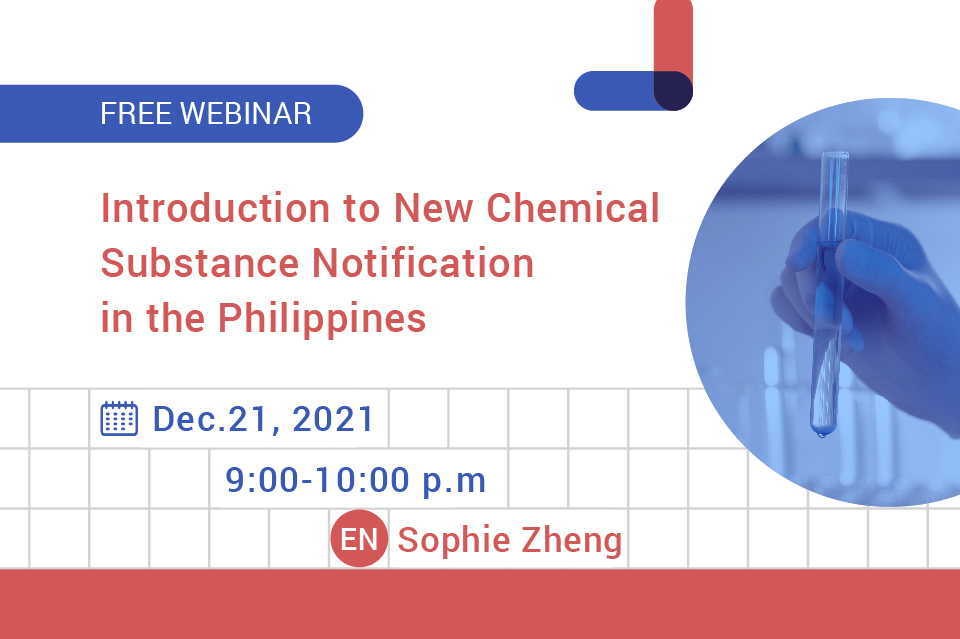 Both the video and the presentation slides are available.
About the Expert:
 |
Senior Technical Specialist
Ms. Sophie Zheng is mainly responsible for the declaration technology of new chemical substances in China and the registration of chemical regulations in the Philippines. She has many years of experience in the declaration of new chemical substances and has completed many new chemical substance declaration projects and post-declaration obligations in China. She has rich experience in the formulation of declaration strategies, data gap analysis, determination of hazard properties of substances, risk assessment and post-declaration obligations. |


 Request a Demo




