Request a Demo
On February 6, 2024, South Korea's Ministry of Environment (MoE) announced the adoption of proposed amendments to K-REACH and K-CCA, which were passed by South Korea’s National Assembly on January 9, 2024.
Major amendments to K-REACH
The critical tonnage band for new chemical registration will be updated from 0.1 t/y to 1 t/y (to be in force from 1 Jan 2025. (read more)
The authority will review submitted materials for the appropriateness of the notification and disclose information on the notified new chemical substance (manufactured or imported < 1 t/y) to the public. For CBI substances, the generic names will be disclosed.
For substances manufactured/imported only for export which have obtained the Exemption Conformation from the MoE for registration or notification, the calculation of the quantity to be registered or notified under K-REACH should exclude the quantity that has obtained exemption confirmation.
Toxic substances will be classified into three types based on their hazards, and more appropriate management measures under K-CCA will apply (see table below).
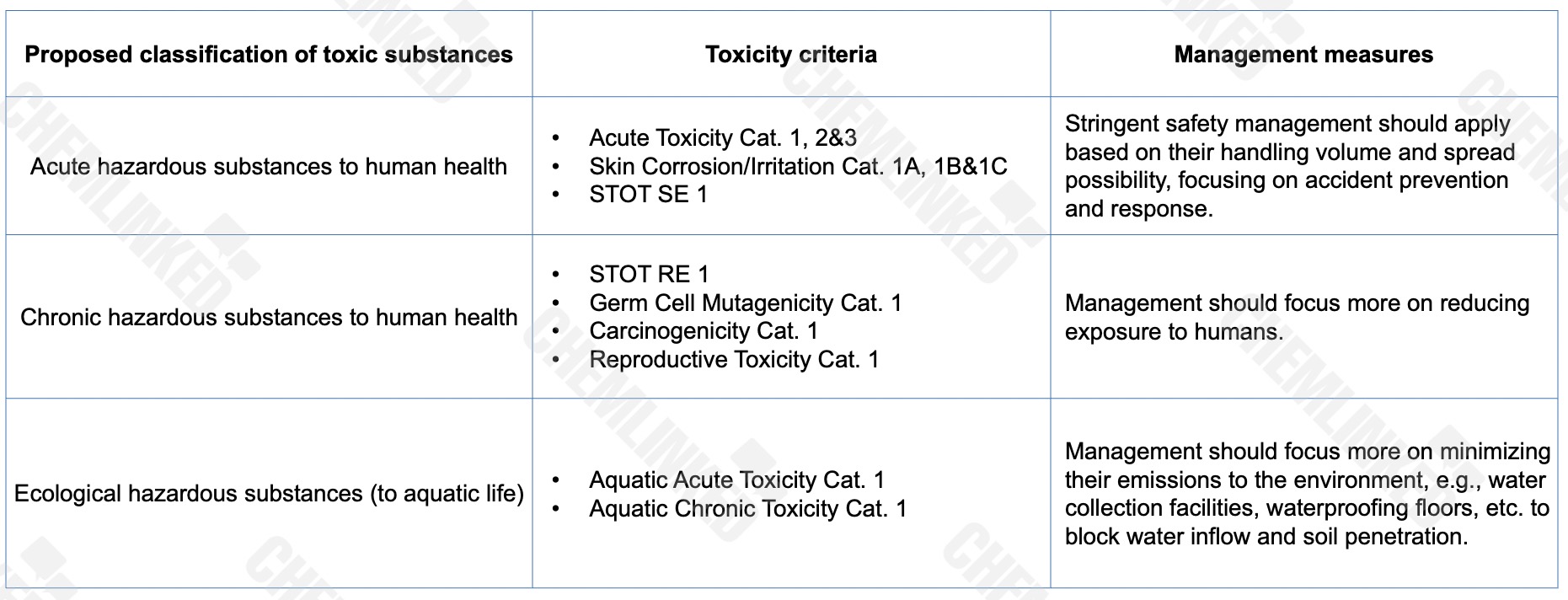
For substances with undetermined hazards, until it is confirmed that such a substance with undetermined hazards is not hazardous, it should be presumed to be hazardous, and appropriate measures should be taken to ensure that it does not cause harm to human health or the environment.
According to Ordinance No. 20232, most of the amendments to K-REACH will take effect on August 7, 2025, except for the updates concerning new chemical registration criteria, i.e., from 0.1 t/y to 1 t/y, which will take effect on January 1, 2025.
Major amendments to K-CCA
Differentiated management measures will be imposed on different types of toxic substances (designated in line with K-REACH) based on their quantities, hazards and risks.
The definition of “Hazardous Substance” under K-CCA will only refer to the abovementioned three types of toxic substances and accident precaution substances.
Companies may only need to fulfill notification obligations (instead of licensing and reporting requirements), if the hazardous chemicals they handle are of low hazard or in minimal quantities, and the possible chemical accidents they may cause have little impact on the environment and public around the workplace.
Consumers may be excluded from general handling and management obligations for hazardous chemicals when using them in their daily lives.
The handling, collection and transport of designated wastes containing hazardous substances will be regulated under the Waste Control Act.
The prohibition/restriction against handling prohibited/restricted substances will not apply to prohibited/restricted substances manufactured/imported for exporting them in their entirety overseas.
Stakeholders who intend to manufacture, import, sell, store, or use restricted substances for unspecified purposes must report to the MoE. However, this requirement will not apply to cases where the manufacture, import, store, or sell a reagent intended for use in experiments, research, or testing.
Stakeholders who intend to manufacture or import any substances subject to authorization for exporting them in their entirety overseas should report to the MoE, even if they have obtained the Exemption Confirmation under K-REACH and are within the exemption period. (*No substances subject to authorization have been officially designated in South Korea so far. Read more.)
According to Ordinance No. 20231, most of the amendments to K-CCA will take effect on August 7, 2025, except for the updates concerning the management of wastes containing hazardous substances, i.e., their handling, collection and transport should be regulated under the Waste Control Act, which take effect immediately after the publication on February 6, 2024.
As announced in a press released by the Ministry of Environment, the supporting regulations under K-REACH and K-CCA are expected to be revised in due course.