Request a Demo
The 16th Chemical Regulatory Annual Conference (CRAC) took place on September 5-6, 2024, in Nanjing, China, featuring a notable presentation by Dr. Catherine Cornu from the European Chemicals Agency (ECHA). During her talk, Catherine shared essential updates on European chemicals management, offering attendees vital insights into the evolving regulatory landscape that governs chemical safety and compliance.
EU CLP Revision
A significant focus of Catherine's presentation is the ongoing EU CLP revision. This revision is being executed through two distinct tracks:
Introduction of new hazard classes and corresponding hazard statements via the Delegated Act (DA) adopted in April 2023, and
Change of CLP body text through the Ordinary Legislative Procedure (OLP), which is anticipated to be finalized later this year.
The new hazard classes are:
ED HH in Category 1 and Category 2 (Endocrine disruption for human health)
ED ENV in Category 1 and Category 2 (Endocrine disruption for the environment)
PBT (persistent, bioaccumulative, toxic), vPvB (very persistent, very bioaccumulative)
PMT (persistent, mobile, toxic), vPvM (very persistent, very mobile)
Manufacturers, importers, downstream users and distributors are granted transitional periods to classify their substances or mixtures according to the new hazard classes. Separate transition times apply for single substances and mixtures (See below Chart).
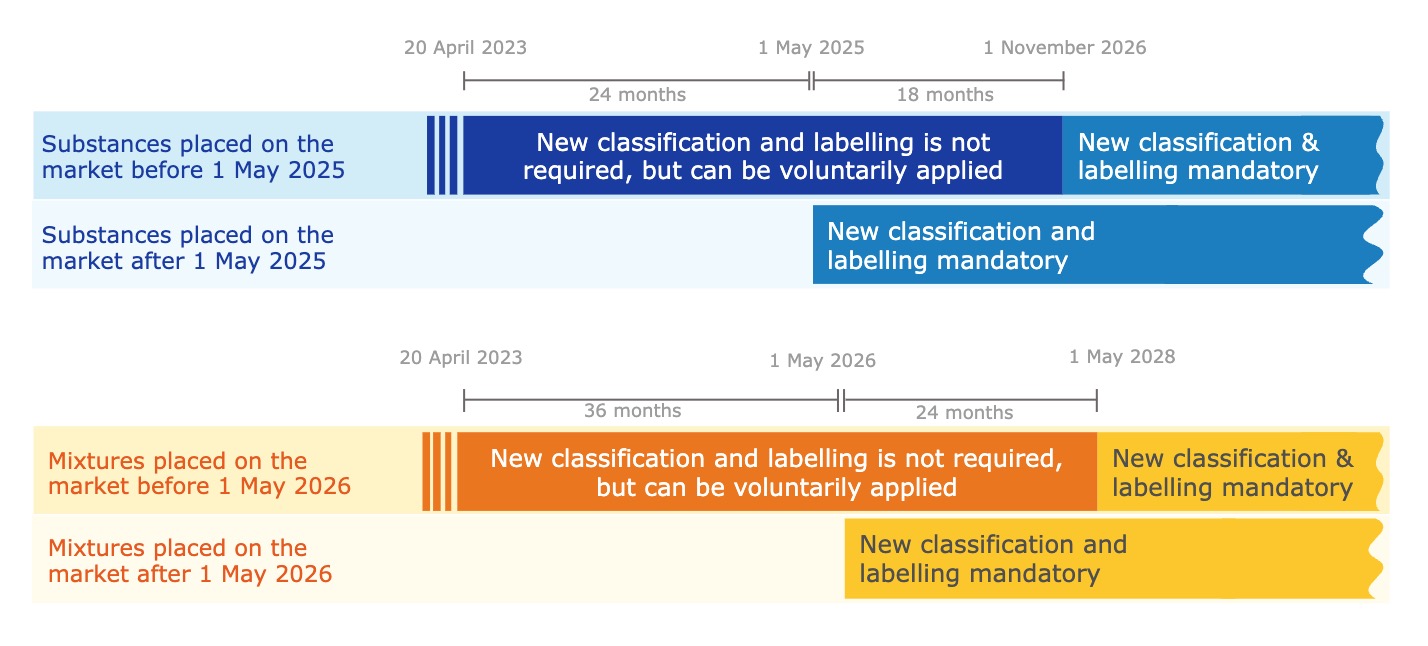 Source: ECHA
To support the introduction of new hazard classes, IUCLID has been updated to allow submit related information and the Guidance on the Application of the CLP Criteria will be updated in Q3 2024.
As the CLP revision nears completion, it is crucial for businesses to remain agile. Catherine recommended companies to review their portfolios, assessing whether their substances will fall under the new hazard classes, and then update labels, SDS and CLP notifications/REACH registrations if needed.
ECHA CHEM System
Catherine also introduced the new ECHA CHEM system, launched in January 2024. This system marks a pivotal advancement in improving the transparency and accessibility of chemical data across various EU legislation. By gradually onboarding datasets from older systems, ECHA aims to provide stakeholders with more user-friendly and relevant information.
As part of this initiative, a redesign of the classification and labelling (C&L) inventory is set for Q4 2024, which will bring the "best available" data for each substance entry.
Update on REACH Operations
The update on the REACH regulation is another crucial aspect of the presentation. Catherine detailed the current status of registrations, evaluations, restrictions, and authorizations. With approximately 4,000 initial registrations and 10,000 dossier updates submitted annually, the sheer volume illustrates the ongoing commitment to chemical safety.
Since 2018, ECHA has gradually shifted its evaluation focus from single substances to groups of structurally related substances to speed up the identification of chemicals that need regulatory action. In addition, high tonnage substances (>100tpa) are mostly screened. Special attention was given to the PFAS restriction proposal, emphasizing the restriction regulatory landscape's evolution.
Regarding authorization, the years 2022 and 2023 have witnessed a peak in the authorization of chromium VI (Cr(VI)) compounds. Catherine noted that managing substances subject to authorization while with widespread uses, like Cr(VI), poses significant challenges. These difficulties further underscore the complexities involved in enforcing chemical safety.
EU Enforcement Projects
In her closing remarks, Catherine addressed current EU enforcement projects, which prioritize import controls, online sales, and the classification and labelling of mixtures. These initiatives represent a broader effort to enhance compliance and regulatory oversight, emphasizing the EU's commitment to ensuring that chemicals are managed safely and responsibly.