Request a Demo
On October 20, 2022, South Korea’s Ministry of Environment (MoE) made public the Revised Guide on Registration of Existing Chemical Substances under K-REACH (hereinafter referred to as the Revised Guide). The updates mainly focus on the registration procedures of reaction products which are regarded as existing chemicals in South Korea.
Background According to the MoE Announcement No.2021-160 issued on August 12 of 2021, three broad categories of chemical substances can also be regarded as existing chemical substances, including:
|
The previous registration application procedures for a reaction product under K-REACH are as below:
Step 1 - Submit relevant materials to the National Institute of Environment Research (NIER) to verify the reaction product is an existing chemical in South Korea.
Step 2 - If confirmed as an existing chemical by the NIER, it will be granted with a unique number (KE number) as identification information. Registrants can use the KE number to apply for pre-registration or registration under K-REACH.
The Revised Guide updates the Step 2, i.e.,
A reaction product is generally named in the form like “Mixture (reaction mass) of X+Y+ (...Z)”. If the reaction product is confirmed as an existing chemical by the NIER, registrants then can go on to the following procedures:
Apply for pre-registration with the KE number of the existing substance X;
Join the exist consortium of the existing substance X;
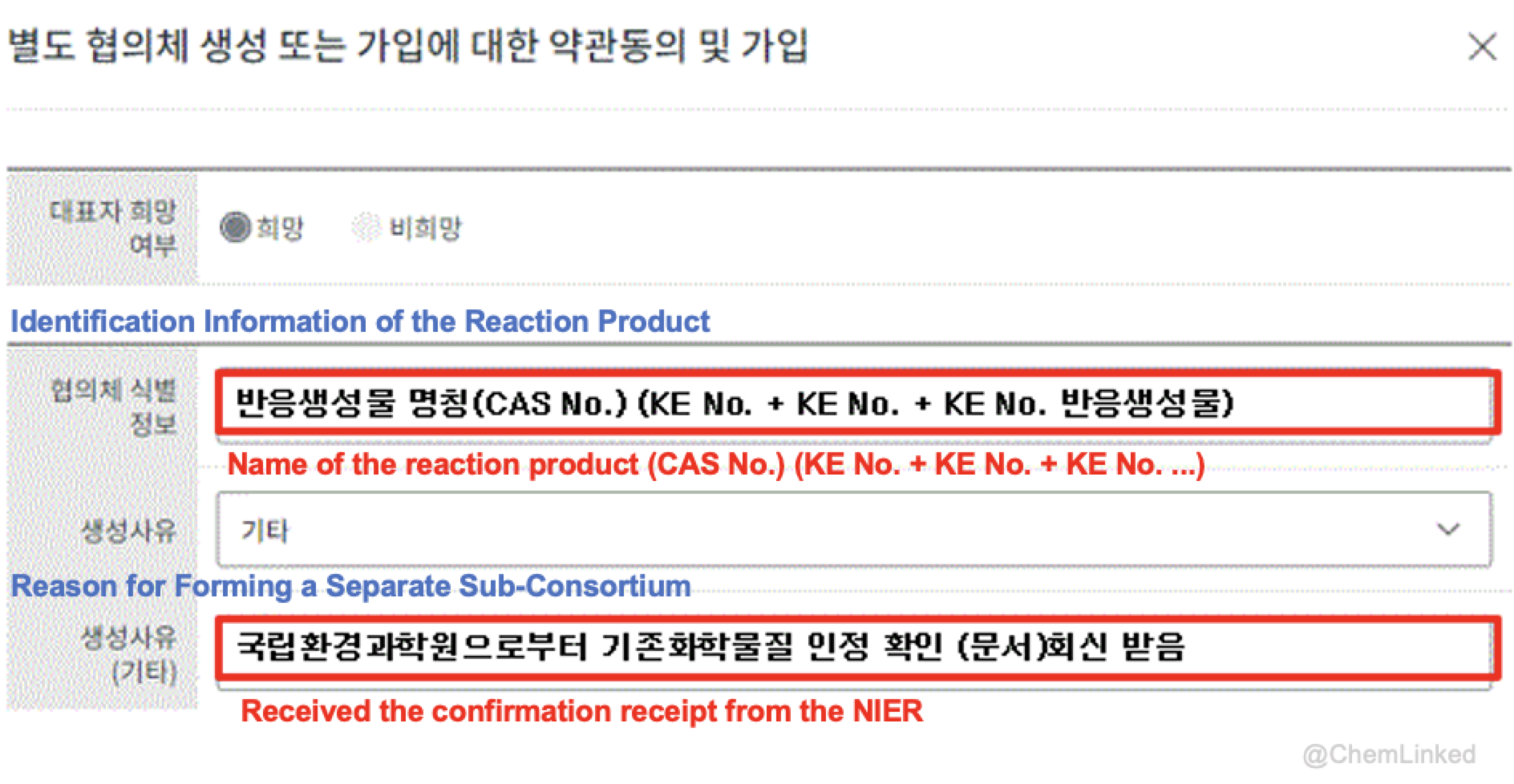
Form a separate sub-consortium to prepare for the registration of the reaction product*.
*When forming a separate sub-consortium, the Identification Information of the Reaction Product and the Reason for Forming a Separate Sub-Consortium can be filled as the figure below shows.