Request a Demo
The revised version of both the Toxic Chemical Substance Control Act (TCSCA) and the Occupational Safety and Health Act (OSHA) were fully enacted on 11 Dec 2014 and 1 Jan 2015 respectively. As a result of the revisions to TCSCA and OSHA a new chemical registration system has been implemented in Taiwan.
The subordinate regulations under TCSCA and OSHA for new and existing chemical registration details were both finalized in Dec of 2014, namely the “Regulation of New and Existing Chemical Substances Registration” (EPA’s regulation) and the “Regulation of New Chemical Substances Registration” (MoL’s regulation). The two regulations fall under the remit of two different authorities and are built on different legislative foundations. EPA’s regulation is designed to regulate the environmental impact of industrial development by evaluating chemical substances hazardous properties and instituting measures to reduce risk. The MoL’s regulation was developed to ensure safe working conditions for all workers. The two frameworks have very similar data requirements for chemical registration.
The authorities have agreed to ease the regulatory burden facing industry and ensure against unnecessary duplicate submissions under the two regulations. By inter-agency cooperation, a single registration system for receiving both dossiers is being established, which starts with the coordination in the implementation of Article 11 (registration) of the MoL’s regulation under the OSHA and Article 16 (supplementation program) of the EPA’s regulation under TCSCA.
The supplementation program as articulated by Article 16 of the EPA’s regulation includes all chemicals manufactured or imported to the Taiwanese market before 11 Dec 2014 into the inventory of existing chemical substances. The inventory serves as the basis for judging new and existing chemicals and their corresponding registration requirements. Article 11 of the MoL’s regulation is a transitional measure for the management of new chemical substances manufactured or imported into Taiwan before 1 Jan 2015. The registration certificate is valid only for one year. The deadline for both two kinds of applications is 31 Mar 2015.
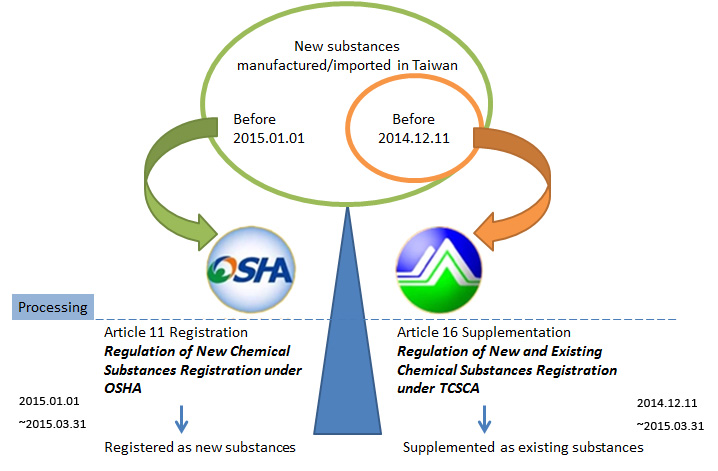
EPA and MoL developed their own IT tools to facilitate administration of the two regulatory frameworks. The tool originally designed for the supplementation program under TCSCA will now serve to facilitate the two kinds of applications (due by 31 Mar 2015) under both frameworks. When applying for the supplementation program under TCSCA, the registrant can opt whether to authorize the MoL to process the dossier for Article 11 registration under OSHA. There are four choices.
Submitted only to MEP for supplementation program of existing chemical substances under TCSCA
Submitted EPA and MoL for supplementation program of existing chemical substances under TCSCA and Article 11 registration of new chemical substances under OSHA
Inapplicable to the supplementation program, thus only submitted to MoL for Article 11 registration of new chemical substances under OSHA (chemicals manufactured/imported during 2014.12.11-2015.1.1)
Application for supplementation program submitted before, thus only submitted to MoL for Article 11 registration of new chemical substances under OSHA
If you click on the option authorizing the MoL to review material for registration dossier, the registrant should submit additional documents since the regulatory requirements under the two systems are not identical. The additional materials include:
Factory Registration Document: Registrant enterprise identification
Declarative Statement: Statement declaring regulatory compliance and the integrity of application documents
Letter of Authority (Power of attorney): Evidence for appointment of a TPR if applicable
The single registration system for Article 11 (registration) of the MoL’s regulation under the OSHA and Article 16 (supplementation program) of the EPA’s regulation under TCSCA is a preliminary measure after a basic consensus was reached to fully harmonize registration under both frameworks. Further harmonization is still required as the regulations have different data requirements. The EPA and MoL are still engaging in dialogue with stakeholders with a view to improving the IT tool and providing guidance documents to facilitate regulatory compliance and market access.