Request a Demo
China has one of the world’s largest hazardous chemical manufacturing bases. The management of hazardous chemicals has always been a vital task for the Chinese government and involves a lot of governmental branches. Enterprises are required to register and apply for permits for the hazardous chemicals they deal with during manufacture and import. However, when it comes to transport, another concept of “dangerous goods” is brought in. The idea of “dangerous goods” is not exactly the same as “hazardous chemicals” and enterprises face different requirements from manufacture and import when transporting their chemicals. This article will try to examine the concept of “dangerous goods” and “hazardous chemicals” in China’s legal framework and summarize the differences between them.
1. Hazardous chemicals.
The overarching legislation for the management of hazardous chemicals in China is State Council Decree No.591, the Regulations on the Control over Safety of Hazardous Chemicals. Article 3 of Decree No.591 stipulates that “hazardous chemicals” means chemicals hazardous to the human body, facilities and the environment which have toxic, corrosive, explosive, combustive and combustion-supporting properties. To be more specific, “hazardous chemicals” in China means the chemicals that are included in the Inventory of Hazardous Chemicals (2015) and the chemicals that are regarded as hazardous according to the determination principles of the Inventory.
The Inventory of Hazardous Chemicals (2015) adopts the classification of hazardous chemicals specified by the national standard Rules for classification and labeling of chemicals (GB 30000.x series), which is consistent with UN GHS rev. 4. The detailed classification is as follow: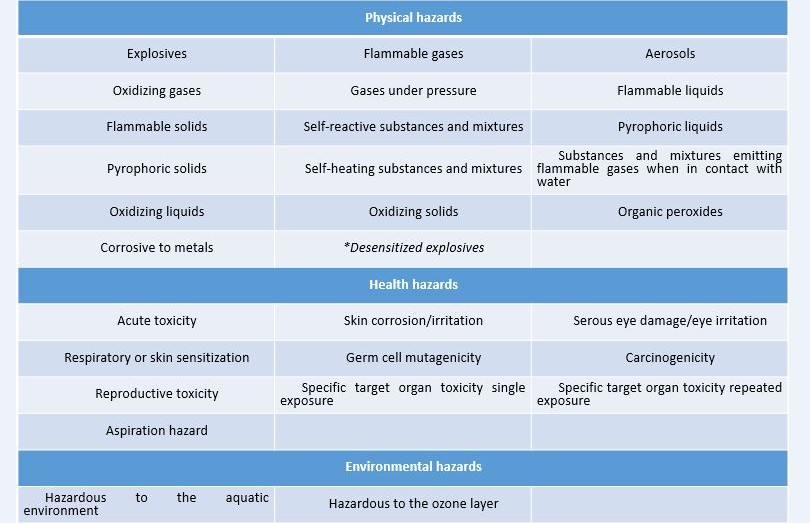 *Note: “desensitized explosives” is a new physical hazard that was added in the UN GHS rev. 7 and hasn’t been adopted by China’s determination principles.
2. Dangerous goods.
The determination of dangerous goods in China is mainly based on 2 national standards, Classification and Code of Dangerous Goods (GB 6944-2012) and List of Dangerous Goods (GB 12268-2012), which are consistent with UN’s Recommendations on the Transport of Dangerous Goods. The dangerous goods are classified into 9 classes as follow: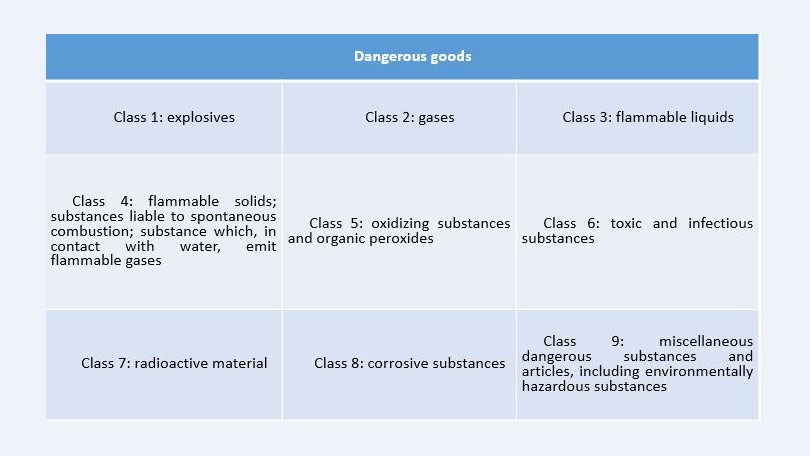
3. Comparison between hazardous chemicals and dangerous goods.
It can be seen from above that in the determination and classification systems, hazardous chemicals and dangerous goods are treated quite differently. Some chemicals are classified as hazardous chemicals but are not classified as dangerous goods, and vice versa. Take the first chemical listed in the Inventory of Hazardous Chemicals, opium, for example. It is classified as “specific target organ toxicity - repeated exposure” and therefore is a hazardous chemical. But it doesn't fall into any of the 9 hazard classes for dangerous goods. So it can be transported as ordinary goods. Another example is lithium batteries. They are classified as dangerous goods but not identified as hazardous chemicals because they are articles instead of chemicals. The same applies for airbags of automobiles. So enterprises should be aware of the different obligations that come with different concepts and classifications.
Hazardous chemicals and dangerous goods are regulated and managed by different regulations and competent authorities in China. Each competent authority focuses on different activities associated with the chemicals. For example, the State Administration of Work Safety (SAWS) is mainly responsible for the management of the manufacture, operation, and storage of the chemicals; the management priority of the General Administration of Quality Supervision, Inspection and Quarantine (AQSIQ) lies in the import and export of the chemicals; and the Ministry of Transport (MOT) focuses on the transportation of the chemicals. The main regulations and competent authorities are:
Scope | Regulation | Competent authority |
Hazardous chemicals | Regulations on the Control over Safety of Hazardous Chemicals (Decree No.591) | 10 governmental branches including SAWS, AQSIQ, MOT, MEP, etc. |
10 governmental branches including SAWS, AQSIQ, MOT, MEP, etc. | ||
Measures on the Administration of Hazardous Chemicals Registration (SAWS Order No.53) | SAWS | |
SAWS | ||
AQSIQ | ||
Dangerous goods | Regulation on the Transport of Dangerous Goods by Air (CAAC Order No.216) | Civil Aviation Administration of China (CAAC) |
MOT | ||
Provisions on the Supervision and Administration of Safe Railway Transportation of Dangerous Goods | MOT & National Railway Administration (NRA) |
The compliance duties for enterprises can vary throughout the substance lifecycle during manufacture, import, export, storage, and transport of hazardous chemicals and dangerous goods. ChemLinked plans to publish a series of articles and interpret which will detail the regulatory requirements that enterprises have to follow in different links of the supply chain. Please stay tuned with ChemLinked for more information.