Request a Demo
To enhance the digital and intelligent management of hazardous chemicals, China has introduced a policy called ‘One Enterprise, One Chemical Product, One QR Code’ in 2022. Many provinces and cities in China, e.g., Guangdong, Shandong, Beijing, Shanghai, etc., have successively piloted their own local QR code requirements for hazardous chemicals management in recent years. Based on the pilot experience, local authorities respectively prepared technical specifications to standardize implementation of hazardous chemical QR code in their jurisdictions.
Beijing: ‘DB11/T 2196—2023 Technical Specification for full process traceability management of hazardous chemicals’ was issued on December 25, 2023, and took effect on April 1, 2024.
Guangdong: ‘DB44/T 2564—2024 Application specification for safety information code of hazardous chemicals’ was issued on November 11, 2024, and took effect on February 11, 2025.
Shanghai recently closed the one-month public consultation on its local standard ‘DB31/T 1250-XXXX Technical specification for traceability code of hazardous chemicals’ (Draft for approval). No comments were submitted. This standard has successfully completed the comment phase, entered the final review and approval process.

According to Shanghai’s pilot project, to generate a Hazchem traceability code, the manufacturers and importers of hazardous chemicals within Shanghai shall first obtain the hazardous chemical safety code (NRCC QR code) via the national registration system and provide it to Shanghai’s hazardous chemical traceability system together with additional information. This time, the local standard DB31/T 1250-XXXX drafted for approval aims to clarify requirements for the Hazchem traceability code application within Shanghai. It specifies the technical methods, identification information, use and maintenance requirements of traceability codes used to identify the safety information of hazardous chemicals in their production, transportation, storage, use, etc.
Although Beijing’s technical specification DB11/T 2196-2023 covers the hazardous chemical traceability code’s generation, use, affixing, etc., its requirements are relatively general. Shanghai’s draft standard DB31/T 1250-XXXX provides more detailed application requirements, e.g., the specific size of the QR code, the code margin, and affixing samples. Major points of Shanghai’s draft local standard are summarized below.
Styles of Hazchem Traceability Code
The Hazchem traceability code has two styles i.e., standard version and simplified version. Notably, there are some differences between styles of the Hazchem traceability code implemented in Shanghai and the styles of the NRCC QR code implemented in Guangdong (DB44/T 2564—2024).
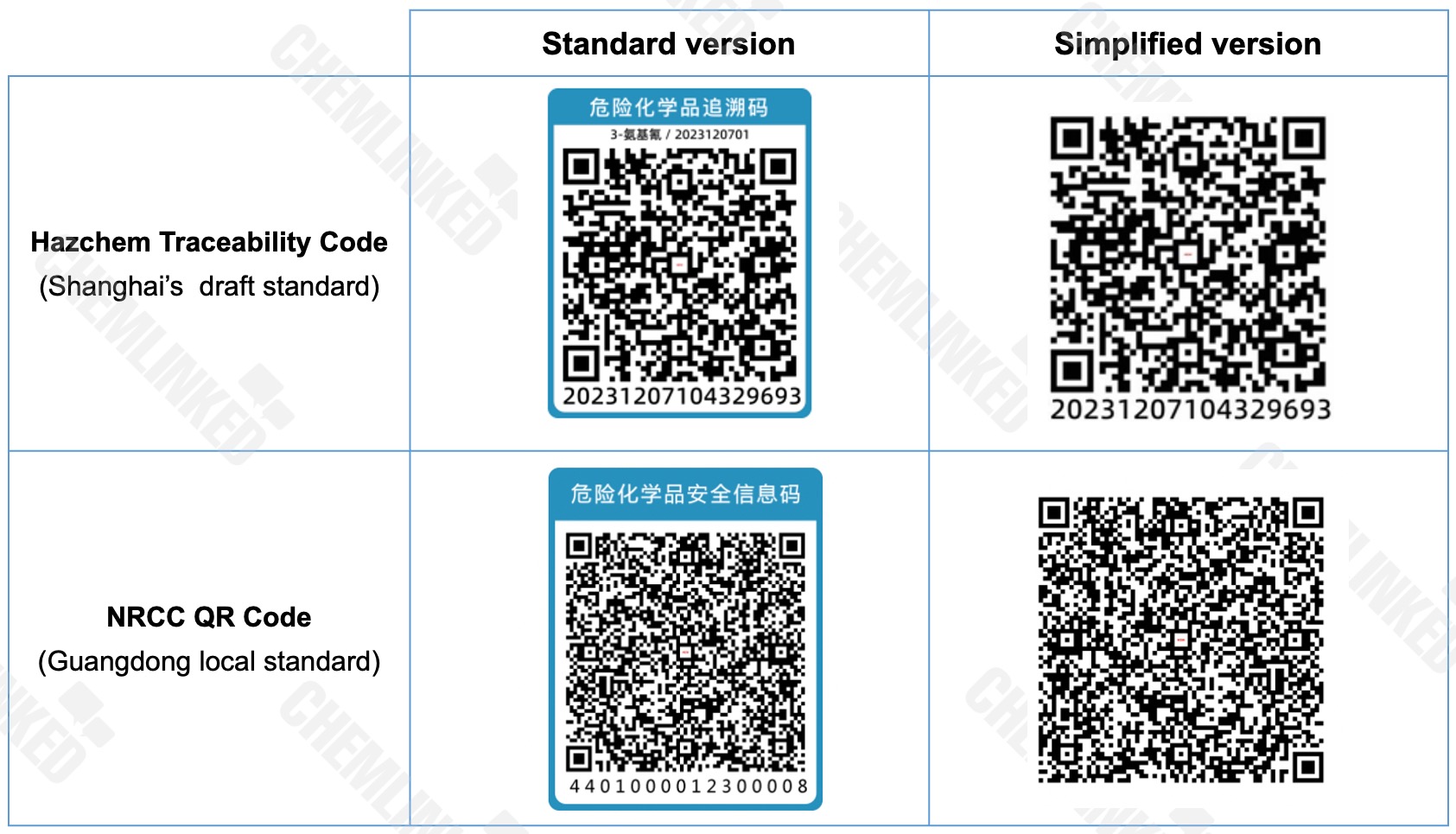
According to Shanghai's DB31/T 1250-XXXX, the standard version of the Hazchem traceability code should include the product name (in Chinese) and batch number, and the simplified version should maintain the sequence number of the traceability code. Notably, the simplified version can only be used for packaged chemicals in volume within 1,00 mL and 1,000 mL.
The traceability code should not be smaller than the size of the hazard pictogram in the chemical safety label, and the length of the short side should not be less than 10mm. Sufficient space must be left around the edges of the QR code, with a minimum width of 1mm in each direction.
Affixing requirements and examples
The traceability code can be affixed next to the last hazard pictogram on the label or on the bottom right of the label. The position of the Hazchem traceability code on the label shall be consistent for the same product of the same enterprise.

A unique Hazchem traceability code for each batch of hazardous chemical should be affixed to the smallest outer packaging throughout its circulation within Shanghai. The position of the Hazchem traceability code on the packaging shall be consistent for the same product of the same enterprise.
Manufacturers should print or paste traceability codes on their product packaging, and repackaging and distribution companies should regenerate and print or paste traceability codes when hazardous chemicals need to be repacked or mixed.
For non-packaged hazardous chemicals transported in intermediate bulk containers, large containers, portable tanks and tank trucks, virtual traceability codes can be used, or the Hazchem traceability codes can be printed on the bill of lading/order.
This standard is not finalized so far. However, its official release is expected to come soon.