Request a Demo
Updates:
By the MoE Announcement No. 2023-253 issued on 2 November 2023, South Korea's MoE adopted the proposed handling quantity limits for 3 newly designated toxic substances (NIER Given No. 2023-1-1116 ~ 2023-1-1118), which came into force immediately.

The announcement can be accessed here.
--------------------------------------------------------------------------------------------------------------
On October 6, 2023, South Korea’s Ministry of Environment (MoE) issued a notice to solicit public comments on the proposed handling limits for 3 toxic substances, which were previously designated on August 1, 2023 (CL news). Comments are welcome before October 26, 2023.
Under K-CCA, toxic substances, restricted substances, prohibited substances and the substances subject to authorization are required to submit a chemical accident prevention management plan if exceeding the corresponding handling limits. The concerned chemical lists are attached to the Stipulated Quantities for Toxic Substances, Restricted Substances, Prohibited Substances, and Substances Subject to Authorization (hereinafter referred to as the Regulation), including Annex 1 for toxic substances, Annex 2 for restricted substances, and Annex 3 for prohibited substances. As for the substances subject to authorization, eleven candidate substances for authorization under K-REACH have been proposed, including benzene, bisphenol A, DBP, BBP, etc. (CL news). Currently, there’re no substances in the Authorization List.
This time the proposed amendments to the Regulation are for Annex 1 toxic substances. See the screenshot below.
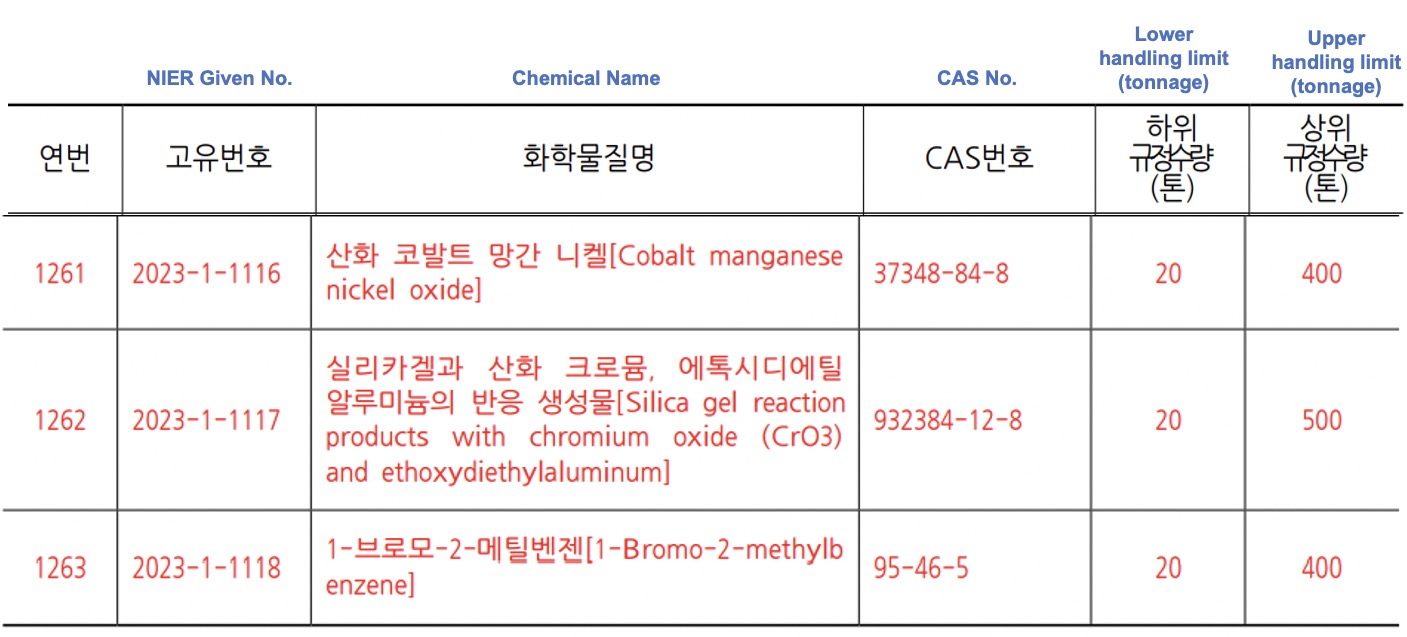
The whole document is available here.
According to K-CCA and the Regulation, for a target chemical, exceeding the upper handling limit requires submitting the Grade 1 chemical accident prevention management plan, while the Grade 2 chemical accident prevention management plan can apply if it only exceeds the lower handling limit.