Request a Demo
On 15th October 2010, a REACH-style legislature that regulates the environmental risk and hazard of China's new chemical substances, 'Measures for the Environmental Management of New Chemical Substances', came into effect, under the Ministry of Environmental Protection (MEP) Order No. 7. This regulation adopts several of the same principles and concepts of the European regulation, and thus has been dubbed ‘China REACH’.
This legislation is a significant update on its previous Measures enacted in 2003, which has retained the system of New Chemical Substance Notification (NCSN) and introduced a series of new concepts also contained in EU REACH. These include GHS-based criteria hazard communication, notification tonnage bands, post-notification tracking and acceptance of notifications only by legal-entities within the jurisdiction of the regulation. The revised law follows an international practice in seeking for a more comprehensive management system for chemical substances in aspects of registration, evaluation, assessment and tracking control.
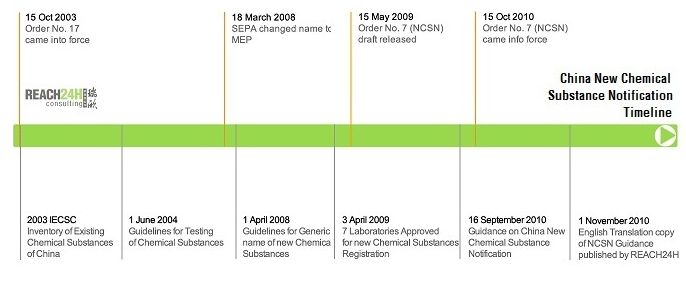
China New Chemical Substance Notification (NCSN) Timeline
CONTENTS
Substances to be Notified under China NCSN
China NCSN requires registration of 'new' chemical substances in China. Substances to be notified under NCSN include:
New chemical substances not listed in IECSC (the Inventory of Existing Chemical Substances manufactured or Imported in China);
Raw materials (ingredients) or intermediates, if not listed in IECSC, used to produce cosmetics, pharmaceuticals, pesticides, veterinary medicine, feed additives, radioactive materials, etc.;
New substances presented in preparations or mixtures such as surfactants, plasticizers, preservatives, dispersing agents, flame retardants etc, and which are manufactured after 2003 (not included);
New substances of variable composition and complex reaction products without unique structural formulae;
Low concern polymer and polymers with one or more monomers present in a low concentration (<2% w/w);
New substances in articles, which are designed to release by intention. For example, scented product, ink cartridge and fire-fighting equipment.
Notification Cost: According to the current regulations, neither application for China NCSN nor the registration certificate obtaining has any administration fee. However, notifying companies still need to take account of their own capital and time investment on notification dossiers preparation and test data requirement as well as the various post-notification corporate duties, like data/MADS communication, substance activity reporting and risk control measures, etc.
IECSC Search and IECSC Supplementation
IECSC is the Inventory of Existing Chemical Substances in China, which are manufactured/processed/sold/used in China or imported from overseas for commercial purposes.
The latest IECSC list issued in 2010 include 45, 602 substances, among which 3,166 substances are marked as "confidential" and 42,436 substances are available on public. 37,424 substances in IECSC have CAS numbers while 8,175 substances have no CAS number and are coded with machine serial numbers instead. Also, 32,793 substances on the list have identified chemical structural formulae with 12,809 substances no structures.
IECSC Search (Inquiry): Chemicals that are not listed on IECSC are identified as new chemical substances subject to China new chemical substance notification. Therefore, confirmation of whether the substance in your product falls under IECSC is essential before your entering the Chinese market. Non-confidential substances can be queried through the CRC-MEP website by inputting the substance CAS number or full English name. For example, input 'Formaldehyde' or '50-00-1'.
IECSC 2010 Software: IECSC 2010 has two versions: web-based search tool and standalone. The standalone version allows a search with the CAS No., chemical name and the structural formula; it also displays more detailed results than the web-based search tool. However, it is not free, and is priced at RMB 8500 on the CRC website. Notifiers that have already purchased the 2008 or 2009 version can download the 2010 version for free. Non-Chinese notifiers subscribing to the software need to pay RMB 500 more for EMS postage charge. REACH24H now offer free consulting for "non-confidential" substance search and enquiry.
According to the Nov-18 MEP notice, IECSC Supplementation has been cancelled since 18 November 2011!
IECSC Supplementation: If your substance was placed on the Chinese market before 15 October 2003 and it is currently not listed on the IECSC, you can apply for the IECSC supplementation and submit the corresponding enquiry documentation to CRC-MEP so that your substance could be added to the IECSC list. However, IECSC supplementation should not be considered as a type of notification.
Companies Affected under China NCSN
New substances manufactured or imported in China need to be registered with the Chemical Registration Centre (CRC) under MEP before they are placed on the Chinese market. Companies are not permitted to engage in manufacturing or import activities without first obtaining a registration certificate.
Chinese manufacturers and importers can either register by themselves or via a Chinese representative agent;
Non-Chinese exporters are not allowed to register directly but rather required to appoint a China-based representative to complete the registration on their behalf;
Companies based in Hong Kong, Macau and Taiwan are also regarded as non-Chinese notifiers;
Chinese downstream users may re-notify in case of any use change of the substance.
Similar to the REACH regulation in Europe, an OR-like representative is required for non-Chinese enterprises registering new substances. The OR-like representative is required to complete the registration and assume the post-notification tracking obligations. A Chinese importer can also notify, thereby relieving its foreign supplier of its registration obligations.
According to the MEP's 'Guide for New Chemical Substance Notification', a Chinese downstream user can also register an already registered substance. This is in the case of the use of a substance classified by the evaluation committee as 'hazardous' and 'hazard of high environmental concern'.
Notification Types and Procedures under China NCSN
In general, a notifier begins with the IECSC search & enquiry to identify which type of notification he shall submit. There are three types of notification under NCSN, depending on his purpose of manufacturing/export/import and the quantities.
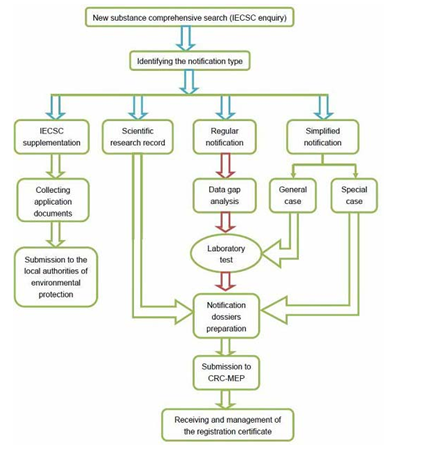
Notification Procedure of NCSN
Here is a detailed description on the three notification types.
Scientific Research Record
Scientific Research Record has the simplest demand in all the three notification types. To apply for a scientific research record, your substance should be manufactured/imported/exported:
for the purpose of scientific research and development (R&D), or
in very low quantities (<0.1 tonne per annum), or
as samples used for a compulsory eco-tox test that must be performed in a verified Chinese laboratory (which is also viewed as the prerequisite to the regular notification for imported new substances).
Simplified Notification
Simplified Notification is required for tonnage quantities<1 tonne per annum. There are four special cases of Simplified Notification for which substances have less registration requirements than the general case of simplified notification.
General Case
Manufactured/imported in quantities < 1 tonne per annum.
Special Case
Intermediates or for the sole purpose of exporting from China in quantities < 1 tonne per annum;
Polymer of low concern (LCPs) with low monomer concentration (< 2% w/w);
For R&D purposes: 0.1 – 1 tonne (not included) per annum;
For purposes of product research or process technology:<10 tonnes per annum over a 2-year period.
Regular Notification
The general case of Regular Notification applies to tonnage quantities > 1 tonnes per annum. There are four tonnage bands for NCSN:
Band 1: 1-10 tonnes per annum
Band 2: 10-100 tonnes per annum
Band 3: 100-1000 tonnes per annum
Band 4: 1000+ tonnes per annum
In the case of a regular notification, dossiers need to be submitted to the Chemical Registration Centre (CRC) of the MEP for processing. The dossier is first checked for technical completeness, next evaluated by the NCSN evaluation committee and finally submitted to MEP for approval. The notification dossier documents are required to be in Chinese with notarised translations for non-Chinese languages.
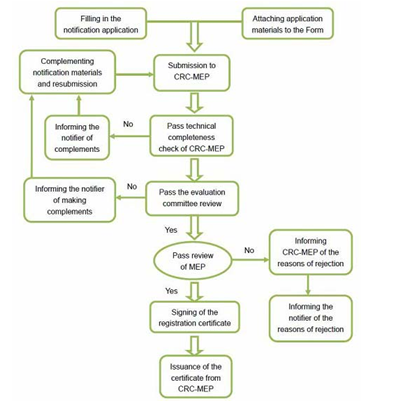
Approval Procedure of NCSN
Stakeholders Involved in the Implementation of China NCSN
China New Chemical Substance Notification involves a number of national and local enforcement authorities as well as other interested stakeholders, including the Ministry of Environmental Protection (MEP), the Chemical Registration Centre of MEP (CRC-MEP), local authorities of environmental protection at province/city/county level (local authorities), and etc.
MEP: responsible for the supervision and comprehensive inspection of NCSN registration work; also responsible to issue notices of supervision and inspection to local authorities of environmental protection at the province level;
CRC-MEP: responsible for reception and processing of NCSN dossiers and all kinds of application materials; also responsible for the issuance and cancellation of the NCSN registration certificate;
Evaluation Committee: responsible for the scientific reviewing and evaluation of NCSN dossiers (mainly regular notification);
Local authorities: responsible for the supervision and inspection the NCSN registration within each own administrative regions; among which local authorities at the city/county level shall be responsible for the confirmation check on registration certificates and the tracking control check of the registered substances.
Testing organizations: responsible for carrying out verified physic-chemical, toxicological, eco-toxicological tests required of NCSN;
NCSN notifiers: new substance manufacturers or importers in China;
NCSN representative agents: the Chinese representative agents appointed by a new substance exporter outside Chinese mainland.
In addition to the above mentioned interested parties, the social public has the right to report on or file charges against any acts that violate regulations on NCSN.
Data Requirements for China NCSN
China NCSN adopts a principle of "the larger notified quantifies, the higher test data requirement". One complete NCSN regular notification dossier consists of the following parts:
New substance regular notification application form;
The report on the safety rules for classification, precautionary labelling and precautionary statements of the new substance;
Material Safety Data Sheet of the new substance;
The chemical risk assessment report;
Test reports of the physic-chemical/toxicological/eco-toxicological data, including evaluation of the test report and the report summary;
Credentials of the testing laboratory.
Physico-chemical testing data (irrespective of tonnage):
Physical State (at 20°Cand 101.3 kPa) | Minimum Data Requirements |
Gas | oxidizing properties, self-ignition temperature (°C), explosive limit and critical point |
Liquid | Boiling point (°C), density (kg/m3), vapour pressure (kPa, °C), partition coefficient n-octanol/water (Log Pow), water solubility (g/L), surface tension1 (N/m), pH value, flash-point (°C), oxidizing properties, self-ignition temperature (°C), flammability and explosive properties. |
Solid | Melting point (°C), density (kg/m3), partition coefficient n-octanol/water (Log Pow), water solubility (g/L), granulometry (μm), oxidizing properties, self-ignition temperature (°C), Flammability and explosive properties. |
Others | According to the above data requirements of the three physical states of matter, the notifier should provide all the applicable testing data. For a chemical substance near its critical point, the details of the stability and degradation properties within an organic solvent shall be provided. If applicable, the critical temperature should also be calculated |
Toxicological testing data (based on the specific tonnage band):
Minimum data requirements | Band 1 1≤Q | Band 2 10≤q | Band 3 100≤q | Band 4 Q≥1000t/a |
Acute toxicity | √ | √ | √ | √ |
28-day repeated dose toxicity | √ | √ | √ | √ |
Mutagenicity | √ | √ | √ | √ |
90-day repeated dose toxicity |
| √ | √ | √ |
Reproductive/developmental toxicokinetics |
| √ | √ | √ |
Toxicokinetics |
| √ | √ | √ |
Chronic toxicity |
|
|
| √ |
Carcinogenicity |
|
|
| √ |
Others |
|
|
|
|
Note: 'Q' standards for the notified quantities. | ||||
Eco-toxicological testing data (based on the specific tonnage band):
Minimum data requirements | Band 1 1≤Q | Band 2 10≤q | Band 3 100≤q | Band 4 Q≥1000t/a |
Algae growth inhibition study | √ | √ | √ | √ |
Acute toxicity testing on Daphnia magna | √ | √ | √ | √ |
Fish, Acute toxicity testing | √ | √ | √ | √ |
Activated sludge respiration inhibition testing | √ | √ | √ | √ |
Adsorption/desorption | √ | √ | √ | √ |
Degradation | √ | √ | √ | √ |
Earthworm, Acute toxicity testing | √ | √ | √ | √ |
Fish, Prolonged toxicity testing (14-day study) |
| √ |
|
|
Daphnia magna reproductive testing |
| √ | √ | √ |
Bioaccumulation |
| √ | √ | √ |
Fish, Chronic toxicity testing |
|
| √ | √ |
Seed Germination & Root Elongation Toxicity Test |
|
| √ | √ |
Note: 'Q' standards for the notified quantities. | ||||
Post-Notification Duties of NCSN Notifiers
NCSN adopts different management requirements for different categories of new substances. New chemical substances registered for Regular Notification will be divided in three categories following the expert panel's evaluation. They are respectively 'the general chemical substance', 'hazardous chemical substance' and 'hazardous chemical substance of high environmental concern'.
If you have submitted a Scientific Research Record Notification (SRRN), you should
Exercise the management of the registered substance by using the specialized facilities and under the guidance of professional personnel;
Apply the regulations on dangerous waste when disposing of the new substances under SRRN.
If you have submitted a Simplified Notification (SN), you should perform a yearly checkup to
Notify your next year's plan of the registered substance;
Keep relevant documentation materials over 10 years.
If you have submitted a Regular Notification, you should:
In the case of a General chemical substance (general category):
Identify the hazard information in the MSDS of the substance and communicate it to its processers and downstream users;
Exercise risk control measures indicated in the registration certificate;
Inform competent authorities of its first-time activity report;
Keep relevant documentation materials over 10 years;
Avoid transferring or selling in any way your registered substance to a third processing or using unit who is unable to take effective risk control measures (Article 33);
Informing competent authorities about the newly arising hazard or risk information of the registered substance.
In the case of a Hazardous chemical substance (hazard category), besides the above 6 requirements in 'general category':Report to competent authorities the activities of the registered substance over the past year;
Comply with the State Council Decree No. 591 and other related laws, which is also applicable to the substance processors and downstream users.
In the case of a Hazardous chemical substance of high environmental concern (environmental priority category), besides the above 8 requirements provided in 'hazardous category':Have a good mastery on the releasing activity of the substance to its environmental media and perform transference or disposal activities for the substance;
Report to competent authorities the flowing chart of the registered substance;
Report to competent authorities your next year's plan of the registered substance.
Listing of IECSC
Notifiers who have completed regular notifications and received the registration certificates should notice several timelines concerned with their substances listing into IECSC.
A new general substance registered under Regular Notification will be listed into the IECSC in 5 or above years since the first date of its manufacturing or import. For example, Manufacture A receives on June 2011 the registration certificate of a new general substance which was first manufactured on 1 July 2011, so his substance will be automatically listed into IECSC on 1 July 2016.
A new hazardous substance or substance with high environmental concern registered under Regular Notification is required to report CRC-MEP its actual activity submitted by the registration certificate holder within not less than 6 months before the end of the 5th year as of its first date of manufacturing or import. After that, a review evaluation on the substance hazard information will be conducted at the NCSN evaluation committee. At last, it is up to the MEP to incorporate the substance into IECSC based on the result agreed at the evaluation committee. For example, Importer B receives the registration certificate of a new hazardous substance on May 2011 and the certificate indicates his first-time importing begins on 1 December 2011, so he shall submit an actual activity report for the substance to CRC-MEP on not later than 1 June 2016. With all conclusions reached at an agreement, the MEP will soon publish this update of the IECSC list.
However, new substances in a simplified notification or scientific research record notification do not require listing into IECSC.
Accredited Testing Organizations under China NCSN
Although the new chemical substance notification recognizes data from both Chinese and non-Chinese testing organizations, Article 10 (3) of MEP order No. 7stresses that an eco-toxicological test report for NCSN regular type must include data using Chinese treated species and the experiment must be conducted in China (mainland).
A none-Chinese laboratory has to pass the inspection of the country where it is based or follow the GLP standards of United Nations. Chinese laboratories have more specific requirements shown as below.
Testing organizations available for physic-chemical data should qualify for either of the following credentials:
A China National Accreditation Service for Conformity Assessment (CNAS) certificate; or
A national China Metrology Accreditation (CMA) certificate; or
Passing the pesticides GLP evaluation of China's Ministry of Agriculture (6 units in China by May 2010).
Testing organizations available for toxicological data should qualify for either of the following credentials:
A pharmaceutical nonclinical study GLP certificate issued by SFDA (42 units in total in China by May 2010); or
Meeting the laboratory conditions and work standards for toxicity identification issued by China's Ministry of Health; or
Passing the GLP evaluation of the Certification and Accreditation Administration of China (only 1 unit in China by May 2010).
Testing organizations available for eco-toxicological data are seen as published in the MEP website.
Until today (by October 2011), China MEP has openly announced 2 testing institutions as qualified to issue competent eco-toxicological test data for NCSN. See MEP Announcement No. 78 of 2010
Year of approval | Name of Accredited Testing Organization | Available test type |
2010 | Shanghai Research Institute of Chemical Industry Testing Center | eco-toxicological test for simplified notification under NCSN |
2010 | Guizhou Research Center of Physical Test and Chemical Analysis | eco-toxicological test for simplified notification and regular notification (Band 1) under NCSN |
In addition, China MEP in its announcement No. 14 of 2009 approved 7 testing organizations to provide eco-toxicological test for the 2003 version of Measures on Environmental Management of New Chemical Substances. They are located respectively in Shanghai (2), Beijing (1), Nanjing (1), Hangzhou (1), Shenyang (1) and Guangdong (1).
Altogether 9 testing organizations have been accredited by the nation to carry out the required eco-toxicological test for China's new chemical substance notification.
Supporting Technical Documents and Guidance for China NCSN
In order to implement China NCSN, MEP has published 6 supporting documents and 2 technical guidance papers. Recently two more guidelines on the risk assessment and hazard identification of new chemical substances are released for public or inter-ministry consultation. Measures for the classification, registered marking/labeling and hazard evaluation under new chemical substance notification shall be referred to the GB and HJ/T standards listed as follows.
Supporting documents on the implementation of NCSN:
Standard rules for the supervision and inspection of new chemical substance management
New chemicals regular notification application form and guidance
New chemicals simplified notification application form and guidance
New chemicals scientific research record application form and guidance
Technical requirements on the marking information of new chemical substance notification (Interim) (published on 22 July 2011)
Guidelines for the generic name of new chemical substances (HJ/T420-2008) (in effect since 1 April 2008)
Technical supporting standards:
Guidelines for Risk Assessment of Chemicals (draft proposal published on October 2011)
Guidelines for Hazard Identification of New Chemical Substances (draft proposal published on October 2011)
The guidelines for the hazard evaluation of new chemical substances((HJ/T 154-2004)
The guidelines of chemical testing good laboratory practices (HJ/T155-2004)
The guidance for the testing of chemicals (HJ/T 153-2004)