Request a Demo
South Korea’s Ministry of Employment and Labor (MoEL) recently released training materials created in 17 different languages for the Material Safety Data Sheet (MSDS) and GHS label, in order to ensure that foreign workers are fully aware of the hazards and risks associated with chemical substances. Languages include Filipino (English), Chinese, Thai, Indonesian, Myanmar, Nepali, Vietnamese, Mongolian, Cambodian, East Timorese, Lao, Bengali, Sri Lankan, Uzbek, Kyrgyz, Pakistani, Tajik. These multilingual training materials are all downloadable.
According to Korean Occupational Safety and Health Act (K-OSHA), companies must strictly adhere to the MoEL Notice No. 2023-9 when creating the Korean version of the MSDS. Companies must accurately present product hazard information in compliance with Korean regulations, including pictograms, signal words, hazard descriptions, and precautionary measures, ensuring that the warning labels are consistent with the MSDS. Article 114 of the Korean OSHA also requires employers to provide MSDS training to the workers who handle target substances. For companies targeting the Korean market, timely updates to the MSDS and GHS labels are crucial for ensuring that foreign workers understand and follow safety regulations, ultimately minimizing legal risks and safety incidents.
As defined in the training material:
MSDS is the explanatory sheet to assist safe handling of chemicals, comprised of 16 sections, including hazard identification of substances, first aid measures and handling and storage.
GHS label is a system that includes the product identifier, hazard pictograms, signal words, hazard statements, precautionary statements and supplier identification to the container and package of chemicals based on the description in paragraph 1 and paragraph 2 of the MSDS.
GHS label is easier for workers to verify the hazard identification and precautions for handling succinctly and promptly. Therefore, the MoEL prepared these training materials in 17 different languages to describe the sections constituting GHS label, and how to understand them. This initiative aims to help companies comply with GHS standards and enhance overall workplace safety and reduce accidents caused by improper chemical use.
Workers must recognize hazards indicated by the pictograms and signal words on the GHS label, understand substance properties through hazard statements (H codes), and follow handling and storage precautions from the precautionary statements (P codes). For any inquiries about the MSDS and GHS label, please contact the supplier.
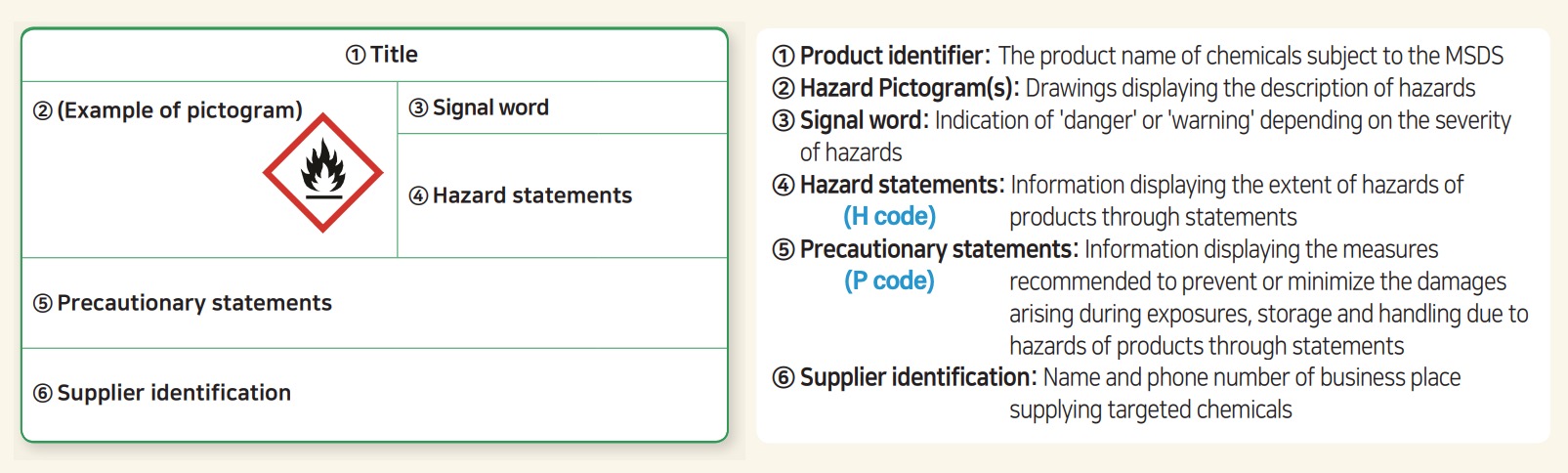 Screenshot 1 of the training material in English
Pictograms are the simplest way to identify hazards associated with substances. Each pictogram corresponds to a specific hazard, allowing workers to easily recognize risks by referring to them. The adopted pictograms and applicable hazards are shown in the figure below.
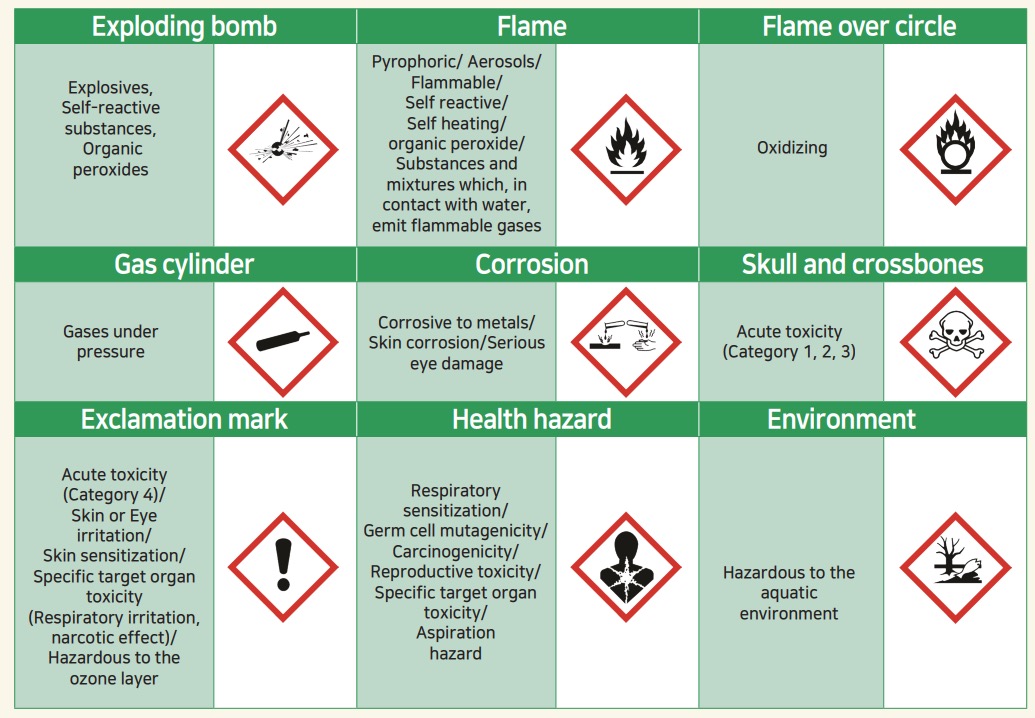 Screenshot 2 of the training material in English
These multilingual training materials can be downloaded here.