Request a Demo
1. Introduction
The Act on Registration, Evaluation and etc. of Chemicals (a.k.a “K-REACH”) has been revised and will come into effect on 1 Jan 2019. The revised K-REACH legislation sets out a plan of registering existing substances over 1 ton per year in the next 12 years. It is anticipated that approximately 7,000 existing chemicals will be registered considering their circulation amount in South Korea.
It should be noted that pre-registration before 30 Jun 2019 is necessary to be eligible for the phase-in registration grace period. In addition, it will streamline mandatory joint registration of identical substances. The corresponding deadline for phased-in registration are set as below.
>1000 t/y; or designated CMRs (364 substances) above 1 t/y: by 2021
100-1000 t/y: by 2024
10-100 t/y: by 2027
1-10 t/y: by 2030
2. Applicable Scope for K-REACH Pre-registration
Relevant stakeholders should first complete an inventory check against the Korean Existing Chemicals Inventory (KECI) to confirm whether the substance is listed in the KECI as an existing chemical substance. All existing chemical substances manufactured or imported at ≥ 1 ton per year are subject to pre-registration before 30 Jun 2019. The manufacture/import volume can be determined based on the records in year 2016 to 2018.
Online searching website of KECI: http://ncis.nier.go.kr/en/main.do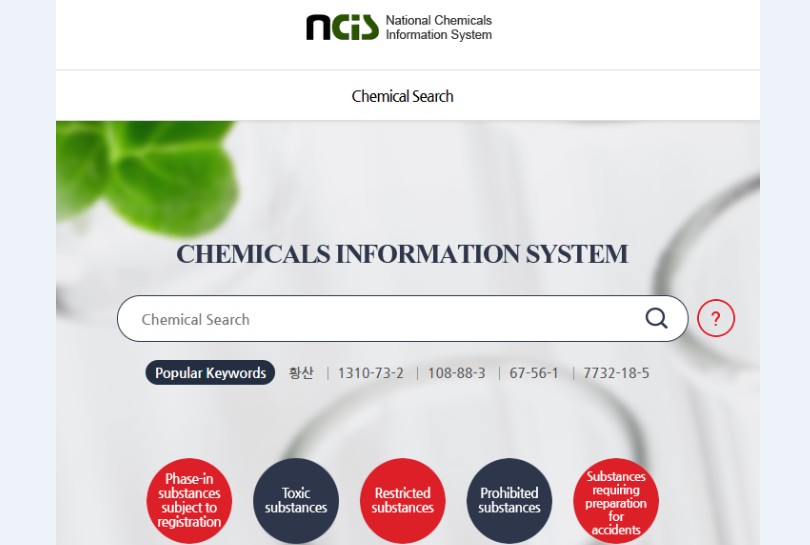 Exemptions for pre-registration
Pre-registration before 30 Jun 2019 is necessary to be eligible for the phase-in registration grace period. However, under some conditions the chemical substances can be directly or indirectly exempt from registration, which means there is no need to do pre-registration as well.
| Exemption conditions | Details |
| Substances controlled by other regulations, which are not subject to K-REACH management |
|
| Direct exemption without any application |
|
| Substances published by MOE after deliberation of the chemical evaluation committee as of low hazard, subject to direct exemption | The substances have been issued (see ChemLinked news) |
| Indirect exemption needing application for registration exemption confirmation |
|
| Priority existing chemicals | 510 PECs have been published on 1 Jul 2015 and are subject to joint registration before 30 June 2018. |
Considering the slow progress in the joint registration of PECs, some substances cannot complete registration work on schedule. Only 340 substances have completed registration on time (updated in Sep, see ChemLinked news), which means the others will be subject to a ban preventing all manufacturing and importing until the registration is completed. However, in fact more than 100 PECs had no manufacture/importation records in recent years or the volume is less than 1 t/y thus there is no one to do registration. Even if these substances are later to be manufactured/imported ≥1 t/y, they are not eligible to do pre-registration to get a grace period for full registration. They should be registered without any delay.
3. Who is affected and When
Who is affected?
Korean importers or manufacturers are obliged to complete pre-registration. Foreign manufacturers may appoint an Only Representative (OR) to fulfill it.
Pre-registration Duration:
The pre-registration is from 1 Jan to 30 June 2019. Failure to comply will result in a substance being banned from manufacturing or importing from 1 July 2019.
However, late pre-registration may apply for the following situations.
Late pre-registration eligibility criteria:
Existing chemical substances manufactured or imported > 1t/y for the first time after 30 June 2019 while no manufacture or importation activities occurred before.
Existing chemical substances manufactured or imported > 1t/y for the first time after 30 June and previous manufacture or importation activities < 1t/y
4. System
Pre-registration will take place through an online system (https://kreachportal.me.go.kr/potweb/main.do) to the Korea Environment Corporation (KECO).
5. Submission Requirements
Materials required:
Basic information of manufacturers/importers/OR
Substance information
Annual production/import volume
Classification and label
Usage information (Usage classified according to Korean use category, at present 55 categories)
In cases of modification of volume (manufacture or import), declaration should be made in advance to update the pre-registration. In addition, declaration should be made within a month if there is any change of:
Classification and label
Uses
6. Advice
It is recommended to establish a comprehensive tracking system for handling chemicals in South Korea. For companies planning to register phase-in (existing) substances, an internal inventory listing all relevant substances handled in South Korea should be made. Their manufacture/importation volume in the past three years should be recorded to determine whether the substances are subject to registration. If the estimated volume in 2019 is at or above 1 ton per year, it should be noted that only chemicals that are pre-registered before 30 Jun 2019 can have a grace period to manufacture/import chemicals before the corresponding registration deadline. If a company does not do this the substances will be banned from manufacturing or importing from 1 July 2019.
The exemption situations specified above should be paid attention to. For the direct exemption situations, substances are automatically exempt from registration without any application. However, for the indirect exemption situations, registration exemption confirmation should be obtained from the KECO in advance. For the 510 PECs, they are not eligible for pre-registration. No grace period can apply to the PECs and registration is the premise of manufacture or importation.