

 Request a Demo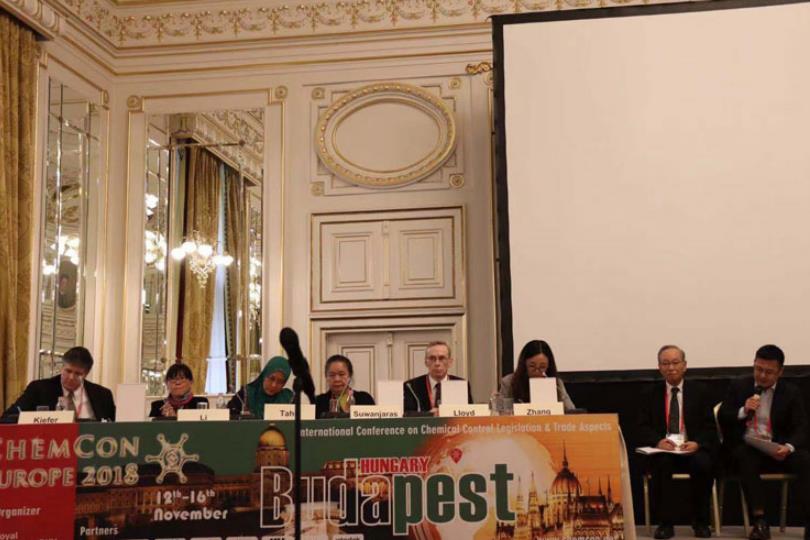
The revised K-REACH will come into force on Jan 1st, 2019. During ChemCon Europe 2018 (Nov 12th to Nov 16th) held in Budapest, Jonghee Koh from The Korea Ministry of Environment underscored two important updates to be promulgated in Dec. Ms. Koh also offered official details on K-REACH current status and its amendments.
The two important enactments before K-REACH implementation are:
Substance of very low risk in Dec, 2018
Subordinate laws/ME public notice in Dec, 2018
Substance of very low risk could be exempted from registration (drafted list downloadable in CL News: Low Hazard Chemicals Proposed for Exemption of Registration and Notification under Korea REACH). Exemptions from K-REACH include:
(Exemption without specific procedure)
Chemical substance imported as a part of machinery
Chemical substance imported along with machinery or equipment for test-run
Chemical substance contained in product in solid state of certain shape that is not released during its use (include article)
Chemical substance of very low risk designated by the Minister of Environment (come into force on Jan 1st, 2019.)
(Exemption by completing exemption confirmation)
Chemical substance manufactured/imported for export only (come into force on Jan 1st, 2019)
Chemical substance for scientific test, chemical/scientific analysis, R&D purpose
Some of polymers to meet exemption criteria
Non-isolated intermediate, or on-site isolated intermediate that its release or exposure is blocked with technical means (come into force on Jan 1st, 2019)
Subordinate laws/ME public notice which will be promulgated in Dec, 2018 could be referenced to preview CL News:
South Korea Outlines Proposed Revisions to K-REACH Support Regulations
Korea Consults on 1195 Substances subject to Priority Management under K-REACH
Korea Consults on 544 CMRs Requiring Registration Before 2021
K-REACH Legislation Further Amended: Law No. 15844
The important systematic amendment in the coming K-REACH is pre-registration /notification for all existing chemicals over 1 ton/y. The already manufactured/imported existing substance should complete pre-registration by Jun 30th, 2019, while the newly manufactured/imported existing substance should complete pre-registration prior to manufacture or import of the substance. (CL Expert Article: K-REACH Pre-registration: Concise Overview of Critical Checkpoints)
Another major amendment in K-REACH is that registration is not required based on manufacturing/importing volume of each company. Authorities may require registration depending on its hazard and risk by designating it as substance subject to registration.
| Registration Criteria (per manufacturer/importer) | Criteria for possible registration (total volume M/I nationwide) |
Existing Substance | ≥1ton/y | Exceeding total 10 ton/y |
New Substance | ≥0.1ton/y | Exceeding total 1 ton/y |
Chemlinked Qs answered by Ms. Jonghee KOH and Ms. Jean Cho from Chemtopia, the chair in the Korea session in ChemCon Budapest:
Q: We all know the threshold for pre-registration is 1 ton/y. In the case of designated substance subject to registration measured in a volume on a nationwide basis, what if the involved entity is not required to do the pre-registration before, do they have the same grace period as those who complete it?
A: According to K-REACH, even though a substance is not subject to registration (i.e. existing chemicals less than 1ton/year or new chemicals less than 100kg/year), if the substance is later considered as hazardous in human health and environment, such substance will be designated as subject to registration and its required data to submit and its registration period also will be notified when the list of substance will be published. Therefore, you don't need to do pre-notification for them, since its individual volume does not exceed 1 ton/year for existing chemical, and also grace period of registration will not be given to them.
Q: Will the list be published along with other notice and subordinate laws this Dec?
A: No, because the implementation date of K-REACH is very close, and the evaluation and assessment of the substance will take a long time, it will not be published this year. The publication date is still uncertain.
Entities benefit from completing the pre-registration not only for obtaining a grace period, but also finding potential registrants in the SIEF-like platform and operate the joint registration during the designated period. So for the small amount substances subject to registration without pre-registration, ChemLinked has a concern whether there is enough time and a certain way to contact with other intended entities to do a joint registration. If the required registration data aligns with current requirements, the burden is relatively big for single entity and will certainly push entities seeking the joint registration for a cost& information share.
The English version of K-REACH translated by ChemLinked is under final review and will be released at the end of Nov, please stay tuned.




