

 Request a Demo
On February 9, 2021, Chile implemented GHS into its national law under Decree 57/2019 Regulations on Classification, Labeling, and Notification of Hazardous Substances and Mixtures (hereinafter referred to as Decree 57). This Regulation adopts GHS Rev.7 with the following transitional period for implementation following its publication in the official journal:
| Industrial use | Non-industrial use | |
| Substances | February 9, 2022 | February 9, 2023 |
Substances contained in mixtures | February 9, 2025 | February 9, 2027 |
1. Classification
On August 21, 2021, the Ministry of Health published the Resolution No. 777/2021 Approving The Official List Of Classification Of Substances With Their Classes And Hazard Categories (hereinafter referred to as the List), which serves as the minimum reference for manufacturers and importers based in Chile to classify their products.
The referred list contains 4500 substances with their chemical names, CAS numbers, classes and hazard categories, as well as specific concentration limits and multiplying (M) factors. If the substances are not on the List, they should be classified in accordance with Title III of Decree 57.
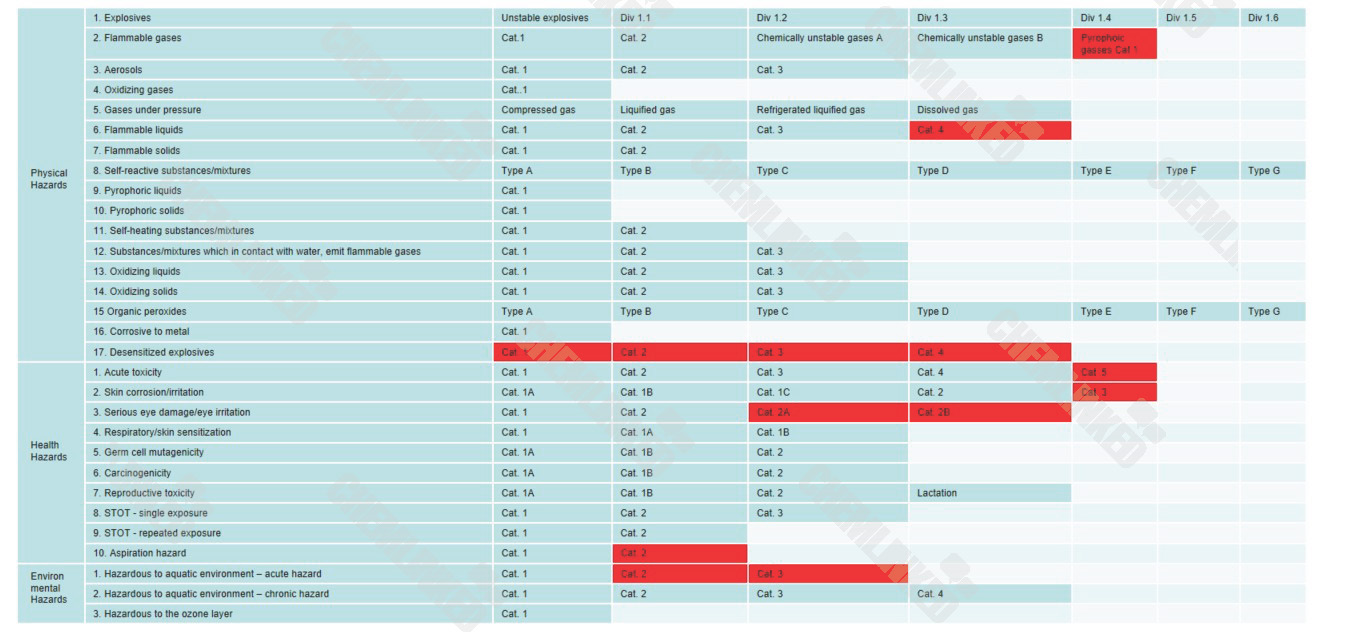
In general, the GHS building block adopted by Chile has basically adhered to UN GHS Rev.7 as follows (The building blocks highlighted in red are not covered by Chile GHS ):
2. Labeling
2.1 Labeling Elements
Manufacturers, importers and/or packagers is responsible for labeling the packaging of containers containing substances and mixtures classified as hazardous. The safety label must be in Spanish and clearly and visibly include the elements mentioned below:
Product identifiers: For mixtures, include hazardous ingredients that contribute to the classification of acute toxicity, serious skin corrosion or eye damage, germ cell mutagenicity, carcinogenicity, reproductive toxicity, skin or respiratory sensitization, and specific target organ toxicity.
Hazard pictogram(s): If GHS06 is applied, then GHS07 shall not be displayed; if GHS05 is applied, then GHS07 for skin and eye irritation shall not appear; if GHS08 for respiratory sensitization is applied, then GHS07 for skin sensitization or skin and eye irritation shall not be displayed.
Signal word: Danger or Warning
Hazard statement: If H410 (very toxic to aquatic life with long lasting effects) is assigned, H400 (dangerous to the aquatic environment) may be omitted; if H314 (causes severe skin burns and eye damage) is assigned, H318 (causes serious eye damage) may be omitted.Appropriate precautionary advice;
Precautionary statement: Shall not exceed 6 unless additional requirements are made
Additional information: Include 24-hour emergency number of a poison control center in Chile for consumer products, and use instructions.
2.2 Labeling Size
The minimum label size for each container/package are specified below:
| Package size | Minimum label dimension (cm2) | Minimum pictogram size (cm) |
| <50 ml | Not applicable | 0.5×0.5 |
≧50 ml and<125 ml | Not applicable | 0.5×0.5 |
≧125ml and<250 ml | 25 | Not less than 1.0×1.0 |
≧250ml and<1L | 50 | Not less than 1.5×1.5 |
≧1L and<5L | 100 | Not less than 2×2 |
≧5L and<50L | 200 | Not less than 2.5×2.5 |
≧50L and<500L | 400 | Not less than 3.5×3.5 |
≧500L | 600 | Not less than 6×6 |
3. Safety Data Sheet (SDS)
The supplier of a substance or mixture classified as hazardous must provide its recipient with a safety data sheet. For consumer products intended for the general public, the supplier must also provide SDS to the Toxicology Centre indicated on the label.
3.1 Cut-off Limits
For mixtures, hazardous ingredients that are present above the following thresholds shall be stated on SDS:
| Hazard class | Cut-off value |
Acute toxicity | ≧1.0% |
Skin corrosion or irritation | ≧1.0% |
Serious eye damage/eye irritation | ≧1.0% |
Respiratory/skin sensitization | ≧0.1% |
Germ cell mutagenicity (Cat 1) | ≧0.1% |
Germ cell mutagenicity (Cat 2) | ≧1.0% |
Carcinogenicity | ≧0.1% |
Reproductive toxicity | ≧0.1% |
Specific target organ toxicity - single exposure | ≧1.0% |
Specific target organ toxicity - repeated exposure | ≧1.0% |
Aspiration hazard (Cat 1) | ≧1.0% |
| Aspiration hazard (Cat 2) | ≧1.0% |
Hazardous to aquatic environment | ≧1.0% |
3.2 SDS content
The SDS shall be compiled in Spanish and must include the following 16 headings consistent with UN GHS requirements:
identification of the substance or mixture and of the company or undertaking
identification of the hazard or hazards;
composition/information on ingredients;
first aid;
fire fighting measures;
measures to be taken in the event of accidental spill/release;
handling and storage;
exposure controls/personal protection;
physical and chemical properties;
stability and reactivity;
toxicological information;
ecotoxicological information;
Information relating to the disposal of the substance or mixture;
information relating to transport;
information on regulations; and
other information.
Suppliers must update the SDS within a period of no more than 6 months when there is new information on hazard classification or a new restriction or prohibition is imposed in national regulation. In Section 3 of SDS, product identifier of impurities and additives shall be listed such as CAS number.
4. Confidential Business Information (CBI)
In the event that the hazardous ingredients are regarded as confidential business information (CBI), as established in Law No. 19039 Establishes Rules Applicable To Industrial Privileges And Protection Of Industrial Property Rights, the supplier shall not be obliged to report the said substance on the label/SDS but need to report the hazards related to the substance, in order to protect the health and safety of workers or consumers, and the protection of the environment.
