

 Request a Demo
(Last updated on April 23, 2025)
China RoHS Legal Framework
China first introduced the RoHS-like regulation in 2006 titled “Administrative Measures on the Control of Pollution Caused by Electronic Information Products”.
The regulation was revised and promulgated on Jan 6, 2016 with a new title “Administrative Measures on the Restriction of the Use of Certain Hazardous Substances in Electrical and Electronic Products” (a.k.a. China RoHS 2) .
#English Translations
China RoHS 2: Administrative Measures on the Restriction of the Use of Certain Hazardous Substances in Electrical and Electronic Products (2016 Finalized Version)The Measures was issued by Ministry of Industry and Information Technology (MIIT), National Development and Reform Commission (NDRC), Ministry of Science and Technology (MOST), Ministry of Finance (MOF), Ministry of Environmental Protection (MEP), Ministry of Commerce (MOFCOM), General Administration of Customs (GAC) and General Administration of Quality Supervision, Inspection and Quarantine (AQSIQ) as Joint Order No.32 and scheduled to enter into force on Jul 1, 2016 to replace former MII etc. Joint Order 39. (Read CL news)China RoHS 2 FAQs was published by MIIT on May 16, 2016. Download the English translation here.Applicable Products
According to China RoHS 2, the regulated product types have been expanded from electronic information products (EIPs) to all electrical and electronic products (EEPs) manufactured in or imported to China. EEPs refer to devices and accessories with a nominal working voltage under 1500 V DC, or 1000 V AC, including all the EIPs listed in MIIT’s Clarification on Electronic Information Product Categories. Accessories are subassemblies/spare parts, components and materials of EEPs.

Fig. 1 - China RoHS 2 Decision Tree
Exemption
1. Equipment for power generation, transmission and distribution
2. EEPs for military use
3. EEPs for use in special or extreme environment
4. EEPs for export solely (Note: EEPs for export only shall comply with provisions concerning the restriction of the use of certain hazardous substances in export country/ region)
5. Temporarily imported EEPs or EEPs inbound for maintenance not for sale
6. Prototypes used for scientific research, R&D or testing
7. Samples, exhibits and so on used for exhibition not for sale
The Scope of Enforcement
On May 28, 2026, the Ministry of Industry and Information Technology (MIIT) officially released Qualification Management Catalogue (2026 Version) and the Application Exemption List (2026 Version) for the restriction of hazardous substances in electrical and electronic products, replacing the original 2018 Qualification Management Catalogue (first batch) and Exemption List.
#English Translations
Qualification Management Catalogue for the Restriction of Hazardous Substances in Electrical and Electronic Products (2026 Version)China's Ministry of Industry and Information Technology (MIIT) released the Qualification Management Catalogue (2026 Version) for China RoHS. The update expands the regulated product scope by introducing 23 categories of products (marked in red). The original 12 products have been optimized and consolidated into 10 (e.g., printers, copiers, and fax machines are merged into one category)
#English Translations
Application Exemption List for the Restricted Substances under the Qualification Management Catalogue (2026 Version)China's Ministry of Industry and Information Technology (MIIT) released the Application Exemption List (2026 Version) for China RoHS. The update mainly deletes certain clauses for mercury exemptions conflict with Minamata Convention and supplements new clauses aligning with the latest EU RoHS Directive (EU) 2024/1416.The 2026 edition of the Qualification Management Catalogue significantly expands the scope of regulated products by introducing 23 categories of products, covering 33 types of EEPs subject to mandatory conformity assessment and substance restrictions.
The Exemption List specifies technical applications that are exempt from the substance limits.
The 2026 Qualificatoin Management Catalogue and Exemption List will take effect immediately from the date of publication for products already in the old catalogue (first batch). Newly added product categories will be granted a transition period and are scheduled to be implemented starting August 1, 2027.
RoHS Standards
Over the years, China RoHS standard is evolving from a voluntary, recommendation-based framework to a single, mandatory, and comprehensive regulation that aligns with international standards like EU RoHS. Here is a breakdown of the three main phases:
Phase 1: The Foundational (but Voluntary) Framework
Key Standard: GB/T 26572-2011 Requirements of Concentration Limits for Certain Restricted Substances in Electrical and Electronic Products.

#English Translations
GB/T 26572-2011 Requirements of concentration limits for certain restricted substances in electrical and electronic products (Consolidated version)On June 29, 2024, China's State Administration of Market Regulation (SAMR) officially approved the First Amendment of RoHS standard, namely GB/T 26572- 2011 Requirements of Concentration Limits for Certain Restricted Substances in Electrical and Electronic Products. The new phthalates restriction is set to take effect from January 1, 2026.What it did: This standard sets the maximum concentration limits for the first six hazardous substances (Lead, Mercury, Cadmium, Hexavalent Chromium, PBBs, and PBDEs).
Supporting Standard: This was paired with SJ/T 11364-2014, which specified the labeling requirements for products.
The "/T" in the standard's name signifies that it is a recommended (voluntary) standard, not a legally mandatory one. Despite the China RoHS 2 mandates that the EEPs included under the Catalogue must comply with the concentration limits, in practice, compliance was driven more by industry practice and supply chain pressure without strong legal enforcement.
Phase 2: The Transitional Upgrade (Aligning with EU)
Key Change: Amendment No. 1 to GB/T 26572-2011
What it did: This amendment adds four new substances—all phthalates (DBP, BBP, DEHP, DIBP)—to the restricted list, bringing the total to ten. This aligns China's substance list with the EU's RoHS directive.
Effective Date: January 1, 2026.
While it still amends the voluntary standard, it signals a clear move toward international alignment and gives companies a firm deadline to prepare for the 10-substance restriction.
Phase 3: The Final Mandatory Standard
Key Standard: GB 26572-2025 - Requirements for Restricted Use of Hazardous Substances in Electrical and Electronic Products.
#English Translations
GB 26572-2025 Requirements For Restricted Use Of Hazardous Substances In Electrical And Electronic ProductsOn August 1, 2025, the State Administration for Market Regulation (SAMR) and Standardization Administration of China officially approved and released China's first mandatory national RoHS Standard GB 26572-2025, titled "Requirements for Restricted Use of Hazardous Substances in Electrical and Electronic Products".It's Mandatory: The "/T" is dropped, making it a "GB" standard, which is legally binding and enforceable for all EEPs produced, sold, or imported in China.
It's Unified: It replaces and integrates the old limit standard (GB/T 26572-2011 and its amendment) and the labeling standard (SJ/T 11364) into a single, comprehensive document.
It's Comprehensive: It officially codifies the 10 restricted substances, refines product classification, and introduces updated labeling rules, such as allowing for QR codes.
Effective Date: August 1, 2027.
From August 1, 2027, all companies must comply with one single, mandatory standard for both substance limits and labeling.
RoHS Limits
Table 2 - Restriction Limits for Hazardous Substances in EEPs
| Restricted Substances | Concentration Limit |
| Lead (Pb) | ≤ 0.1% |
| Mercury (Hg) | ≤ 0.1% |
| Hexavalent chromium [Cr(VI)] | ≤ 0.1% |
| Polybrominated biphenyls(PBB) | ≤ 0.1% |
| Polybrominated diphenyl Ethers (PBDE) | ≤ 0.1% |
| Cadmium (Cd) | ≤ 0.01% |
Diisobutyl phthalates (DIBP) | ≤ 0.1% |
Dibutyl phthalate (DBP) | ≤ 0.1% |
Benzyl butyl phthalate (BBP) | ≤ 0.1% |
Bis(2-ethylhexyl) phthalate (DEHP) | ≤ 0.1% |
RoHS Marking
Manufacturers or importers of EEPs must label information regarding hazardous substance content in their products. There are two primary marking methods:
Marking I: Used when the hazardous substance content in the product complies with the restriction limits. This mark indicates that the product's hazardous substance content meets the standard.
- Marking II: Used when the hazardous substance content in the product does not comply with the restriction limits. This mark must include the environmental friendly use period (EFUP) of the product and cannot be green. If a specific material or component in the product falls under an exemption but its hazardous substance content still does not meet the requirements, this mark should also be used. (The determination of EFUP can be determined in reference with SJ/Z 11388-2009).
 Fig 2 - Marking I
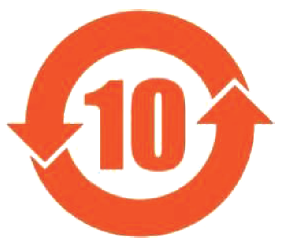 Fig 3 - Marking II
Furthermore, for products marked with Marking II, manufacturers or importers must provide a hazardous substance content information table, detailing the hazardous substance content in each component of the product. This table must clearly indicate which hazardous substances exceed the standard requirements in which components.
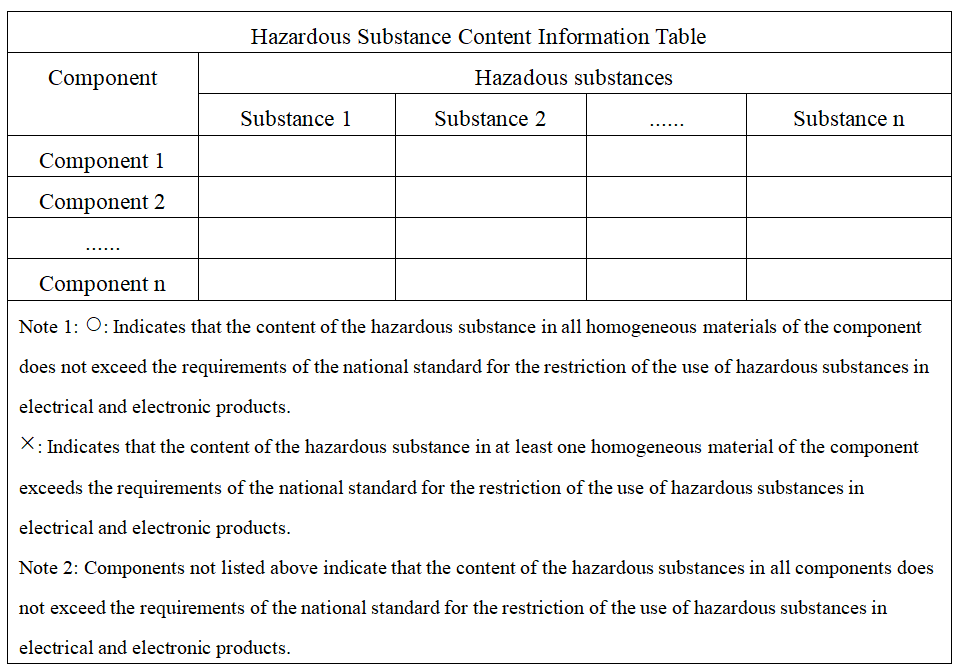 Fig 4 - Hazardous Substance Content Information Table
RoHS Testing
According to the China's National Certification and Accreditation Administration, starting from March 1, 2024, the applicable testing methods for conformity assesment is changed from GB/T 26125-2011 to GB/T 39560 series. In case the products have been manufactured or imported before March 1, 2024, the new standards shall not apply.
The following is a summary of the existing RoHS standards in China.
Table 3 – China RoHS standards
Subject | Standard | Remark |
Restriction of certain hazardous substances | GB 26572-2025 Requirements for Restricted Use of Hazardous Substances in Electrical and Electronic Products |
|
Labeling | ||
Testing | GB/T 39560.1-2020 Determination of certainsubstances in electrical and electronic products—Part 1: Introduction and overview | GB/T 39560 series shall replace GB/T 26125-2011 as the applicable RoHS testing standards |
GB/T 39560.2-2024 Determination of certain substances in electrical and electronic products—Part 2: Disassembly, disjointment and mechanical sample preparation | ||
GB/T 39560.301-2020 Determination of certain substances in electrical and electronic products—Part 3-1: Screening lead, mercury, cadmium, total chromium and total bromine by X-ray fluorescence spectrometry | ||
GB/T 39560.302-2024 Determination of certain substances in electrical and electronic products—Part 3-2: Screening fluorine, chlorine and bromine in polymer and electronics by combustion-ion chromatography (C-IC) | ||
GB/T 39560.303-2024 Determination of certain substances in electrical and electronic products—Part 3-3:Screening polybrominated biphenyls, polybrominated diphenyl ethers and phthalates in polymers by gas chromatography-mass spectrometry using a pyrolyser/thermal desorption accessory (Py/TD-GC-MS) | ||
GB/T 39560.4-2021 Determination of certain substances in electrical and electronic products—Part 4: Mercury in polymers, metals and electronics by CV-AAS, CV-AFS, ICP-OES and ICP-MS | ||
GB/T 39560.5-2021 Determination of certain substances in electrical and electronic products—Part 5: Cadmium, lead and chromium in polymers and electronics and cadmium and lead in metals by AAS, AFS, ICP-OES and ICP-MS | ||
| GB/T 39560.6-2020 Determination of certain substances in electrical and electronic products—Part 6: Polybrominated biphenyls and polybrominated diphenyl ethers in polymers by gas chromatography-mass spectrometry (GC-MS) | ||
| GB/T 39560.701-2020 Determination of certain substances in electrical and electronic products—Part 7-1: Hexavalent chromium—Presence of hexavalent chromium [Cr(VI)] in colourless and coloured corrosion-protected coatings on metals by the colorimetric method | ||
| GB/T 39560.702-2021 Determination of certain substances in electrical and electronic products—Part 7-2: Hexavalent chrome—Determination of hexavalent chrome [Cr(VI)] in polymers and electronics by the colormetric method | ||
| GB/T 39560.8-2021 Determination of certain substances in electrical and electronic products—Part 8: Phthalates in polymers by gas chromatography-mass spectrometry (GC-MS), gas chromatography-mass spectrometry using a pyrolyzer/thermaldesorption accessory (Py/TD-GC-MS) | ||
| GB/T 39560.9-2024 Determination of certain substances in electrical and electronic products—Part 9: Hexabromocyclododecane in polymers by gas chromatography-mass spectrometry (GC-MS) | ||
| GB/T 39560.10-2024 Determination of certain substances in electrical and electronic products—Part 10:Polycyclic aromatic hydrocarbons (PAHs) in polymers and electronics by gas chromatography-mass spectrometry (GC-MS) | ||
| GB/T 39560.12-2024 Determination of certain substances in electrotechnical products—Part 12: Simultaneous determination of polybrominated biphenyls, polybrominated diphenyl ethers and phthalates in polymers by gas chromatography-mass spectrometry |
Conformity Assessment
On 16th May, 2019, China State Administration for Market Regulation (SAMR) and Ministry of Industry and Information Technology (MIIT) released China RoHS 2: Implementation Arrangements for Conformity Assessment System. Conformity assessment is only mandatory for EEPs listed under the Qualification Management Catalogue .
#English Translations
Implementation Arrangements for Conformity Assessment SystemOn 16th May, China State Administration for Market Regulation (SAMR) and Ministry of Industry and Information Technology (MIIT) released China RoHS 2: Implementation Arrangements for Conformity Assessment System. The Implementation Arrangements were formulated to strengthen the management of the Qualification Management Catalogue (First Batch) for China RoHS 2. China RoHS 2 normally refers to Administrative Measures on the Restriction of the Use of Certain Hazardous Substances in Electrical and Electronic Products, which was released on 1st July 2016. Following on from this a series of regulations have been formulated based on it. Products in the Catalogue that are manufactured and imported after 1st November 2019 shall meet the requirements of the Implementation Arrangement to complete conformity assessment.Two methods of conformity assessment are recognized in the Implementation Arrangements. The supplier (including producers, authorized representatives, etc.) can select the voluntary certification promoted by the state, or the compliance self-declaration to complete the conformity assessment of products in the Catalogue. For the voluntary certification, the enterprise should submit an application for conformity assessment to an official certification body established according to law. The whole process is implemented and standardized by the state. For the self-declaration, suppliers can autonomously adopt a reasonable way to complete the conformity assessment and then provide the government with corresponding technical support documents to get reviewed.
It is worth noting that the implementation arrangements do not mention that the products in the Exemption List are required to perform conformity assessments in this way.
Voluntary Certification
The certification scheme is applicable to the assembled equipment, subassemblies, component parts and materials though the certification models differ. The conformity assessment mark for products undergo voluntary certification is as Fig.5 showing.

Figure. 4 - Voluntary Certification Logo
Table 4 – Different certification models for different products
Certification Model | Sample testing | Initial factory inspection | Post-certification supervision | Applicable scope | ||
Sample delivery | Sampling inspection | Conformity declaration | ||||
Mode 1 | √ (Type testing) | √ | √ | Parts and componts, materials | ||
Mode 2 | √ | √ | √ | Parts and components | ||
Mode 3 | √ (Optimized testing) | √ | √ | Assembled equipment and subassemblies (Complex products) | ||
Mode 4 | √ | √ | √ | √ | All products subject to the certification | |
The requirements of concentration limits for certain restricted substances and the dismantling of electrical and electronic products are according to GB/T 26572. Tests are carried out in accordance with GB/T 39650 Series on determination of certain substances in electrical and electronic products. The supplier's declaration of conformity to the certification model shall comply with the requirements of GB/T 27050.1 "Conformity assessment―Supplier's declaration of conformity―part 1: General requirements".
More details can be found in the Implementation Rules for Voluntary Certification.
Self-declaration
Self-declaration is another method of conformity assessment which is initially recognized in the 2019 Implementation Arrangements. It is applicable to products listed in the Qualification Management Catalogue (First Batch) for China RoHS 2. The conformity assessment mark for products undergo self-declaration is as Fig.6 showing.

Fig.5 - Self-declaration Logo
The content of self-declaration includes the certification that the product meets the requirements for the limit of hazardous substances, and related technical support documents. The self-declaration shall at least include:
The name and contact information of the supplier;
Electrical and electronic product name, specification and model, technical support document number, and technical support file type;
Commitment to the truthfulness, completeness and consistency of the contents of the statement and related declaration materials;
Additional information, including signature of the authorized person, company seal, etc.
Suppliers of electrical and electronic products shall upload conformity reports as technical support documents through the public service platform, which is newly set up under the requirement of the Implementation Arrangements. The report should be able to prove that the product meets the requirements for the limit of hazardous substances in the products. The following two methods are available:
The supplier can commission an inspection and testing agency to test the harmful substances in the product according to relevant standards, and develop a product testing report. The inspection and testing agency can be a laboratory which is owned by a producer or a production enterprise and has corresponding technical capabilities, or a qualified third-party inspection and testing agency.
The supplier can develop a conformity report based on the determination of hazardous substances in all components, parts and raw materials.
Industry Obligations
China RoHS is double-pronged, with two differing sets of obligations applying depending on the type of EEPs:
Type 1: EEPs listed in the Qualification Management Catalogue
All products listed in the Catalogue must comply with the concentration limits of hazardous substances as specified in the GB 26572-2025 and pass conformity assessment established by Certification and Accreditation Administration of China (CNCA). Products listed under the RoHS 2 exemption list can be exempted.
Type 2: EEPs not listed in the Qualification Management Catalogue
Manufacturers or importers of EEPs are not required to comply with the concentration limits but are reuquired to comply with the labeling requirements under GB 26572-2025.
