


 Request a Demo
1 Introduction
The regulatory landscape for hazardous chemical compliance in China has reached a new milestone with the formal implementation of the Hazardous Chemicals Safety Law of the People's Republic of China. The Law serves as the highest-level legal framework for chemical safety in the country, aiming to strengthen the life-cycle management of hazardous chemicals, prevent accidents, and protect public health, property, and the ecological environment. Officially effective as of May 1, 2026, the Law consolidates previous administrative regulations (State Council Decree No. 591) into a robust national statute. For the chemical industry, understanding this legislation is imperative to ensure smooth market access, avoid severe penalties, and maintain sustainable operations within China's chemical supply chain.

2 Regulatory Authorities
The supervision of hazardous chemicals in China involves multiple government agencies, each with specific jurisdictions across the supply chain. According to the Law, the primary responsibilities are allocated as follows:
Department | Supply Chain | Management Scope |
|---|---|---|
Ministry of Emergency Management (MEM) and local emergency management departments | Production, Storage, Use, Operation | Overall comprehensive safety supervision; formulate the Inventory of Hazardous Chemicals; conduct safety reviews for construction projects; issue licenses for safety production, safe use, and business operation; manage hazardous chemical registration and emergency rescues. |
Ministry of Public Security (MPS) and local public security organs | Transport, Purchase | Issuing purchase permits and road transport passes for highly toxic chemicals; managing restricted transport routing and road traffic safety for hazardous chemical transport vehicles. |
State Market Regulatory Administration (SMRA) and local market regulatory administration departments | Production, Operation, Transport (Equipment) | Industrial product production license management for hazardous chemicals and packaging/containers; product quality supervision; issuing business licenses for hazardous chemical enterprises. |
Ministry of Ecology and Environment (MEE) and local ecology and environment departments | Waste Disposal | Supervising hazardous chemical waste disposal; assessing ecological/environmental hazards; managing of new chemical substance environmental registration; handling environmental pollution accidents. |
Ministry of Transport and local transport departments | Transportation (Road, Waterway, Rail, Air) | Supervising transport safety activities; issuing transport licenses; managing transport vehicles and personnel qualifications (drivers, crew, supercargoes). |
State Postal Bureau and local postal administration departments | Post | Postal authorities supervise the mailing of chemicals. |
National Health Commission and local health commission departments | Occupational Health, Toxicity Evaluation | Managing toxicity identification of hazardous chemicals; overseeing occupational health in hazardous chemical units; coordinating medical rescue for chemical accidents. |
Ministry of Natural Resources and local natural resources departments | Planning, Site Selection | Incorporates chemical construction projects, chemical parks, and dedicated storage zones into national spatial planning; manages safety control distances. |
Ministry of Industry and Information Technology (MIIT) and local industry and information departments | Industry Layout, Chemical Parks | Responsible for industry planning and layout for production and storage; formulates construction standards for chemical parks; promotes phase-out of outdated capacity. |
General Administration of Customs of China (GACC) and local Customs | Import / Export | Inspecting imported and exported hazardous chemicals and their packaging according to the Law. |
Notably, the Law indicates that where the duties of hazardous chemical safety supervision and management are unclear due to their involvement in emerging industries or fields, the people's government at or above the county level shall promptly designate the supervision and management department in accordance with the principle of similar business.
3 Legal Framework and Regulatory Scope
With the enforcement of the Law, China elevates the hazardous chemical management framework from an administrative regulation to a higher legal status. The Law establishes a comprehensive management framework focusing on "safety first, prevention-oriented, and comprehensive governance". It emphasizes preventing major safety risks at the source and establishes a comprehensive mechanism that involves unit responsibility, employee participation, and government oversight.
The application scope covers the safety management of the production, storage, use, business operation, and transportation of hazardous chemicals within the territory of China. According to the Law, enterprises, schools, scientific research institutions, medical institutions, testing institutions, and inspection institutions that carry out such activities shall implement a safety production responsibility system for all employees.
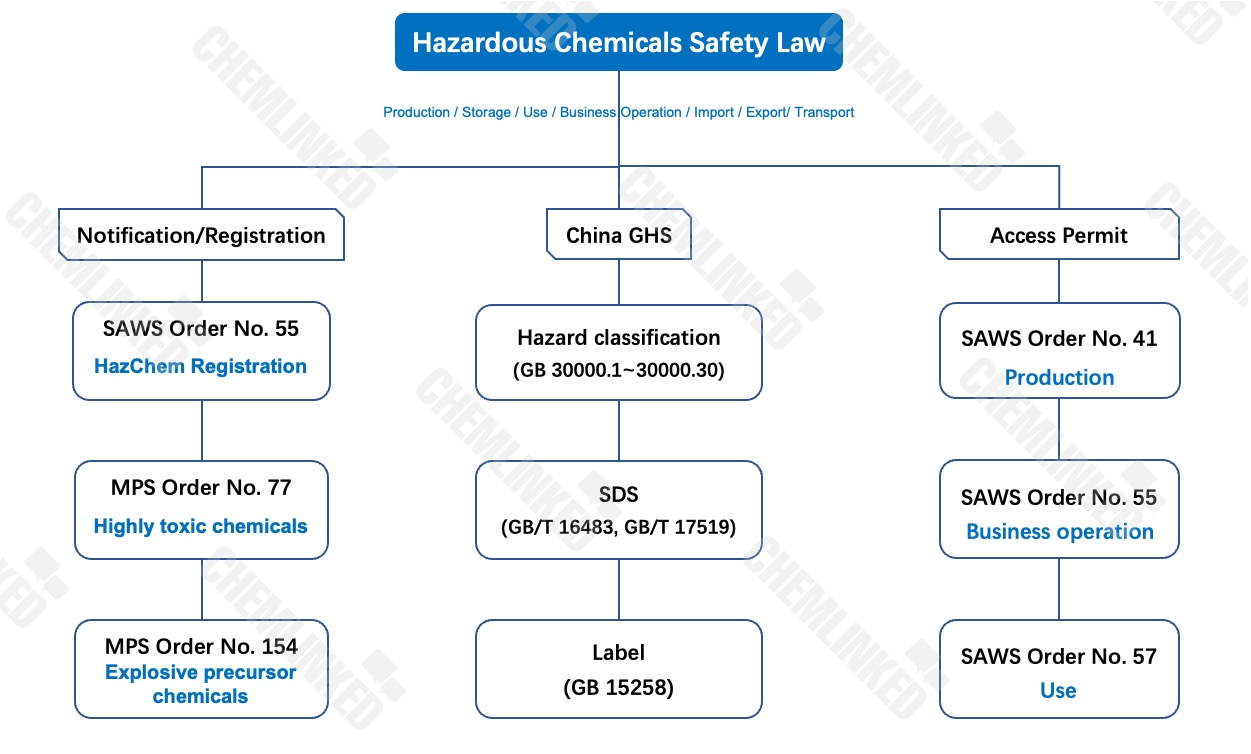
"Hazardous chemicals" are defined as highly toxic chemicals and other chemicals possessing toxic, corrosive, explosive, flammable, or combustion-supporting properties that harm the human body, facilities, or the environment. The Law does not apply to civil explosives, fireworks, radioactive materials, nuclear substances, or chemicals used for national defense research and production.
4 Inventory of Hazardous Chemicals
The State implements a catalog management system, jointly determined and published by multiple ministries. The Inventory of Hazardous Chemicals shall be determined, published, and adjusted in due time, based on the identification of hazardous properties and classification criteria of chemicals. The current version of the Inventory was issued in 2015 and revised in 2022 to adjust the entry of 'Diesel'. On April 16, 2026, the MEM officially announced the addition of 5 more chemicals to this inventory (read more). The Inventory also includes 148 highly toxic chemicals, referring to 148 listed hazardous chemicals marked 'highly toxic (剧毒)'.
5 Hazardous Chemical Registration
To provide technical and informational support for safety management and emergency rescue, China enforces a strict Hazardous Chemical Registration system under the Law.
1) Compliance Entities:
Domestic manufacturers and importers of hazardous chemicals are legally obligated to register their products with the designated registration agency under the Ministry of Emergency Management (MEM).
2) Compliance Requirements:
The registration information must include:
Classification and label information.
Physical and chemical properties.
Main uses.
Hazard characteristics.
Safety requirements for storage, use, and transportation.
Emergency disposal measures for dangerous situations.
No duplicate registration is required for the same chemical produced or imported by the same enterprise. However, if new hazard characteristics are discovered or registration details change, the enterprise must promptly update the registration.
3) Exemptions:
Chemicals that are low-volume, low-release, and low-exposure used specifically during R&D or trial production phases may be exempted from registration, subject to specific rules formulated by the authorities. (*Specific supporting regulations are under formulation to detail the exemption criteria. No draft has been made public so far.)
6 GHS Requirements
Compliance with the Globally Harmonized System (GHS) is strictly mandated. The Law explicitly outlines requirements for the Chemical Safety Data Sheet (SDS) and chemical safety labels:
Provision of Information: Manufacturers and importers must provide a Chinese SDS matching the specific hazardous chemical. A corresponding Chinese label must be firmly affixed, printed, or tied to the packaging (including outer packaging).
Updates: If an enterprise discovers new hazard characteristics, it must immediately make a public announcement and revise the SDS and label in a timely manner.
Supply Chain Transmission: Business operation enterprises and users must not sell or use hazardous chemicals lacking compliant SDS and labels. Operations are strictly forbidden to arbitrarily alter the provided SDS or safety labels. Operators must distribute these documents to downstream users and employees to ensure safe handling.
Companies handling hazardous chemicals must comply with China GHS obligations, including those related to classification, labeling, and SDSs, according to the specific national standards. For more detailed explanations, please refer to Chempedia - China GHS.
The Law requires authorities at or above the county level to strengthen information-based supervision, implementing electronic labeling of hazardous chemicals and information-based management throughout their lifecycles. The GB 15258-XXXX General Rules for Preparation of Chemicals Safety Label (Draft for Approval) proposes to adopt the NRCC QR Code as a mandatory label element, which will be generated after completing hazardous chemical registration on the national online platform. This means that once the revised standard is approved, producers and importers of hazardous chemicals shall attach the NRCC QR code to their labels. So far, the revision has not been officially released.
7 Production and Storage Safety
A Hazardous Chemicals Safe Production License shall be obtained for the production (including storage) of hazardous chemicals. The Law imposes stringent prerequisites for manufacturing and warehousing facilities.
Construction and Evaluation: All newly built, expanded, or reconstructed production and storage projects must undergo strict safety condition reviews by the emergency management department. Safety facilities must be designed, constructed, and put into operation simultaneously with the main project. A third-party safety evaluation is required every three years for operational enterprises.
Operational Requirements: Enterprises must adopt automated control systems and safety instrumented systems. Major hazard installations must be registered, continuously monitored, and filed with local authorities.
Management of Special Chemicals: Highly toxic chemicals and explosive precursor chemicals require extraordinary measures. They must be stored in dedicated warehouses or cabinets, completely separate from other goods, and managed under a strict "double-person receiving and dispatching, double-person keeping" system. Detailed flow records must be kept and reported to public security organs, and dedicated security guards must be appointed.
8 Use Safety
Enterprises using hazardous chemicals for production (excluding chemical manufacturers) must adhere to the following.
Safe Use License: Chemical enterprises that use certain designated hazardous chemicals in quantities reaching standard thresholds must apply for a Hazardous Chemical Safe Use License.
Conditions: To obtain this license, companies must employ qualified professional technical personnel, establish a dedicated safety management agency, maintain accident emergency plans with necessary rescue equipment, and pass a formal safety evaluation. Furthermore, users are mandated to train their workers thoroughly regarding the hazards and proper emergency protocols detailed in the SDS.
9 Business Operation Safety
The Law mandates a licensing system for the business operation and warehousing of hazardous chemicals.
Licensing Requirement: No entity or individual may engage in chemical business operations without a Hazardous Chemical Business Operation License. Operators must possess compliant storage facilities (if applicable), trained personnel, and comprehensive safety management systems.
Purchase and Sale Restrictions: Purchasers of highly toxic chemicals and explosive precursor chemicals must present relevant operational licenses, safe use licenses, or legally obtained purchase permits. Sales records, including the buyer's identity, quantity, and intended use, must be kept for at least three years and reported to the public security organ within three days of the transaction. Sales of these restricted chemicals to unauthorized individuals or via the internet are strictly prohibited.
10 Transportation Safety
Transportation is a highly regulated sector of the supply chain, requiring specific transport licenses for road and waterway modes.
Qualifications and Equipment: Carriers, drivers, crew members, supercargoes, and loading inspectors must pass exams to obtain qualification certificates. Vehicles must be equipped with functioning satellite positioning systems that cannot be disabled or tampered with.
Routing and Bans: Transporting highly toxic chemicals by road requires a specific Road Transport Pass from the public security organ, detailing approved routes and times. Furthermore, transporting highly toxic chemicals through inland enclosed waters is totally banned, and the state maintains a catalog of other chemicals prohibited from inland waterway transport.
Consignor Duties: Shippers must properly pack chemicals, affix safety labels, provide the SDS, and declare the goods accurately. Concealing hazardous chemicals as ordinary goods is strictly prohibited.
11 Prohibitions and Penalties
The Law establishes a severe penalty framework to enforce compliance, holding both companies and directly responsible management personnel accountable.
Prohibitions / Violations | Corresponding Penalties |
|---|---|
Producing, using, or operating State-banned hazardous chemicals (Article 98) | Cessation of activities, confiscation of illegal goods/income, plus fines up to 10 times the product value if over 100,000 RMB. |
Producing, using, or operating without the requisite licenses (Article 100) | Cessation of operations, confiscation of goods/income, and fines ranging from 100,000 to 500,000 RMB. |
Failing to provide compliant Chinese SDS or labels; failing to register hazardous chemicals (Article 101) | Order to correct; fines up to 100,000 RMB. Failure to correct leads to fines up to 200,000 RMB for the company and suspension of business. For executives or directly responsible personnel, the fines range from 20,000 to 50,000 RMB. |
Failing to apply "double-person" management for highly toxic chemicals or major hazards (Article 103) | Order to correct and fines of 50,000 to 100,000 RMB; failure to correct results in license revocation and fines up to 200,000 RMB. For executives or directly responsible personnel, the fines range from 20,000 to 50,000 RMB. |
Selling highly toxic chemicals or explosive precursor chemicals to unauthorized entities or via the internet (Article 107) | Confiscation of illegal income, fines of 200,000 to 500,000 RMB; failure to correct leads to license revocation. For executives or directly responsible personnel, the fines range from 50,000 to 100,000 RMB. |
Concealing or falsely declaring hazardous chemicals as ordinary goods during transport (Article 110) | Order to correct, fines of 200,000 to 300,000 RMB, confiscation of illegal income; failure to correct leads to business suspension. For executives or directly responsible personnel, the fines range from 10,000 to 50,000 RMB. |
The Law significantly increases the personal legal and financial consequences for the person directly in charge and directly responsible personnel. Failure to fulfill safety duties can lead to direct fines, revocation of licenses, and criminal prosecution in cases of major accidents.
In conclusion, the Law represents a comprehensive modernization of chemical safety governance. International chemical enterprises must conduct thorough internal compliance audits, integrate digital supply chain tracking, and ensure strict adherence to licensing, registration, GHS, and transport rules to thrive in the Chinese market.

