


 Request a Demo
1 Overview
China has introduced a policy called “One Enterprise, One Chemical Product, One QR Code” to enhance the digital and intelligent management of hazardous chemicals (Hazchem). This policy was outlined in the National Plan for Centralized Management of Safety Risks of Hazardous Chemicals on January 5, 2022. Following the National Plan, many provinces and cities in China, e.g., Guangdong, Shandong, Beijing, Shanghai, etc., have successively piloted their own local QR code requirements for hazardous chemicals. However, as of now, this policy has not yet been fully implemented at the national level across China.
2 Hazchem Safety Information Code (Not fully implemented)
Domestic manufacturers or importers of hazardous chemicals are obliged to complete Hazchem registration in China. After completing the Hazchem registration via the national registration platform - Hazardous Chemical Registration Comprehensive Service System launched by the National Registration Center for Chemicals (NRCC) of the Ministry of Emergency Management (MEM), a Hazchem safety information code (hereinafter referred to as the “NRCC QR code”) will be automatically generated online.
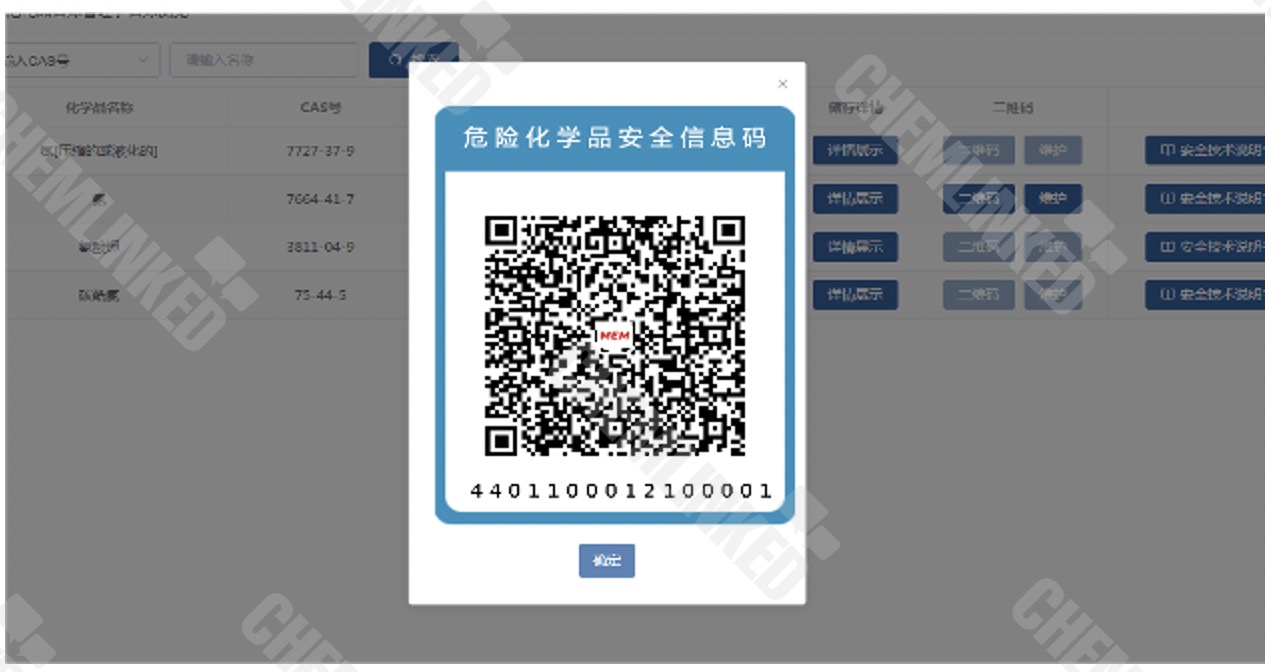
Notably, the generation of NRCC QR code is the most important precondition for piloting the “One Enterprise, One Chemical Product, One QR Code” policy in each pilot province or city. In early 2022, the MEM drafted the Regulations on the Administration of Hazardous Chemical Safety Information Codes (Trial) for comments in limited groups, stipulating the requirements for the generation of NRCC QR code, display requirements, exemptions, etc. Below are the proposed implementation requirements for the use of NRCC QR code in this trial regulation.
2.1 Compliance Entities
Domestic manufacturers and importers of hazardous chemicals that fall under either of the following:
Chemicals listed in the China Inventory of Hazardous Chemicals;
Non-listed chemicals that meet the determination principles specified in the Inventory.
For pilot projects in different provinces and cities, the scope of hazardous chemicals may differ in practice.
2.2 Display Requirements
Enterprises shall affix the generated NRCC QR code on the bottom right (preferred) or other blank space of the label, or next to the label on the packaging if there is no room. The minimum dimension of the NRCC QR code is 1 cm by 1 cm, and it shall not be smaller than the pictogram.
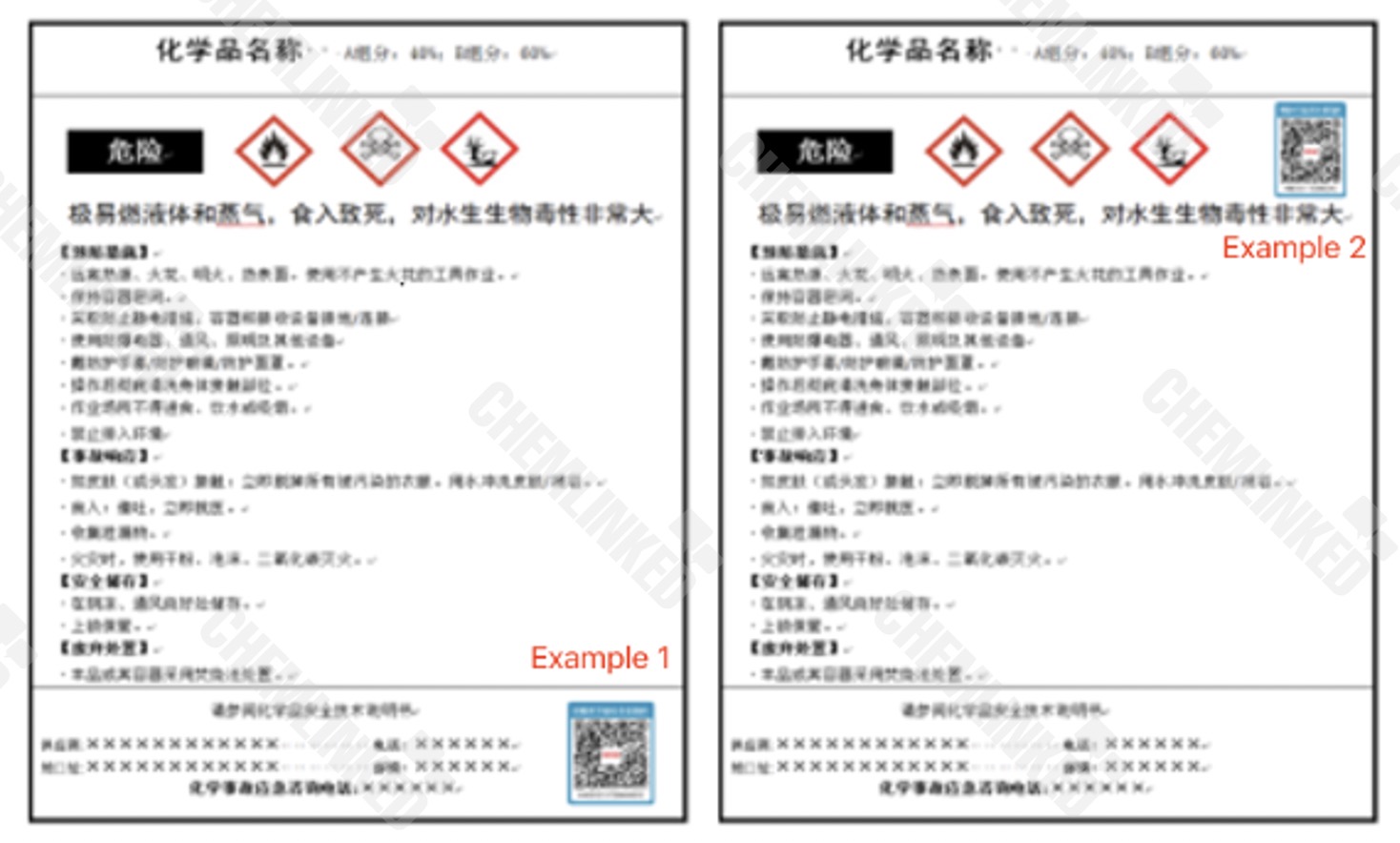
For transportation, the NRCC QR code is also required to be affixed on the outer packaging, containers, vehicles, etc. The position of the NRCC QR code on the label shall be consistent for the same product of the same enterprise.
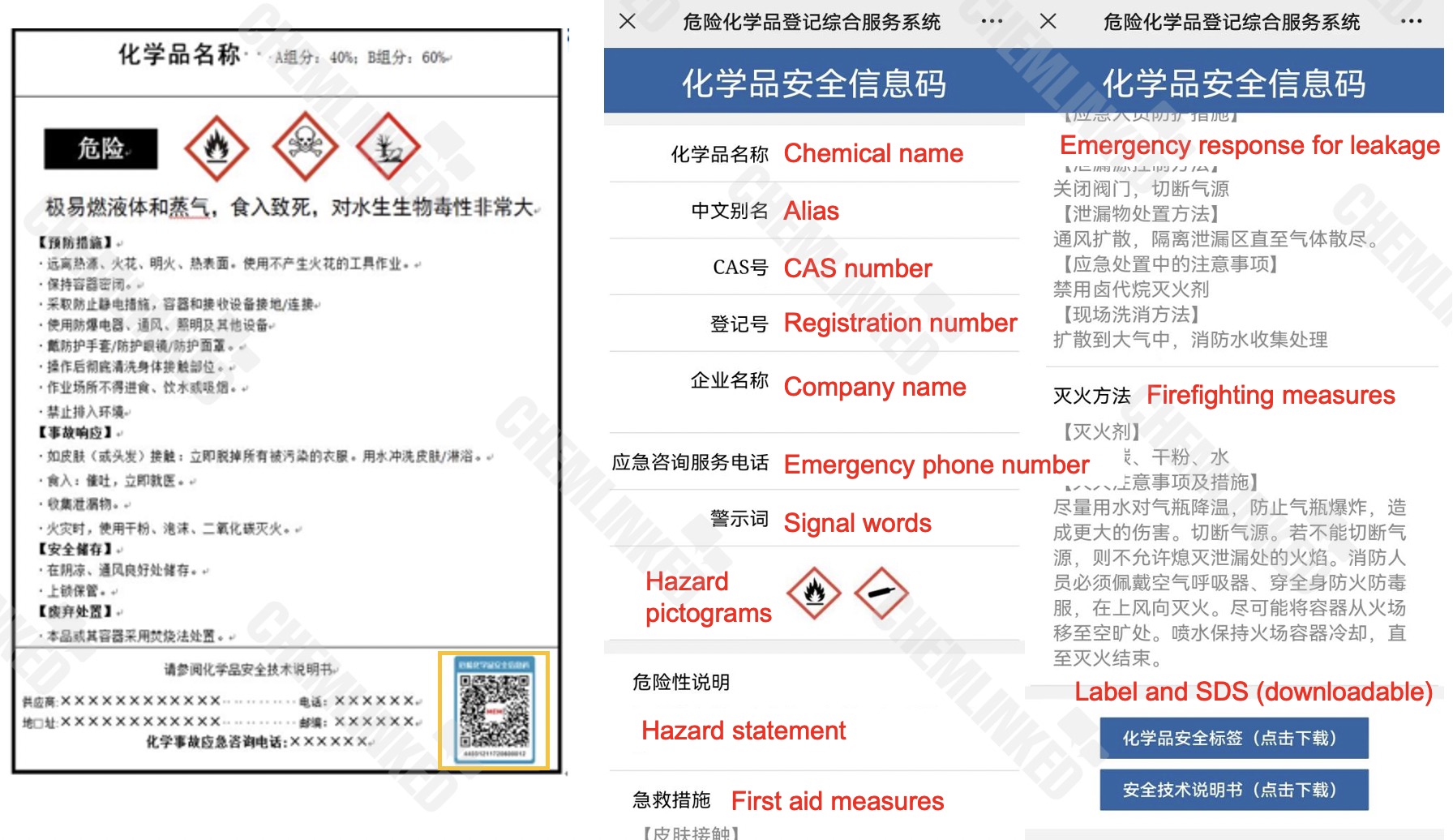
The NRCC QR code can be scanned using WeChat or the official APP developed by the MEM, providing the public and officials with quick and easy access to the basic information automatically extracted from the Hazchem registration information as the figure below shows.
2.3 Exemptions
For hazardous chemicals with a single package volume not exceeding 100mL, printing, and pasting of the NRCC QR code on the inner package of hazardous chemicals may be exempted, which is only required for the outer package.
For hazardous chemicals only for export, printing and pasting of the NRCC QR code on the inner and outer packages of hazardous chemicals may be exempted.
For imported hazardous chemicals directly consumed by importers, printing and pasting of the NRCC QR code on the inner and outer packages of hazardous chemicals may be exempted.
Although this trail regulation is not yet finalized so far, most pilot provinces/cities in China, e.g., Guangdong, Shandong, Jiangsu, etc., adopted the abovementioned requirements in their own local pilot projects. In practice, pilot provinces and cities may further detail the Hazchem QR code requirements based on local conditions.
3 Pilot Project in Guangdong (NRCC QR Code)
Guangdong, the first province designated by the State, initiated the pilot project for the “One Enterprise, One Chemical Product, One QR Code” policy in June 2021. Since October 2021, the use of NRCC QR code has been mandatory on hazardous chemical labels, packaging, containers and vehicles before hazardous chemicals leave the factory or warehouse in Guangdong. The requirements follow the Regulations on the Administration of Hazardous Chemical Safety Information Codes (Trial) issued by the MEM.
Drawing from the practical experience of implementing the NRCC QR code in the recent years, a draft local standard titled Application Specification for Safety Information Code of Hazardous Chemicals (Draft for Approval) was issued for public comments in July 2024. It was jointly drafted by the NRCC and Guangdong’s department of emergency management, aiming to address implementation challenges and fill the regulatory gap at the local level. On November 11, 2024, Guangdong Administration for Market Regulation issued the local standard namely DB44/T 2564—2024 Application specification for safety information code of hazardous chemicals. It took effect on February 11, 2025.
3.1 Main Points in Guangdong's Local Standard
Compared with the foregoing trial regulation, Guangdong’s local standard DB44/T 2564—2024 provides more detailed exemption criteria and additional examples to demonstrate how to properly display the NRCC QR code under different conditions.
3.1.1 Exemption Criteria
For hazardous chemicals with a single package volume not exceeding 100 mL or 100 cm3, the NRCC QR Code does not need to be printed or pasted on the inner packaging, however, it should be printed or pasted on the outer packaging.
For hazardous chemicals intended solely for export, the NRCC QR Code does not need to be printed or pasted on the inner or outer packaging.
For imported hazardous chemicals directly consumed by importers, which will not leave the factory area after entering the factory's storage tanks, the NRCC QR Code does not need to be printed or pasted on the inner or outer packaging.
For household chemical products with individual packages that can be sold separately, the NRCC QR Code does not need to be printed or pasted on the packaging.
3.1.2 Display Requirements
For special products such as gas cylinders and pesticides that have other specific standards, the NRCC QR Code should be affixed close to the product label.
For hazardous chemicals considered dangerous goods, if the outer packaging of the combination package does not have a chemical safety label, the NRCC QR Code should be affixed next to the dangerous goods label.
For hazardous chemicals considered dangerous goods transported through intermediate bulk containers (IBCs), portable tanks, etc., without packages, the NRCC QR Code should be affixed or hung in a prominent position on the container or transport vehicle, while ensuring operational safety and not blocking vehicle lights, license plates, etc.
For flexible packaging, the NRCC QR Code could be printed, affixed or sewn on it.
For packaged chemicals in volume over 100 mL but less than 1000 mL, a simplified NRCC QR Code could be used.
DB44/T 2564—2024 serves as the first official standard for the NRCC QR code application in China. For more details in this regard, please refer to the ChemLinked news.
4 Pilot Project in Shanghai (Hazchem Traceability Code)
In February 2024, the Shanghai Emergency Management Bureau (SEMB) and the Shanghai Municipal Transportation Commission (SMTC) jointly released a notice to pilot the use of Hazchem traceability code. This differs from the NRCC QR code piloted in Guangdong, as the Hazchem traceability code requires additional information.
4.1 Generation of Hazchem Traceability Code
The manufacturers and importers of hazardous chemicals within Shanghai shall first complete the Hazchem registration via the national registration platform to obtain the NRCC QR code. They then shall provide the NRCC QR code and additional information to the Shanghai Hazardous Chemicals Whole Supply Chain Supervision Information System (hereinafter referred to as “Shanghai Hazchem traceability system”) launched by the SEMB to generate the Hazchem traceability code.
The Hazchem traceability code contains information regarding the production, import, transportation, storage, and use of hazardous chemicals. It could facilitate the tracking of Hazchem information and enable the digital supervision of Hazchem business operations throughout the supply chain across multiple departments.
4.2 Compliance Requirements
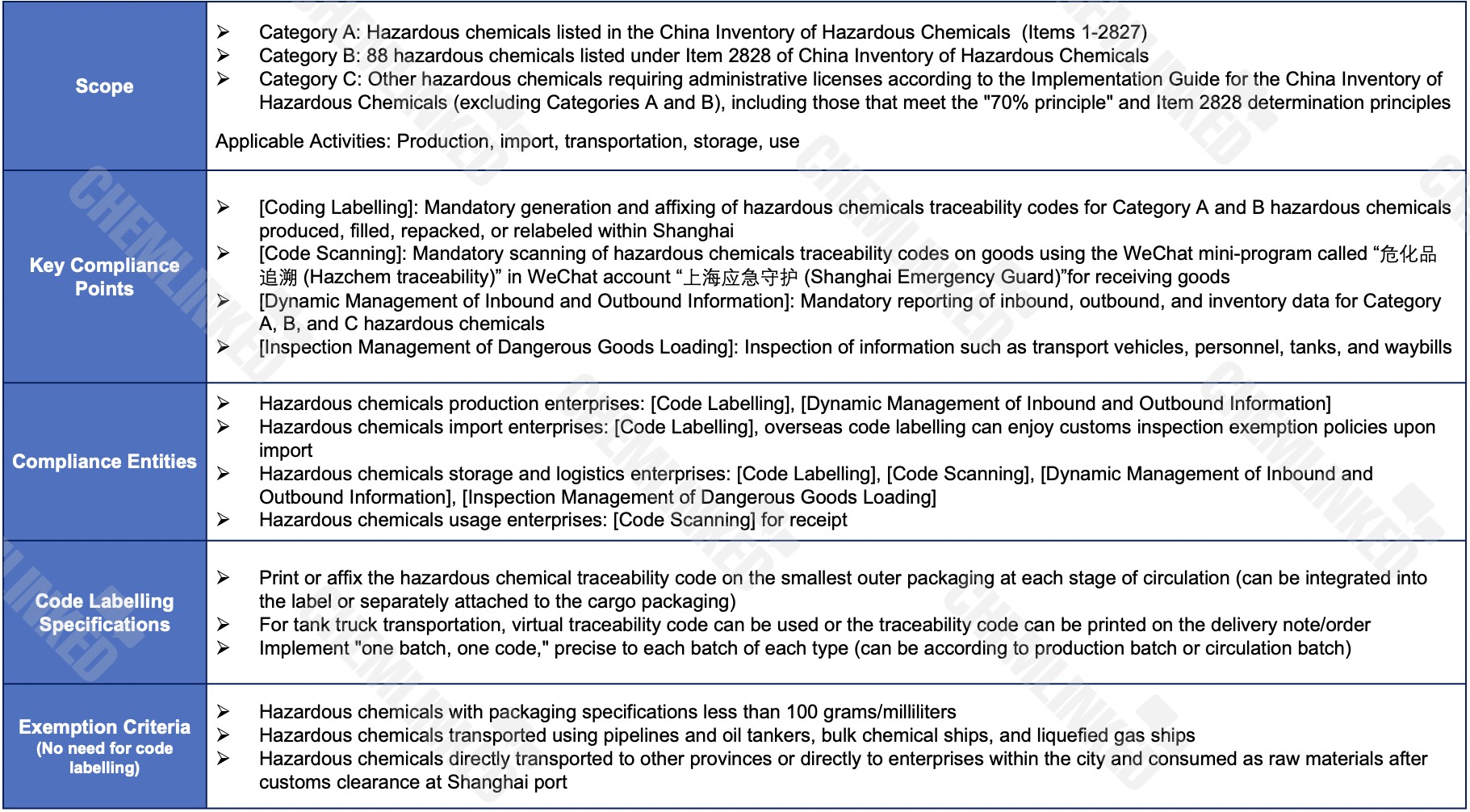
According to Shanghai’s pilot project, the manufacturers and importers shall generate a unique Hazchem traceability code for each batch of hazardous chemical and affix it to the smallest outer packaging throughout its circulation within Shanghai. In addition, enterprises involving hazardous substances shall establish a dynamic management system for the inbound and outbound of hazardous chemicals in the warehouse by December 31, 2024, and connect it with the Shanghai Hazchem traceability system.
The table below shows the relevant compliance requirements of Shanghai’s pilot project for the use of Hazchem traceability code, covering application scope, key compliance points and entities, exemption criteria, etc.
ChemLinked has compiled the 54 official FAQs to guide you through how to meet the Hazchem traceability requirements in Shanghai. Please refer to FAQs of Shanghai Hazchem Pilot Project for Deployment of One Enterprise, One Chemical Product, One QR Code Policy.
4.3 Shanghai's Local Standard
From December 31, 2024 to January 1, 2025, Shanghai initiated one-month public consultation on its local standard DB31/T 1250-XXXX Technical specification for traceability code of hazardous chemicals (Draft for approval). No comments were submitted. This standard has successfully completed the comment phase, entered the final review and approval process. DB31/T 1250-XXXX aims to clarify requirements for the Hazchem traceability code application within Shanghai. It specifies the technical methods, identification information, use and maintenance requirements of traceability codes used to identify the safety information of hazardous chemicals in their production, transportation, storage, use, etc. This standard is not finalized so far. For more detailed requirements in this draft standard, please refer to ChemLinked News: Shanghai Rolls Out Technical Specification for Hazchem Traceability Code.
4.4 Compliance of Overseas Suppliers
Although overseas suppliers exporting hazardous chemicals to China are currently not obligated to affix the Hazchem QR code, they are concerned about potential future compliance burdens. It is crucial to address the concerns of both domestic enterprises and overseas suppliers to ensure the harmonious and effective implementation of the “One Enterprise, One Chemical Product, One QR Code” policy in China.
According to Shanghai's pilot project, the SEMB cooperates with Shanghai Customs to develop a WHITELIST for importers. Importers who coordinate with overseas suppliers to obtain and affix the Hazchem traceability codes before road transport from ports will have the opportunity to be included in the WHITELIST. Once listed, these importers can enjoy exemptions from sample inspection and reduced unpacking and inspection, thereby facilitating expedited customs clearance. However, this WHITELIST initiative is currenly limited to Shanghai.

