



 Request a Demo
Vietnam has fully implemented a GHS-based chemical management system. The latest requirements center on the Law on Chemicals (No. 69/2025/QH15), which takes effect on January 1, 2026. It mandates that Safety Data Sheets (SDS) must contain the 16 standardized sections and be provided in Vietnamese, classification must strictly adhere to applicable GHS standards. Vietnam stipulates labeling requirements for chemicals separately under the implementation decree of the Law on Goods and Products Quality.
History
2007.11.21: Vietnam enacted its first Chemicals Law (Luật Hóa chất 2007), establishing the foundation for GHS adoption.
2008-2010: Decree No. 108/2008/ND-CP (published on 2008.10.21) and Circular 28/2010/TT-BCT (published on 2010.6.28)
2012.2.31: Circular 04/2012/TT-BCT established the requirements for the classification and labeling of substances and mixtures in accordance with GHS (based on UN GHS Rev.2, 2007). The GHS requirements has applied for substance from March 30, 2014 and mixtures from March 30, 2016.
2017: Decree 113/2017/ND-CP and Circular 32/2017/TT-BCT formalized GHS-aligned SDS formats, labeling rules, and import procedures.
2022: Decree 82/2022/ND-CP updated GHS building block to align with GHS Rev.2 and adjusts concentration limits for certain classification criteria.
2026: Circular 01/2026/TT-BCT stipulates GHS requirement under the new Law on Chemicals (No. 69/2025/QH15) passed in 2025.
GHS Regulation System
In Vietnam, GHS implementation is mainly governed by the Law on Chemicals, Circular No. 01/2026/TT-BCT (Classification, SDS) and Decree 37/2026/ND-CP (labeling).
Classification
As per Article 7, Circular No.01/2026/TT-BCT, chemicals shall be classified according to the rules and technical guidance of UN GHS Rev.2 (2007) onwards. Building blocks from GHS Rev.2 onwards can be adopted for chemical classification in Vietnam.
General instructions and criteria for chemical classification shall be referred to Appendix XV to Circular 01/2026/TT-BCT.
Labeling
Accroding to Article 42, Decree 37/20206/ND-CP, the official label language is Vietnamese. The following contents may be displayed in other Latin-based languages:
International or scientific names in cases where there is no Vietnamese equivalent;
Internatioal or scientific names and chemical formulas, structural formulas of chemicals, pharmaceutical materials, excipients, or ingredients;
International or scientific names of ingredients, content of goods in cases where they cannot be translated into Vietnamese or when the Vietnamese equivalent has no meaning;
Names and addresses of foreign enterprises;
International names of countries or territories that cannot be transliterated into Vietnamese or where transliteration has no meaning;
Names of cultural or artistic products, authors, or art groups.
The labeling elements include the basic UN GHS requirements and other compulsory content as stipulated under Decree 37/2026/ND-CP, including compulsory information for physical label as defined in Article 42 (items 1-3):
Chemical name: IUPAC name, trade name, other name (if any)
Name and address of the responsible entity: For goods imported into Vietnam by sale agents directly for foreign traders, their labels must show the name and address of the manufacturer and sales agents.
Origin of chemicals
Chemical identifiers
Hazard pictograms
Signal words: “Danger” or “Warning” or none.
Precautionary statement
Quantity
Ingredients or ingredient content
Manufacturing date
Expiry date
Use instruction, storage condition
A sample of Vietnam GHS label is shown below:
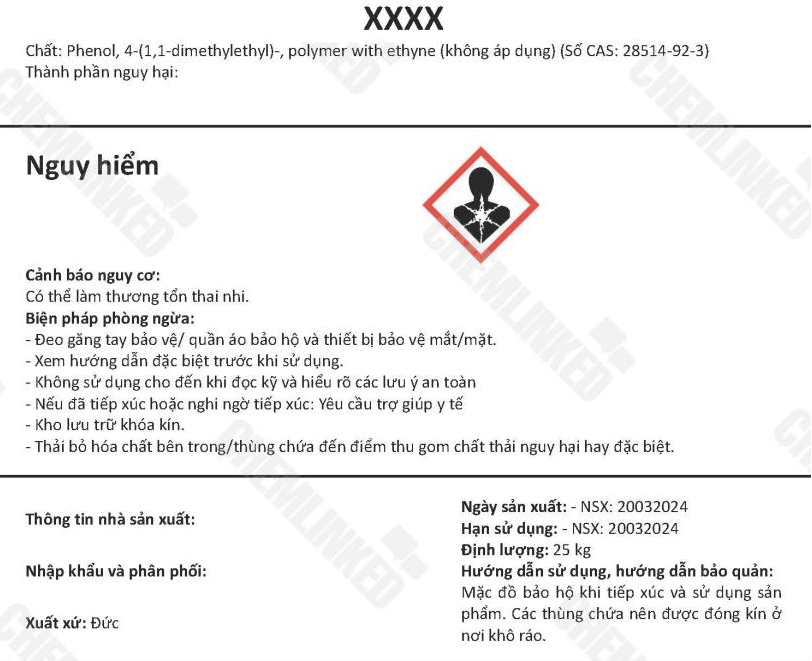
Figure 2- Vietnam GHS Label Sample
There are no specific requirement for label size. The physical label size is determined by the responsible entity, but it must be large enough to contain all compulsory information.
In case of small-dimension goods or packaging (defined as those that cannot display all compulsory information using a minimum font size of 0.9 mm), the minimum labeling information are:
Chemical Name
Name and address of the responsible entity
Origin of chemical
The remaining compulsory content may be provided in accompanying documents or electronic labels.
SDS
Organization, individual manufacturing and importing hazardous chemicals based on GHS Rev.2 shall prepare safety data sheet (SDS).
The SDS should include the following 16 headings consistent with the UN GHS requirement and needs to be updated whenever necessary to ensure correct and updated:
1. Chemical and supplier identification
2. Hazards identification
3. Composition/information on ingredients
4. First-aid measures
5. Fire-fighting measures
6. Accidental release measures
7. Handling and storage
8. Exposure controls/personal protection
9. Physical and chemical properties
10. Chemical stability and reactivity
11. Toxicological information
12. Ecological information
13. Disposal considerations
14. Transport information
15. Regulatory information
16. Other information including information on preparation and revision of the SDS
The detailed instructions on SDS content and form shall be referred to Appendix I of the Circular No. 01/2026/TT-BCT.

