

 Request a Demo
1 Introduction
1.1 History and Use of PFAS
Per- and polyfluoroalkyl substances (PFAS) are a class of organofluorine chemicals that have been manufactured and used for decades. Because PFAS can confer resistance to oil and water and withstand high temperatures, they are used in a variety of applications, including firefighting foams, food packaging and contact materials, textiles, etc.
The earliest known PFAS compound in the U.S. was first synthesized by a DuPont chemist in the late 1930s, called polytetrafluoroethylene (PTFE). In 2000, 3M announced the phase-out of PFOS (or perfluorooctane sulfonic acid) and PFOA(or perfluorooctanoic acid) . Since then, the U.S. Environmental Protection Agency (EPA) has implemented a series of measures to monitor and control the production, import and use of PFAS in products in the United States.
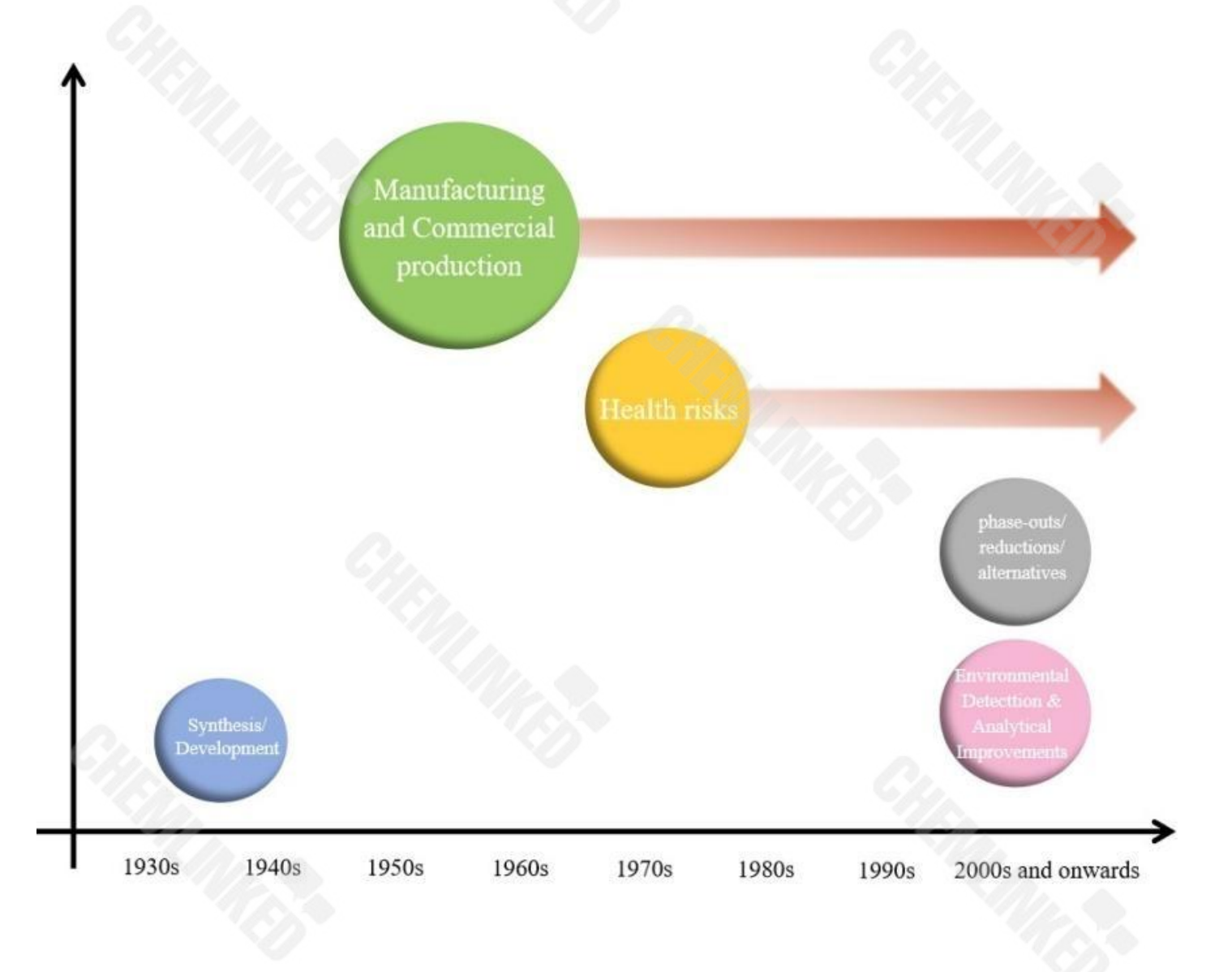 Fig.1 History of PFAS
1.2 Definition of PFAS
Since PFAS are a large group of thousands of synthetic chemicals, U.S. regulations have relied on a structural definition rather than a list of substances. There is no universally accepted definition of PFAS as a group of chemicals. Table 1 provides two commonly cited structure-based PFAS definitions.
| Source | Definition |
| Organisations for Economic Cooperation and Development (OECD) 2021 | PFASs are defined as fluorinated substances that contain at least one fully fluorinated methyl or methylene carbon atom (without any H/Cl/Br/I atom attached to it); i.e., with a few noted exceptions, any chemical with at least a perfluorinated methyl group (–CF3) or a perfluorinated methylene group (–CF2–) is a PFAS. |
| EPA’s Office of Pollution Prevention and Toxics / National PFAS Testing Strategy (2021) | PFAS is defined as including at least one of these three structures:
|
Table.2 Chemical Structure-Based Definitions of the PFAS Class
The current working definition for PFAS used by EPA is defined within the TSCA, as well as the National PFAS Testing Strategy. However, many US states have adopted legislation to phase out PFAS in a wide range of consumer products based on the OECD definition.
1.3 Overview of the Major Families of PFAS
PFAS are a family of man-made chemicals containing carbon, fluorine, and other elements, which can be divided into two main classes: polymers and non-polymers. The non-polymeric PFAS can be further divided into perfluoroalkyl substances (fully fluorinated carbon chain) and polyfluoroalkyl substances (partly fluorinated carbon chain), which include various groups and subgroups of chemicals. The non-polymeric PFAS, such as PFAAs, are essentially non-degradable under normal environmental conditions. The overview of the major families of PFAS has been summarized below.
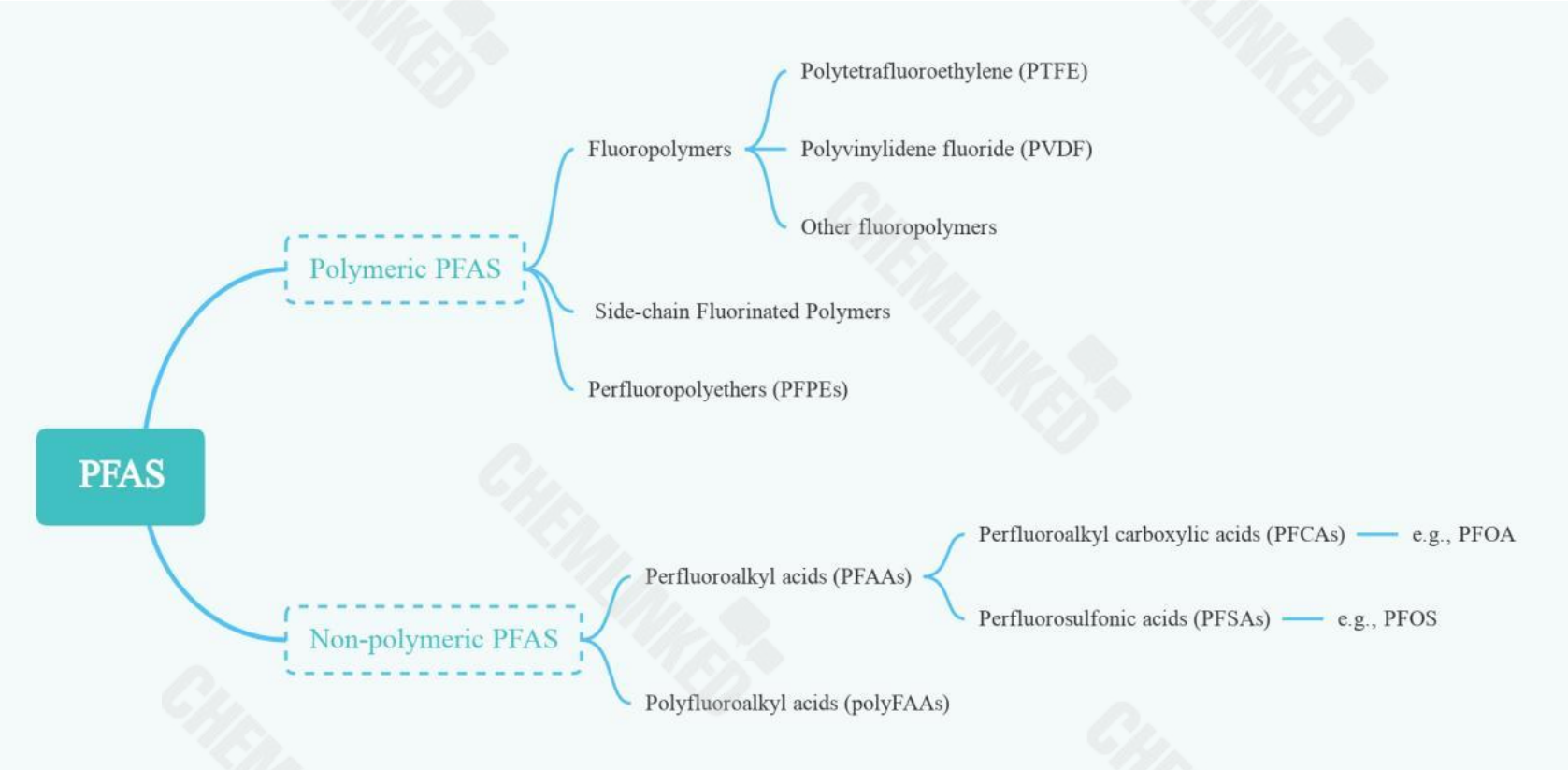 Fig.3 PFAS Family Classification
Short-chain PFASs are widely used as alternatives to long-chain PFASs. The increasingly used short-chain PFASs are assumed to have a lower bioaccumulation potential. Nonetheless, they have other properties of concern and are already widely distributed in the environment, also in remote regions. Therefore, U.S. PFAS Regulations do not exclude short-chain PFASs.
2 EPA Regulatory Status
2.1 Legal Framework
The U.S. Environmental Protection Agency (EPA) has implemented a comprehensive legislation framework to address PFAS in commerce, public water supplies, and in the environment. These actions have been taken primarily under the authorities of the Toxic Substances Control Act (TSCA); the National Defense Authorization Act (NDAA); the Comprehensive Environmental Response, Compensation, and Liability Act (CERCLA); the Safe Drinking Water Act (SDWA); the Clean Water Act (CWA); and the Resource Conservation and Recovery Act (RCRA) (see Fig.4).
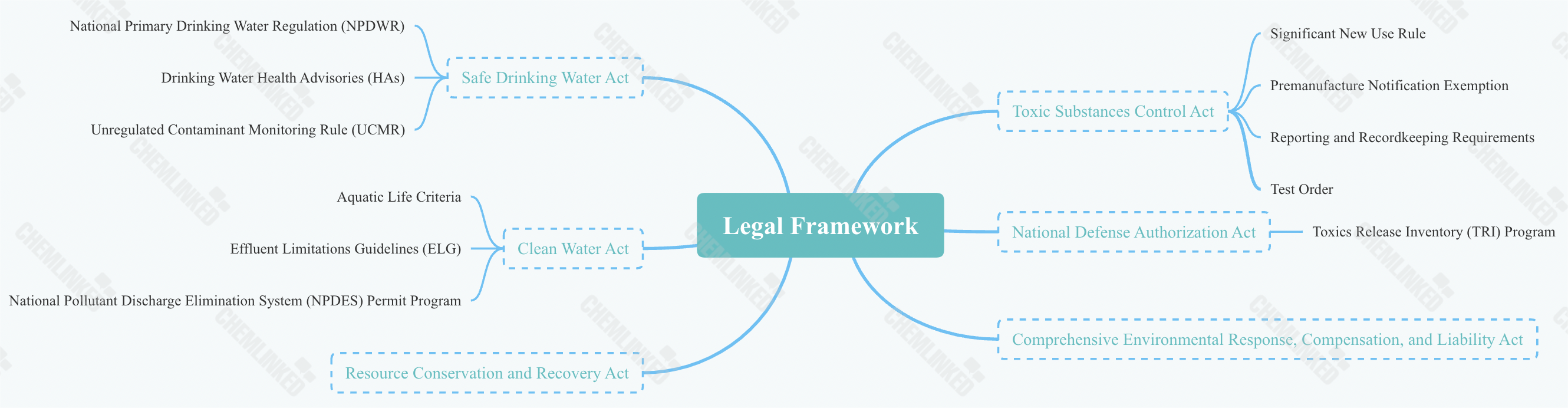 Fig.4 Regulatory Diagram of PFAS Management under the responsibility of EPA
2.2 Key EPA Actions to Address PFAS
Federal key actions to address potential risks of PFAS under TSCA, NDAA, CERCLA, and RCRA are discussed in greater details below.
2.2.1 Regulation of PFAS in Commerce Under TSCA
Use Restrictions and Notification
Once a use of a PFAS substance is determined as a significant new use, manufacturers, importers or processors are required to submit a significant new use notice (SNUN) to EPA at least 90 days before existing PFAS substances are used in new ways that might create concerns. No person may commence manufacture, import or processing for the use specified in the SNUN until EPA has conducted a review of the notice, made an appropriate determination on the notice, and taken such actions as are required by that determination.
Several types of PFAS are currently subject to the significant new uses rules (SNURs) (see Table.5).
| PFAS Subject to SNUR | Restrictions | Exempted from Notification |
| Inactive PFAS | Manufacture, import or processing for any use. |
|
| Long-chain perfluoroalkyl carboxylate (LCPFAC) |
|
|
| PFOA |
|
|
| PFOS |
|
|
| PFHxS | ||
| Perfluoroalkyl sulfonates |
Table.5 TSCA SNURs for the Most Common Types of PFAS
Reporting and Recordkeeping Requirements
On October 11, 2023, EPA released the final rule to require reporting and recordkeeping for Per- and Polyfluoroalkyl Substances (PFAS) under TSCA, which came into effect on November 13, 2023. The details are listed in the table below.
Updates on May 13, 2025:
EPA just released an interim final rule to extend the data submission period for the TSCA PFAS reporting rule. The data submission period now begins on April 13, 2026 and ends on October 13, 2026, with an alternate end date for small manufacturers reporting exclusively as article importers of April 13, 2027. This interim final rule is effective on May 13, 2025.
| Who's Affected | Any entity or person that manufacture, import, have manufactured or imported PFAS that is considered a “chemical substance” for a commercial purpose in any year since January 1, 2011. |
| Applicable Scope | The current working definition for PFAS used by EPA. |
| Information Reporting Requirements | The following information is required to be submitted to EPA:
|
| Recordkeeping requirements | To retain records that document any information reported to EPA for five years, beginning on the last date of the information submission period. |
| Reporting Deadlines | October 13, 2026 (April 13, 2027 for small article importers). |
Ineligibility of PFAS for Certain Exemptions
On May 16, 2023, EPA proposed amendments to make new PFAS categorically ineligible for low volume exemption (LVE) or low release and exposure exemption (LoREX) exemptions, which would ensure that all new PFAS are reviewed through the full Pre-manufacture Notice (PMN) process. The comment period was extended from July 25, 2023, to August 8, 2023.
| Who's Affected | Manufacturer or importer of a PFAS not on the TSCA Inventory. |
| Applicable Scope | The current working definition for PFAS used by EPA. |
| Potential Impacts |
|
2.2.2 Addition of Certain PFAS to TRI by NDAA
On December 20, 2019, the National Defense Authorization Act (NDAA) was signed into law. The 2020 NDAA initially added 172 PFAS to the list of chemicals covered by the Toxics Release Inventory (TRI) for the 2021 reporting year (due by July 1, 2021) and provided a framework to automatically add other PFAS in the coming years.
| Who's Affected | A facility in a covered industry sector (including manufacturing and chemicals and allied products wholesale distributor) and exceed the employee threshold (click here for more details). |
| Applicable Scope | For Reporting Year 2024 (reporting forms due by July 1, 2025), 196 PFAS are reportable. |
| Reporting Threshold | Reported individually for each PFAS for which 100-pound reporting threshold is met. |
| TRI Reporting Requirements |
|
2.2.3 Designation of PFOA and PFOS as CERCLA Hazardous Substances
On April 19, 2024, PFOA and PFOS were designated as hazardous substances under the Comprehensive Environmental Response, Compensation, and Liability Act (CERCLA). Designation is critical to addressing PFOA and PFOS releases in the environment and to protecting public health. This final rule was effective on July 8, 2024.
| Who's Affected | Any person in charge of a vessel or an offshore or an onshore facility. |
| Applicable Scope | PFOA and PFOS, including their salts and structural isomers. |
| Release Reporting Requirements | To notify the National Response Center (1-800-424-8802; in Washington, DC 202-267-2675; the facsimile number is 202-267-1322) when there is a release of a hazardous substance in an amount equal to or greater than the reportable quantity (RQ) for that substance in any 24-hour period. |
2.2.4 Listing of Specific PFAS as Hazardous Constituents under RCRA
On February 8, 2024, EPA proposed changes to the Resource Conservation and Recovery Act regulations (RCRA) by adding nine specific PFAS, their salts, and their structural isomers, to its list of hazardous constituents. These changes aim to address releases of these specific PFAS at RCRA hazardous waste treatment, storage, and disposal facilities. The comment period ended on April 8, 2024.
| Who's Affected | Hazardous waste treatment, storage, and disposal facilities (TSDFs) with solid waste management units (SWMUs) that have released or could release any of the PFAS proposed to be listed as RCRA hazardous constituents. |
| Applicable Scope | These nine PFAS are PFOA, PFOS, PFBS,HFPO-DA or GenX, PFNA, PFHxS, PFDA, PFHxA and PFBA. |
| Potential Impacts | If finalized, when corrective action requirements are imposed at a facility, these PFAS would be among the hazardous constituents expressly identified for consideration in RCRA facility assessments and, where necessary, further investigation and cleanup through the RCRA corrective action process at RCRA treatment, storage, and disposal facilities. |
3 State Regulatory Status
3.1 Regulatory Review on PFAS-containing Products
In the absence of regulations for products at the federal level, 30 states have adopted and 5 states have proposed regulations on PFAS-containing products as of August 2024 (shown in Fig.6).
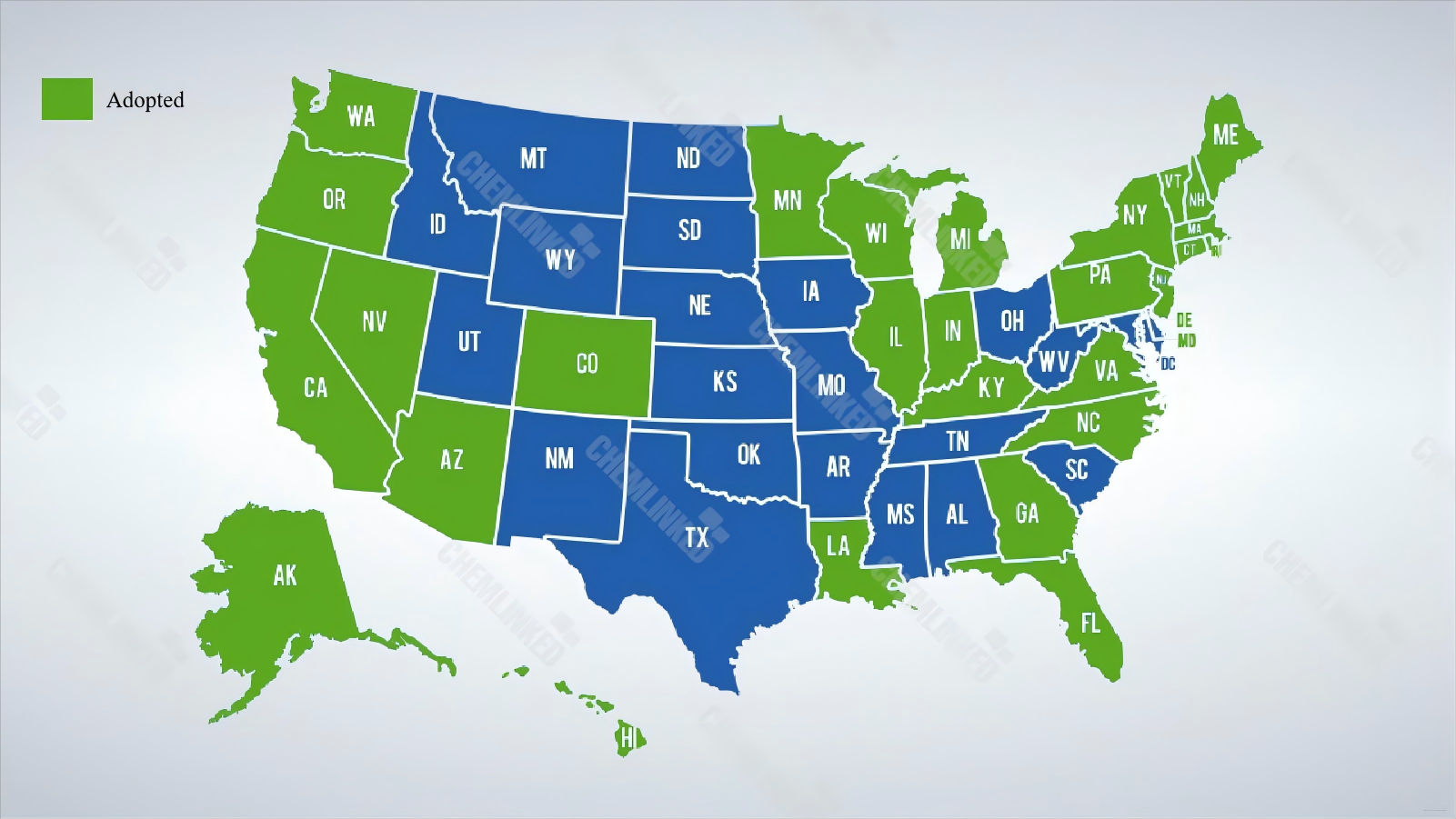 Fig.6 Adopted State-Level Regulations on PFAS-containing Products
The adopted or proposed policies on PFAS-containing products at the state level mainly focus on the following regulatory measures:
Banning “intentionally added” PFAS in certain product;
Reporting or notification requirements for products that contain PFAS.
For regulations that ban “intentionally added” PFAS, states are requiring manufacturers to certify that their products do not contain intentionally added PFAS. This certification can often take the form of a “certificate of compliance” that must be obtained by the manufacturer. Certain laws require manufacturers to report to the state if their products contain PFAS or place warning labels on the product and/or website indicating the presence of PFAS.
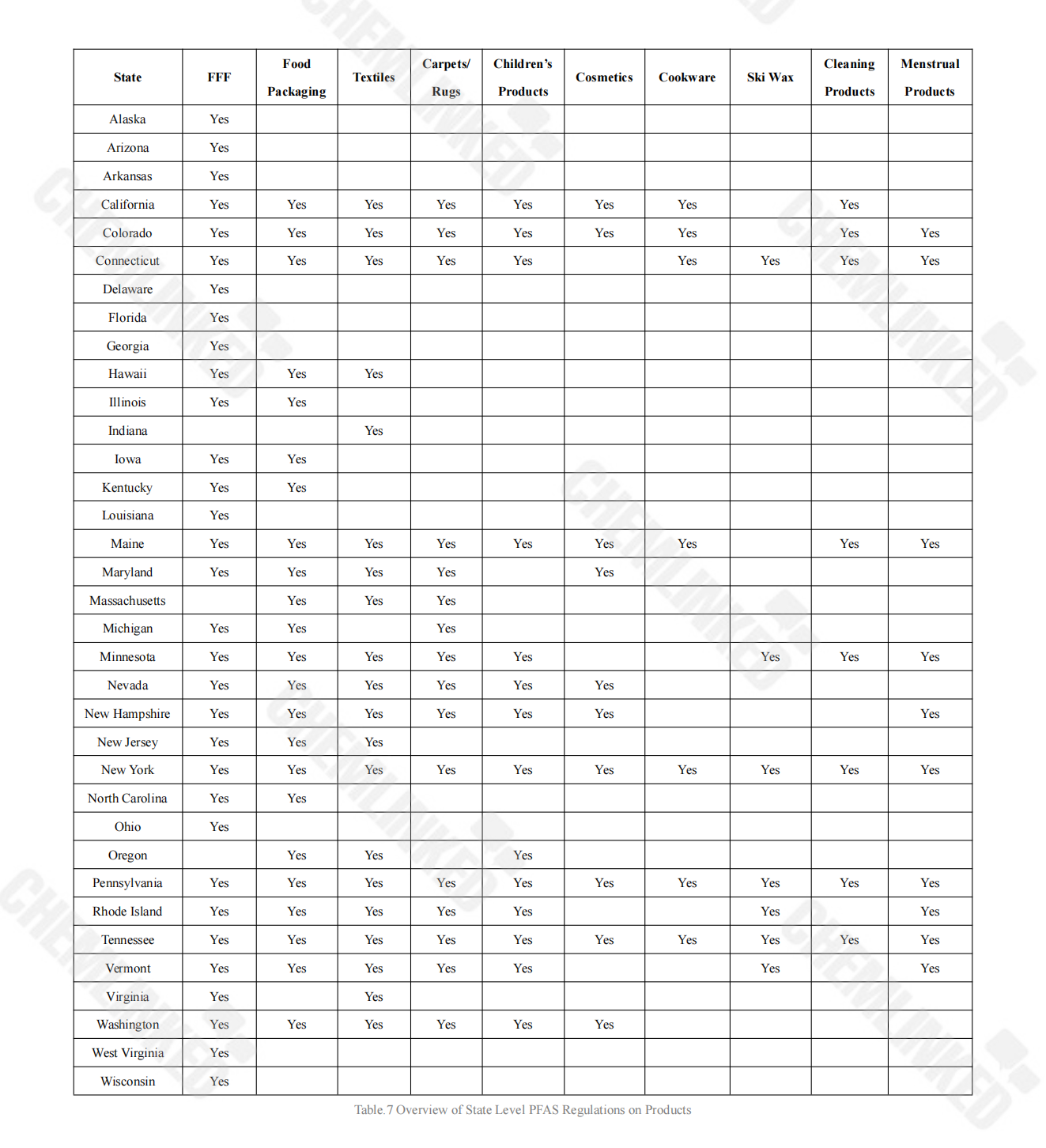
Below is an overview of state-by-state regulatory status on specific product categories to assist you in investigating whether your products may be impacted.
3.2 States with Sweeping PFAS Law
Of the 30 states that introduced policies on PFAS-containing products, Maine and Minnesota have passed comprehensive consumer product laws to phase out all PFAS.
In 2021, Maine enacted An Act To Stop Perfluoroalkyl and Polyfluoroalkyl Substances Pollution and became the first state to ban the sale or distribution of any product containing intentionally added PFAS by 2030, unless determined as a currently unavoidable use (CUU). Ratified on April 16, 2024, the Amendment eliminates the general notification requirement that was previously scheduled to take effect January 1, 2025 and introduced a number of new sales prohibitions for products with different effective dates, etc. (click here to know more details).
Minnesota is the second State to prohibit the sale or distribution of products containing intentionally added PFAS by 2032, except for those determined as CUUs (click here to know more details).
The tables below summarize the PFAS prohibitions and reporting requirements in these two states:
Prohibitions on Products Containing Intentionally Added PFAS
| State | Effective Date | Product Category | Product Categories Exempt from Prohibition |
| Maine | January 1, 2023 |
|
|
| January 1, 2026 |
| ||
| January 1, 2029 |
| ||
| January 1, 2032 |
| ||
| January 1, 2040 |
| ||
| Minnesota | January 1, 2025 |
| / |
| January 1, 2032 |
|
|
Updates on April 8, 2025:
New Mexico Governor Michelle Lujan Grisham signed House Bill 212, the Per- and Poly-Fluoroalkyl Substances (PFAS) Protection Act (HB 212), into law, making New Mexico the third U.S. state to adopt sweeping restrictions on PFAS. Click here to see more about New Mexico's sweeping PFAS ban.
General Notification Requirements
| State | Effective Date | Notification Requirements |
| Maine | August 9, 2024 | The manufacturer shall submit to the Department of Environmental Protection (department) a written notification that includes (click here for more details):
|
| Minnesota | January 1, 2026 | The manufacturer shall submit to the commissioner of the Pollution Control Agency information (commissioner) that includes (click here for more details):
|
4 Alternatives to PFAS
PFAS alternatives largely fall into two categories: functional alternatives, which involve technical or engineering solutions (non-chemical methods), and chemical alternatives, which involve the replacement of fluorinated compounds (short-chain PFAS up to large fluoropolymers) with non-fluorinated alternatives that impart a similar function in the manufacturing process or finished product.
In terms of PFAS control policies at both the federal and state level, there is a push for significant reductions in the use of PFAS-containing products in the future. Subsequently, safer and more environmentally friendly alternatives, including non-fluorinated alternatives, need to be identified for functions like waterproofing, oil and stain resistance, and other key performances that are similar to those made with PFAS.
For instance, the Washington State Department of Ecology identified safer alternatives to PFAS for food packaging in May 2022, including waxes such as beeswax or petroleum-based waxes, bio-based plastics such as polylactic acid (PLA), PLA foam, rigid PLA and clay-based coatings. The Massachusetts Toxics Use Reduction Institute (TURI) is also working to develop safer PFAS surfactant replacements in the semiconductor etching processes, such as Alkyl polyglucoside surfactants of BG-10 and CG-50 as well as Polyoxyethylene surfactants, Brij 35 and Brij S100.
