



 Request a Demo
1 Overview
While regulations for dangerous goods have been in place in China for years, the legal framework for various transportation modes remains inadequate. In recent years, China has actively amended related laws, regulations, and standards to enhance the legal framework, drawing on best practices from developed regions like Europe and the United States. In China, the primary modes of transporting dangerous goods include waterways, roads, railways, and airlines. This multi-modal transport strategy is bolstered by a "Multi-Department Management System" to ensure the safe and efficient transport of dangerous goods, including the Ministry of Transport (MOT), Civil Aviation Administration of China (CAAC), National Railway Administration of China (NRAC), etc.
2 Definition and scope
According to GB 6944 Classification and code of dangerous goods, China adopts the definition in the UN Recommendations on the transport of dangerous goods-Manual of tests and criteria, which defines dangerous goods as “substances and articles requiring specific protection that have such hazardous properties as explosivity, inflammability, toxicity, infectivity, corrosivity and radioactivity, and may cause personal injury, property damage or environmental pollution during transport, storage, production, sales, usage and disposal”. GB 12268 List of Dangerous Goods includes the most common dangerous goods in China during the process of transport, storage, sale, distribution and other related activities, which is intended to cover, as far as practicable, all dangerous substances and articles of commercial importance.
The previous versions of these two mandatory national standards were issued in 2012, adopting the UN Recommendations on the Transport of Dangerous Goods - Model Regulations (Rev. 16). To align with the UN Recommendations on the Transport of Dangerous Goods - Model Regulations (Rev. 22), the UN Manual of Tests and Criteria (Rev. 7), and other relevant domestic regulations and technical standards in China, two revisions were drafted and released in 2023 to solicit public feedback. The adopted revisions were released on March 28, 2025, to align with the UN Recommendations on the Transport of Dangerous Goods - Model Regulations (Rev. 23), the UN Manual of Tests and Criteria (Rev. 8). Their effective date is set for October 1, 2025.
Notably, the regulatory scopes of dangerous goods and hazardous chemicals overlap but differ. Dangerous goods include substances and articles defined in GB 6944 and GB 12268, while hazardous chemicals only refer to substances defined in China Inventory of Hazardous Chemicals.
3 Classification and labelling
In China's regulatory system for dangerous goods, the technical guidelines are primarily based on the UN Recommendations on the Transport of Dangerous Goods Model Regulations. According to the current classification standard GB 6944, dangerous goods in China are categorized into 9 classes, with additional divisions based on their specific hazards.
Each hazard class corresponds to a category of dangerous goods (hazardous substances or articles) defined by their primary hazards. Some classes are further divided into subdivisions that clarify distinctions among varying hazard characteristics. For example, explosives are classified into six divisions (Divisions 1.1 to 1.6), although the numerical order of these divisions does not indicate the severity of the hazards.
Below outlines the definitions, brief descriptions, and divisions defined in GB 6944. It is important to note that the classification of dangerous goods does not align with GHS classifications. The correspondence presented here just reflects the dangerous goods classification without capturing all aspects of GHS classification.
Class 1: Explosives
Explosives refer to the substances or articles, which can cause damage to the surroundings due to the high temperature, pressure or gas produced under violent chemical reactions that occur under the influence of external factors such as heat, vibration, impact or friction. It also includes desensitized explosives and pyrotechnic substances that has no mass explosion hazard, but have a lesser risk of projection or combusted or that produce only heat, light, loud noise, gas or smoke. Divided into six divisions as follows:
Division 1.1 Substances and articles which have a mass explosion hazard;
Division 1.2 Substances and articles which have a projection hazard but not a mass explosion hazard;
Division 1.3 Substances and articles which have a fire hazard and either a minor blast hazard or a minor projection hazard or both, but not a mass explosion hazard;
Division 1.4 Substances and articles which present no significant hazard;
Division 1.5 Very insensitive substances which have a mass explosion hazard;
Division 1.6 Extremely insensitive articles which do not have a mass explosion hazard.
Class 2 Gases
In the regulation of dangerous goods transport, gases refers to the substance which has a vapor pressure greater than 300 kPa at 50 °C, or completely gaseous at 20 °C and a standard pressure of 101.3 kPa. Based on the primary hazard of the gas during transport, class 2 is divided into the following three divisions:
Division 2.1 Flammable gases
Division 2.2 Non-flammable, non-toxic gases
Division 2.3 Toxic gases
Class 3 Flammable liquids
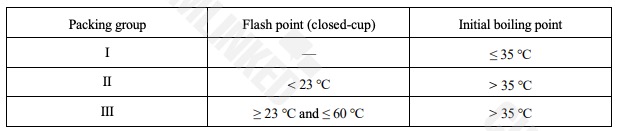
The third class of dangerous goods includes flammable liquids and liquid desensitized explosives. Flammable liquids are liquid or liquid mixtures that emit flammable vapors when flash point is no higher than 60 °C or liquids (such as paints) that contain solids in solution or suspension. Liquids with flash point between 35-60 °C, is not deemed as flammable liquid when a negative result is obtained in continuous flammability test. Liquid desensitized explosives are explosive substances that are dissolved or suspended in water or other liquid substances, to form homogeneous liquid mixtures that suppress their explosive properties.
Flammable liquids are assigned to three different packing groups in accordance with the degree of danger.
Class 4 - Flammable solids; substances liable to spontaneous combustion; substances which, in contact with water, emit flammable gases
Class 4 deals with substances which, under the conditions of their transport, are flammable or may cause a fire, except those classified as explosives.
Division 4.1 Flammable solids
Division 4.2 Substances liable to spontaneous combustion
Division 4.3 Substances which in contact with water emit flammable gases
Class 5 - Oxidizing substances and organic peroxides
Class 5 Dangerous goods are chemicals which may not themselves burn, but may emit oxygen or radiate heat during transport to cause the combustion of other materials. can be divided into:
Division 5.1 Oxidizing substances
Division 5.2 Organic peroxides
Class 6 - Toxic and infectious substances
Class 6 is divided into:
Division 6.1 Toxic substances
These are substances which, upon swallowing, inhalation or skin contact, may cause death or serious injury or harm to human health. However, it is noteworthy that the TDG classification criteria is not completely consistent with that in GHS regulation for this class.
Division 6.2 Infectious substances
Infectious substances are substances that contain pathogen, may causes human or animal infection.
Class 7 - Radioactive material
Radioactive material means a substance that is capable of emitting various types of radiation with radioactive concentrations and total radioactivity in the consignment exceeding specified values.
There is no further divisions to be made in Class 7, the corresponding UN number shall be adopted according to the characteristics of the material, where appropriate. In actual transport practice, the hazard level shall be estimated according to the level of radiation on the surface of the package and the transport index, and shall be marked with corresponding symbols.
Class 8 - Corrosive substances
Corrosive substances are those substances that can seriously damage the biological tissue with which they come into contact through chemical reactions or that can cause damage to other goods or vehicles if scattering from the packaging. This Class includes substances that are corrosive to animal skin, corrosive to metals and that with PH.
Class 9 – Miscellaneous dangerous substances and articles, including environmentally hazardous substances
Class 9 are substances and articles that have potential risk during transportation but not covered by other classes. Including the following divisions:
a) Substances which, on inhalation as fine dust, may endanger health, e.g., UN 2212, UN 2590 in GB 12268- 2025;
b) Substances evolving flammable vapour, e.g., UN 2211, UN 3314 in GB 12268-2025;
c) Lithium batteries, e.g., UN 3090, UN 3091, UN 3480, UN 3481, UN 3536 in GB 12268-2025;
d) Sodium ion batteries, e.g., UN 3551, UN 3552 in GB 12268-2025;
e) Capacitors, e.g., UN 3499, UN 3508 in GB 12268-2025;
f) Live-saving appliances, e.g., UN 2990, UN 3072, UN 3268, UN 3559 in GB 12268-2025;
g) Substances and articles which, in the event of fire, may form dioxins, e.g., UN 2315, UN 3432, UN 3151, UN 3152 in GB 12268-2025;
h) Substances transported or offered for transport at elevated temperatures including elevated temperature liquids at or above 100 °C and elevated temperature solids at or above 240 °C, e.g., UN 3257, UN 3258 in GB 12268-2025;
i) Environmentally hazardous substances, including liquids, solids and mixtures (such as preparations and waste) which cause pollution to the aquatic environment, e.g., UN 3077, UN 3082 in GB 12268-2025;
j) Genetically modified micro-organisms (GMMOs) and genetically modified organisms (GMOs) which do not meet the definition of Division 6.1 toxic substances or Division 6.2 infectious substances, e.g., UN 3245 in GB 12268-2025;
k) Ammonium nitrate based fertilizers, UN 2071 in GB 12268-2025;
l) Other substances or articles presenting a danger during transport, but not meeting the definitions of another class, e.g., UN 1841, UN 1845, UN 1931, UN 1941, UN 1990, UN 2216, UN 2807, UN 2969, UN 3166, UN 3171, UN 3316, UN 3334, UN 3335, UN 3359, UN 3363, UN 3509, UN 3530, UN 3548, UN 3556, UN 3557, UN 3558 in GB 12268-2025.
4 Regulatory system
China utilizes a multi-level system for dangerous goods transport management, with numerous laws and regulations. Regarding marine and aviation transportation, international conventions and regulations are adopted directly, while in inland transportation, the international convention plays a role as a source of law. In the whole regulatory system, the “Regulations on the control over safety of hazardous chemicals” (State Council Decree 591) is the primary legal basis of dangerous goods transport management. The relevant departments have formulated departmental regulations suitable for various modes of transport according to the duties entrusted by Decree 591. Various modes of transport have been centered on these regulations and have developed their independent regulatory systems, including some specific or common technical standards.

Except for GB 6944 and GB 12268, the following mandatory and recommended national standards are also applicable to all modes of transport:
GB 28644.1-2012 Excepted Quantities and Packing Requirements of Dangerous Goods
GB 28644.2-2012 Limited Quantities and Packing Requirements of Dangerous Goods
GB 28644.3-2012 Classification and List of Organic Peroxides
GB/T 191-2008 Packaging - Pictorial Marking for Handling of Goods
Furthermore, each mode of transport has its own regulatory system, the technical content of which is broadly consistent with the UN Model Regulations, but some differences exist. See 4.1 ~ 4.4.
4.1 Transport of dangerous goods by railway
The main departmental regulation on the railway transportation of dangerous goods is the “Provisions on the Supervision and Administration of Railway Transportation Safety of Dangerous Goods”. This regulation was enacted in 2015. A comprehensive revision was drafted for public comments in late 2020. On September 26, 2022, the MOT released the 2022 Provisions on the Supervision and Administration of Railway Transportation Safety of Dangerous Goods to improve the safety supervision and management of railway transportation of dangerous goods and strengthen law enforcement.
Accompanying the publication of the 2022 Provisions, this list was revised and published on October 25, 2022 (see TB/T 30006-2022). For goods not in this list but can be recognized as dangerous goods as per relevant laws, regulations, and standards (e.g., GB 6944), their transport by railway shall also adhere to the 2022 Provisions. The packaging of dangerous goods transported by railway shall be in accordance with the mandatory national standard GB 19359-2009 Safety code for inspection of packaging of dangerous goods transported by railway. The following industrial standards also play an important role in supporting the management of dangerous goods transported by railway:
TB/T 2687-2020 Packaging of Dangerous Goods Transported by Railway
TB/T 30008-2023 Technical Requirements for the Transportation of Dangerous Goods by Railway
4.2 Transport of dangerous goods by road
The Provisions on Road Transport of Dangerous Goods is the current major departmental regulation on road transport of dangerous goods. It was initially issued on July 12, 2005, and has undergone four subsequent revisions in 2013, 2016, 2019, and 2023. Its most recent revision was adopted on November 10, 2023, and took effect on December 4, 2023.
#English Translations
MOT Order 13 of 2023 Provisions on the Road Transport of Dangerous GoodsView now
This departmental regulation stipulates that the classes, divisions and hazard levels of dangerous goods in road transportation shall adhere to the industrial standard JT/T 617 Regulations concerning Road Transportation of Dangerous Goods. JT/T 617 takes a reference from the European Agreement concerning the International Carriage of Dangerous Goods by Road (ADR), and systematically stipulates the operational requirements for dangerous goods classification, transportation and packaging, consignment, loading and unloading, and road transportation.
To improve the advancement and applicability of this industrial standard, the MOT proposed amendments to this industrial standard to align with the ADR (2023 Edition) and invited the public for comments in September 2023. On May 7, 2024, the MOT officially issued the partial amendments to JT/T 617, which took effect immediately.
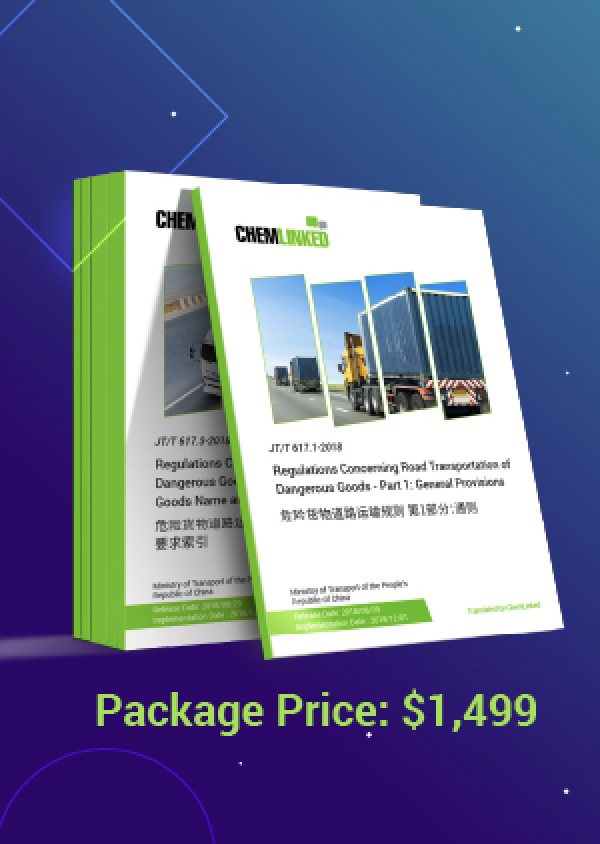
These regulatory updates underline that JT/T 617 become increasingly important for governing dangerous goods road transportation in China. The MOT submitted the national standard project (20241015-Q-348) in May 2024 to elevate the industrial standard JT/T 617 to mandatory national standard. The new mandatory national standard for dangerous goods road transportation derived from JT/T 617 will consider the latest international regulations, especially for the transportation management of lithium batteries. This project has not been finalized so far.
Other standards supporting the management of dangerous goods road transport:
GB 13392-2023 Vehicle Marking of Dangerous Goods for Road Transportation
GB 19269-2009 Safety Code for Inspection of Packaging of Dangerous Goods Transported by Road
4.3 Transport of dangerous goods by waterway
In terms of marine transportation of dangerous goods, China directly adopted the international conventions and regulations, e.g., International Convention for the Safety of Life at Sea (SOLAS Convention) and International Maritime Dangerous Goods Code (IMDG Code). In the case of inland waterway transport, China implements its domestic laws and administrative regulations, including:
Maritime Traffic Safety Law of the People's Republic of China
Marine Environment Protection Law of the People's Republic of China
Law of the People's Republic of China on Ports
Regulations of the People's Republic of China on Administration of Traffic Safety in Inland Rivers
Regulation on the Prevention and Control of Vessel-induced Pollution to the Marine Environment
Regulations on the Safety Management of Hazardous Chemicals (State Council Decree 591)
Specific departmental regulations and supporting standards are also formulated for the safety management of ports, vessels/ships, containers used in transportation of dangerous goods, etc. More specifically,
Port:
Provisions on the Safety Management of Dangerous Goods at Ports, the main departmental regulation of the port's dangerous goods safety management was first issued in 2017 and revised twice in 2019 and 2023. The recent version took effect on August 3, 2023.
Measures for the Supervision and Administration of Major Hazard Installations of Dangerous Goods at Port, took effect on December 1, 2021.
JTS/T328-2024 General Technical Rules for Safety Inspection of Dangerous Goods at Port, took effect on January 1, 2025.
Vessels/ships:
Provisions on the Safety Supervision and Administration of Transport of Dangerous Goods by Ships, the main departmental regulation on safety management of transporting dangerous goods by watercraft. This regulation was first issued in 2018 and revised in 2024. The recent version took effect on March 1, 2025.
Containers:
GB 40163-2021 Safety Technical Specification for Packing Dangerous Goods in containers Transported by Sea, took effect on November 1, 2021.
GB 16994.3-2021 Safety Requirements for Port Operation—Part 3: Dangerous Cargo Container, took effect on December 1, 2022.
4.4 Transport of dangerous goods by air
International aviation
In terms of international transport of dangerous goods by air, China has directly adopted the following international conventions:
Regulations for the Safe Transport of Radioactive Material, by International Atomic Energy Agency
Convention on International Civil Aviation- Annex 18 The Safe Transport of Dangerous Goods by Air
Convention on International Civil Aviation- Annex 18 deals with the air transport of dangerous goods, the provisions of which are implemented through the Technical Instructions for the Safe Transport of Dangerous Goods by Air. Its technical contents are also developed from the UN Recommendations on the Transport of Dangerous Goods. Considering the particularity of air transport, the technical requirements are stricter than that in UN RTDG, however, the core content of the classification, packaging and labeling of dangerous goods is basically the same as that of other modes of transport, so as to ensure the consistency in international transport.
Civil aviation
Based on the Civil Aviation Law of the People's Republic of China, the Regulation on the Transport of Dangerous Goods by Air was launched to strengthen the governance of the domestic transport of dangerous goods by air, promote the development and ensure the safety of the air transport. The regulation was revised in 2024, namely Regulation on Administration of Transport of Dangerous Goods by Air (CCAR-276-R2). CCAR-276-R2 took effect on July 1, 2024, replacing the 2016 version (CCAR-276-R1).
Notably, there is a specific control list of dangerous goods transported by air, i.e., Catalogue of Dangerous Goods for Air Transport (2021). The following provisions were issued to supporting the governance work:
Administrative Measures for the Storage of Dangerous Goods Transported by Air, took effect on January 1, 2019.
Administrative Measures for the Temporary Storage of Dangerous Goods Transported by Air, took effect on March 1, 2023.
Administrative Procedures on the Licensing for Dangerous Goods Air Transport by Public Air Transport Operators, took effect on July 19, 2024.

