

 Request a Demo
1 Overview
The Toxic Substances Control Act (TSCA) was first enacted in 1976. It is the United States’ primary law for chemical management and provides the U.S. Environmental Protection Agency (EPA) with the authority to require reporting, record-keeping, testing and restrictions, etc. relating to chemical substances and mixtures.
In June 2016, President Obama signed into law the Frank R. Lautenberg Chemical Safety for the 21st Century Act (the Lautenberg Act) to amend the TSCA of 1976. The new law strengthens the EPA’s authority to manage existing and new chemical substances in commerce.
TSCA can apply to a chemical substance or mixture or any article containing such substance manufactured, processed, distributed in commerce, used or disposed of in the United States. Certain substances that regulated by other Federal programs, including pesticides, tobacco, specified nuclear material, firearms and ammunition, food, food additives, drugs, and cosmetics are generally excluded from TSCA.
2 History
Current Titles of TSCA include:
Title I - Control of Toxic Substances
Title II - Asbestos Hazard Emergency Response
Title III - Indoor Radon Abatement
Title IV - Lead Exposure Reduction
Title V - Healthy High-Performance Schools
Title VI - Formaldehyde Standards for Composite Wood Products
The legislative history of TSCA is as shown in the figure.
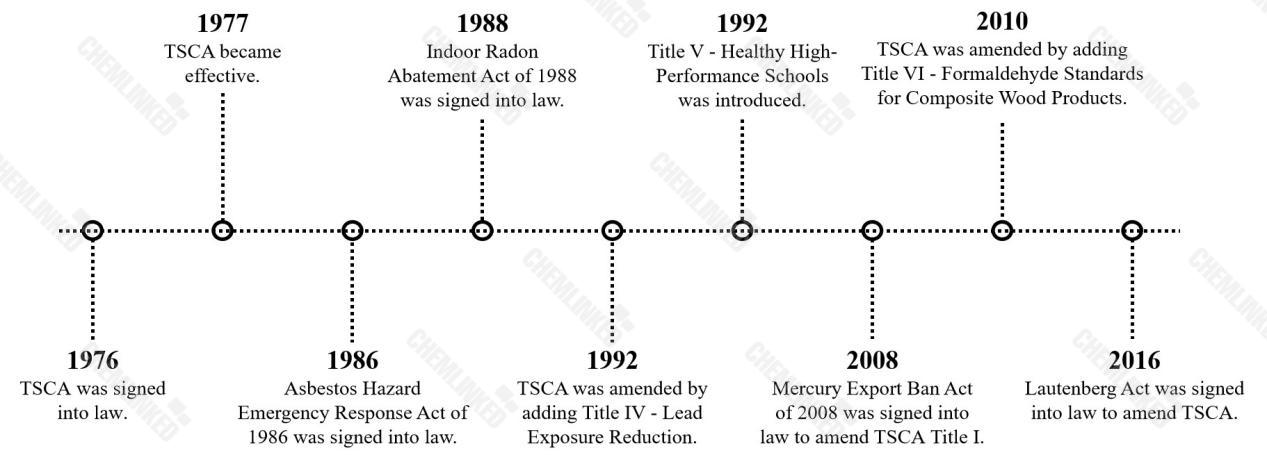 Graphic.1 A Brief History of TSCA
3 Regulatory Authority
TSCA regulatory authority and program implementation rests predominantly with the EPA. The Act protects human health and the environment by authorizing EPA to require reporting and record-keeping requirements, to issue rules requiring the testing of specific chemicals and to establish regulations that restrict the manufacturing, processing, distribution in commerce, use and disposal of chemicals and mixtures.
Generally speaking, TSCA authorizes EPA to:
Gather basic information on chemical risks from chemical manufacturers and processors;
Require companies to test chemicals and mixtures for toxic effects;
Review most new chemicals before they are manufactured; and
Prevent unreasonable risks by regulating chemicals and mixtures, ranging from hazard warning labels to the outright ban on the manufacture, processing, distribution in commerce or use of certain chemicals and mixtures.
4 TSCA Inventory
The TSCA Inventory contains all existing chemical substances manufactured, processed, or imported in the United States for uses under TSCA. If a chemical is on the Inventory, the substance is considered an existing chemical substance in U.S. commerce. Any chemical that is not on the Inventory is considered a new chemical substance. A new substance will become an existing substance after EPA’s review, so the Inventory continues to grow, and the non-confidential portion now lists about 86,770 chemicals.
The non-confidential Inventory can be accessed here. On the other hand, a manufacturer or importer can request EPA to search the confidential Inventory by submitting a Bona Fide Intent to Manufacture or Import Notice (“bona fide notice”). In a bona fide notice, a submitter must provide specific chemical identification data (click here to know more details).
 Graphic.2 Understanding the TSCA Inventory Structure
5 Assessing and Managing Chemicals under TSCA
TSCA requires EPA to carry out a prioritization process for existing chemicals that may be designated as high priority for risk evaluation. If at the end of the risk evaluation process a chemical presents an unreasonable risk to health or the environment, the actions to address unreasonable risks must be taken, including, but not limited to, regulatory restrictions on the manufacture, processing, distribution, use or disposal of the chemical.
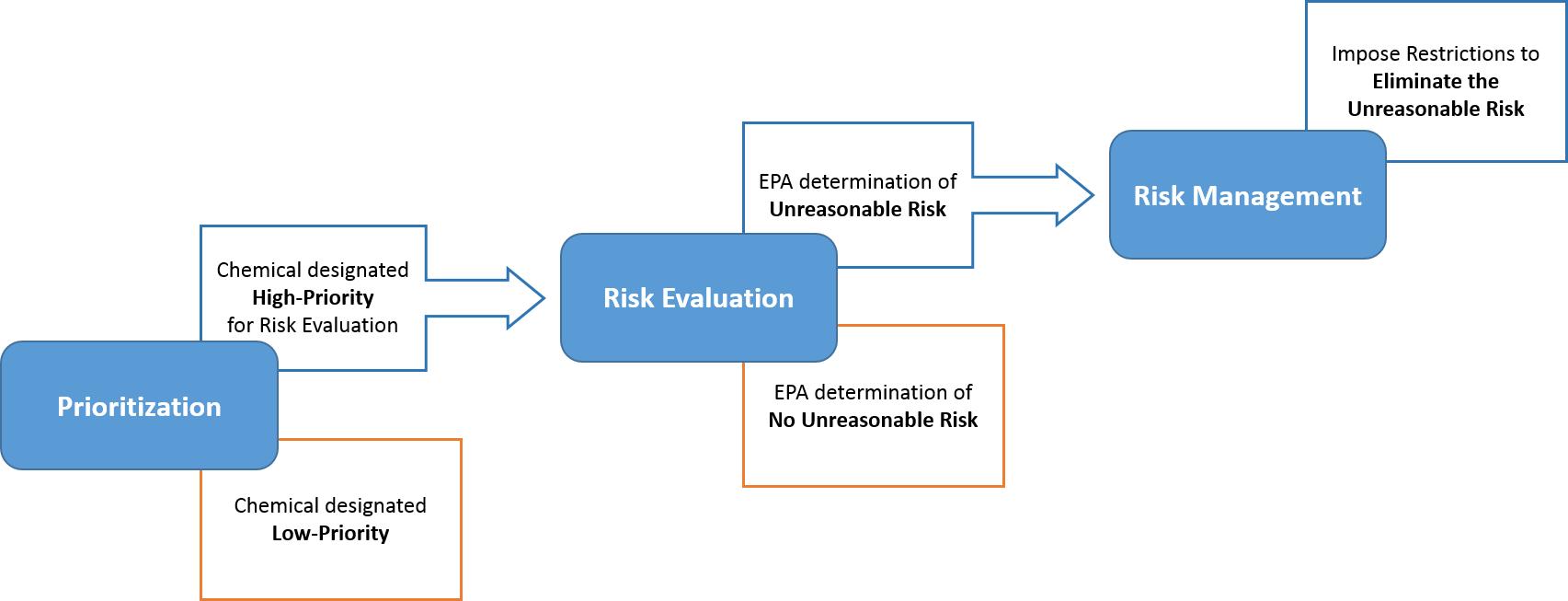
Graphic.3 Overview of EPA’s Process for Evaluating the Safety of Existing Chemicals
Latest update: On July 26, 2024, EPA proposed to designate Acetaldehyde, Acrylonitrile, Benzenamine, Vinyl Chloride and 4,4’-Methylene bis(2-chloroaniline) (MBOCA) as High-Priority Substances for risk evaluation under TSCA. If finalized, risk evaluations for these chemicals will begin.
6 Industry Obligations
6.1 Obligations of Existing Chemical Substances
For existing chemical substance listed on the Inventory, the manufacturers or importers are requested to check if there is any Import Certification, Significant New Use Rules (SNURs), Chemical Data Reporting Rule (CDR) for their product, or if meet the Active-Inactive Rule.
6.1.1 Import Certification
Imports of any chemical substance, mixture, or article containing a chemical substance or mixture must comply with TSCA in order to enter the U.S. market. Importers are required to certify that their imported chemical substances or mixtures (no matter by mail or commercial carrier, including R&D applications) are either: (1) in compliance with TSCA Sections 5, 6 and 7 at the time of import (positive certification); or (2) not subject to TSCA (negative certification). The current TSCA Import Rule does not pertain to importation of articles (no certification).
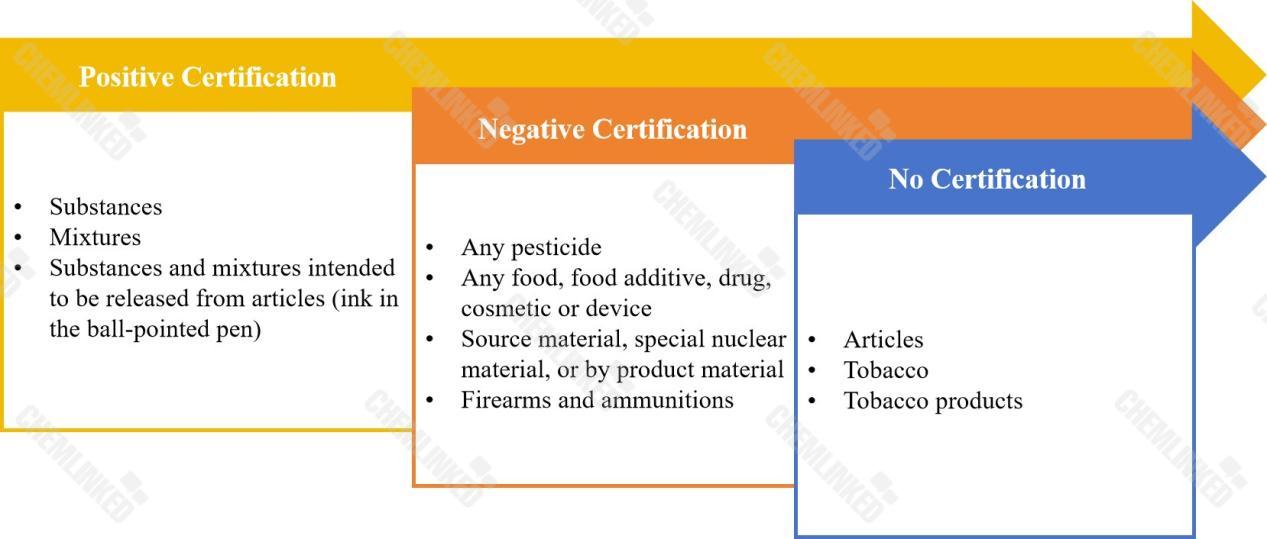 Graphic.4 TSCA Import Certification
A certification must be signed and filed electronically or in writing with U.S. Customs and Border Protection (CBP) by the importer or an authorized agent of the importer, indicating the certifier's name, email address, and telephone number.
6.1.2 Significant New Use Notice (SNUN)
TSCA Section 5(a) requires manufacturers, importers, and processors of existing chemicals to notify EPA at least 90 days before they manufacture, import, or process a substance for a use that has been designated as a “significant new use”.
A “significant new use” may be determined by EPA after considering all relevant factors, including:
Projected volume of manufacturing and processing of a chemical substance;
Extent to which a use changes the type or form of exposure of humans or the environment to a chemical substance;
Extent to which a use increases the magnitude and duration of exposure of humans or the environment to a chemical substance; and
Reasonably anticipated manner and methods of manufacturing, processing, distribution in commerce, and disposal of a chemical substance.
6.1.3 Chemical Data Reporting (CDR)
The Chemical Data Reporting (CDR) rule established recurring reporting requirements for manufacturers and importers of chemical substances on the TSCA Inventory. They are required to report basic exposure-related information including information on the types, quantities and uses of chemical substances produced domestically and imported into the United States every four years.
Reporting Threshold
In general, the annual reporting threshold is 25,000 lbs or more of a chemical substance at any single site. However, a reduced reporting threshold (2,500 lbs) applies to chemical substances subject to any of the below TSCA actions:
A rule proposed or promulgated under TSCA sections 5(a)(2) Significant New Use Rules for Existing Chemicals, 5(b)(4) Concern List or 6 Import/Export Requirements for Specific Chemicals;
An order issued under TSCA Section 4 Test Orders, 5(e) or 5(f) Consent Orders; or
Relief that has been granted under a civil action under TSCA sections 5 Significant New Use Rules or 7 Judicial Actions.
Submission Period
For the 2024 submission period, the need to report is based on the volume for any one of the calendar years 2020-2023. The 2024 submission period runs from June 1, 2024, to September 30, 2024.
6.1.4 Active-Inactive Rule
Identifying the commercial status of existing substances on the TSCA Inventory as either “active” or “inactive” is critical. Manufacturers, importers and processors are required to notify EPA before reintroducing inactive substances into U.S. commerce.
Specifically, substances designated as “inactive” on TSCA inventory must be notified to the US EPA via Notice of Activity Form (NOA-B) 90 days prior to planned manufacture, import or processing. On receiving such notification, EPA will change the commercial activity designation of inactive substances to active.
6.1.5 Other Major Reporting Rules (Asbestos, PFAS, Mercury)
In addition to the CDR rule, there are three other reporting rules under TSCA.
Asbestos Reporting Rule
In July 2023, the reporting and recordkeeping requirements for asbestos were finalized. This final rule was effective August 24, 2023. The details of the rule are shown in the table below.
| Who's Affected | Manufacturers, importers or processors of asbestos and asbestos-containing articles (including as an impurity) between 2019 and 2022 with annual sales above $500,000 (combined with their parent company). |
Applicable Scope | The following types of asbestos in bulk form, in an article and/or product, as an impurity, or as a component of a mixture:
|
| Primary Data Requirements |
|
| Recordkeeping requirements | A five-year recordkeeping period, beginning on the last date of the submission period. |
Data Submission Period | From Feb 24, 2024 to May 24, 2024. |
PFAS Reporting Rule
In October 2023, the reporting and recordkeeping requirements for Per- and Polyfluoroalkyl Substances (PFAS) were finalized under TSCA. This final rule was effective on November 13, 2023. The details of the rule are listed in the table below.
| Who's Affected | Any entities, including small entities, that have manufactured or imported PFAS or PFAS-containing articles in any year since January 1, 2011 through December 31, 2022. Note: the manufacture or importation of PFAS as a byproduct, an impurity, or a non-isolated intermediate is not exempt. |
Applicable Scope | PFAS (*) or PFAS-containing articles. |
| Primary Data Requirements | The following information for each PFAS, for each year in which that substance was manufactured since January 1, 2011 is required to be submitted:
|
| Recordkeeping requirements | To retain records that document any information reported to EPA for five years, beginning on the last date of the information submission period. |
Reporting Deadlines | May 8, 2025 (November 10, 2025 for small article importers). |
*PFAS is defined as including at least one of these three structures:
R-(CF2)-CF(R′)R″, where both the CF2 and CF moieties are saturated carbons;
R-CF2 OCF2-R′, where R and R′ can either be F, O, or saturated carbons; and
CF3 C(CF3)R′R″, where R′ and R″ can either be F or saturated carbons.
Mercury Inventory Reporting Rule
On June 27, 2018, EPA finalized a rule to require reporting from persons who manufacture or import mercury or mercury-added products, or otherwise intentionally use mercury in a manufacturing process. This final rule was effective August 27, 2018. The table below shows the major details.
| Who's Affected | Any companies, organizations, or individuals who manufacture or import mercury or mercury-added products or intentionally use mercury in a manufacturing process. |
Applicable Scope | Mercury (elemental mercury [CAS: 7439-97-6] or a mercury compound) or mercury-added products. |
| Primary Data Requirements | In general, the data to report are:
|
| Recordkeeping requirements | Records relevant to a reporting year must be retained for a period of 3 years beginning on the last day of the reporting year. |
Deadlines | Reporting:
Recordkeeping:
|
6.2 Obligations of New Chemical Substances
6.2.1 Pre-manufacture Notice (PMN)
For new chemical substances not listed on the U.S. TSCA Inventory, a Pre-manufacture Notice (PMN) should be submitted to EPA at least 90 days before manufacturing/importing the substance for a non-exempt commercial purpose, unless the substance meets a TSCA reporting exclusion (e.g., is a naturally-occurring material) or is exempt from PMN reporting (e.g., is an exempted polymer).
PMN submissions must include all available data, including:
Chemical identity, structure and formula;
Process diagram and description;
Production volume;
Byproducts and impurities;
Intended use;
Environmental release;
Disposal practices;
Human exposure; and
Existing available test data on the effect to human health or the environment.
The flowchart describes the EPA's process to review PMNs under TSCA.
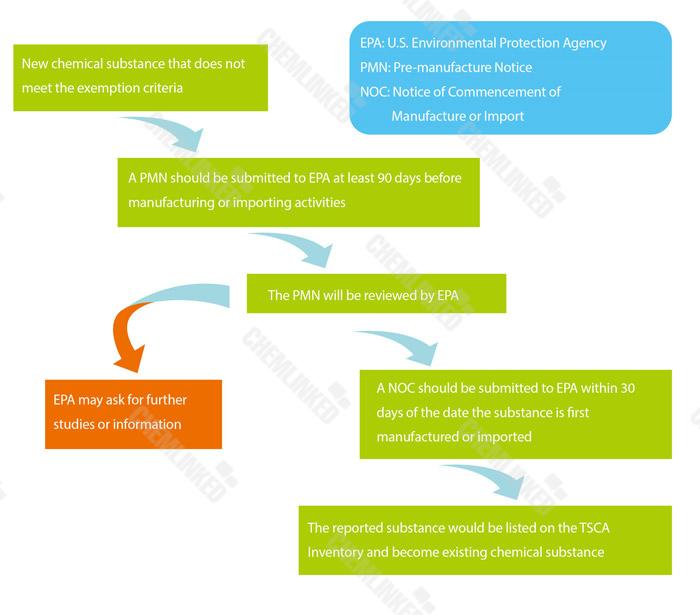 Graphic.5 PMNs Review Process
6.2.2 Notice of Commencement (NOC)
After successfully completing PMN, the PMN submitter needs to provide a Notice of Commencement (NOC) of Manufacture or Import to EPA within 30 days of the date when the substance is first manufactured or imported for nonexempt commercial purposes. This substance will then be added to the Inventory and become an existing chemical.
Please note, NOC is required to any new chemical substance that benefit from certain PMN exemptions. However, TSCA compliance certification is still required to import these chemicals.
6.2.3 PMN Exclusions and Exemptions
The following substances are not subject to the PMN requirements (click here for more details):
naturally-occurring materials;
products of incidental reactions;
products of end-use reactions;
mixtures (but not mixture components);
impurities or byproducts;
substances manufactured solely for export;
non-isolated intermediates;
substances formed during the manufacture of an article.
There are five types of PMN exemptions, of which the LVE, LoREX and TME require advance approval from the EPA.
| Case | Is Application Required? | Applicable Scope | Review Period | Note |
| Low Volume Exemption (LVE) | Yes | New chemical substances manufactured at 10,000 kg/year or less. | 30 days |
|
| Low Releases and Low Exposures (LoREX) Exemption | Yes | New chemical substances satisfying all of the following low environmental release and low human exposure eligibility criteria, regardless of their volume:
| 30 days |
|
| Test Marketing Exemption (TME) | Yes | New chemical substances manufactured or imported for test marketing purposes. | 45 days |
|
| Research and Development (R&D) Exemption | No | New chemical substances only in small quantities (not greater than reasonably necessary) solely for specific R&D activities (solely for purposes of scientific experimentation or analysis, or chemical research on, or analysis of such substance, or another substance, including such research or analysis for the development of a product). | / | A manufacturer or importer may utilize the R&D exemption without notifying the authority, but must keep the following records for 5 years after they are developed (40 C.F.R. § 720.78 (b)(3)).
|
| Polymer Exemption | No | New chemical substances satisfying the following polymer criteria:
Note: Polymers which degrade, decompose, or depolymerize are ineligible for the exemption. Also ineligible are several classes of polymers:
| / |
|
Updates:On May 16, 2023, EPA proposed several amendments (click here to know more about the updates) to the regulations for LVEs and LoREXs, which include requiring EPA approval of an exemption notice prior to commencement of manufacture, providing that certain persistent, bioaccumulative, toxic (PBT) chemical substances are ineligible for these exemptions, consistent with EPA’s 1999 PBT policy. In response to requests for additional time to develop and submit comments on the proposed rule, EPA extended the comment period for an additional 14 days, i.e., from July 25, 2023, to August 8, 2023.
6.2.4 TSCA Fees
The 2016 amendments to TSCA provided EPA with expanded authority to collect fees from eligible TSCA activities to help defray up to 25% of the costs associated with overall TSCA implementation efforts. EPA finalized the first fees rule under amended TSCA in 2018 and revised the 2018 TSCA fees rule in February 2024. The 2024 final rule was effective on April 22, 2024. As required by law, EPA will evaluate and readjust, if necessary, the fees every three years.
The current fees under TSCA Section 5 are listed below:
| Fee category | Current fees for non-small business | Current fees for small business |
| PMN (including intermediate)/SNUN | $37,000 | $6,480 |
| LoREX, LVE, TME | $10,870 | $2,180 |
As a general matter, most fee responsibilities under the final rule are assigned to chemical manufacturers or importers. In certain circumstances, fees may also apply to chemical processors (e.g., when a processor submits a SNUN under TSCA section 5 or is identified in a TSCA section 4 test order).
7 Resources
News
Feb 29, 2024 US EPA Finalizes Amended TSCA Fee Rules
Feb 17, 2023 Latest Update to the U.S. TSCA Inventory
Mar 24, 2020 TSCA’s 20 High-Priority Substances - Requirements for Manufacturers/importers to Self-Identify
Regulatory Database
Updates to New Chemicals Regulations Under the Toxic Substances Control Act (TSCA)
Fees for the Administration of the Toxic Substances Control Act (TSCA)
Webinars
