

 Request a Demo
Introduction
Taiwan introduced the RoHS-like regulation by the publication of CNS 15663 “Guidance to reduction of the restricted chemical substances in electrical and electronic equipment”. CNS 15663 covers the concentration limits of restricted chemical substances in electrical and electronic equipment, marking requirements, exemption conditions, etc. Taiwan RoHS applies to electrical and electronic equipment (EEEs) manufactured in or imported to Taiwan and took effect on 1 Dec 2016.
Competent Authority
The Bureau of Standards, Metrology and Inspection (BSMI) under the Ministry of Economic Affairs (MOEA) is the competent authority responsible for Taiwan RoHS.
Restricted Substances
Six substances are currently restricted under CNS 15663. They are:
| Restricted substance | Maximum threshold limits |
| Cadmium (Cd) and its compounds | 0.01% |
| Lead (Pb) and its compounds | 0.1% |
| Mercury (Hg) and its compounds | |
| Chromium VI (Cr+6) and its compounds | |
| Polybrominated biphenyls (PBB) | |
| Polybrominated diphenyl ethers (PBDE) |
Note:
Testing standard for restricted substances is according to CNS 15050 Electrical and electronic products -Measurement methods for 6 restricted substances (lead, mercury, cadmium, hexavalent chromium, polybrominated biphenyls, polybrominated diphenyl ethers).
For mercury level in fluorescent lamps, the test method is CNS 15479 Method for determination of mercury level in fluorescent lamps.
Regulated Scope
EEEs refer to devices and accessories with a nominal working voltage under 1,500 V DC, or 1,000 V AC, including these listed in Annex B of CNS 15663. These products can encompass a vast array of items, from everyday consumer products to industrial machinery and commercial equipment.
Large household appliances
Small household appliances
IT and telecommunication equipment
Consumer equipment
Lighting equipment (including electric light bulbs and household luminaires)
Electrical and electronic tools (with the exception of large-scale stationary industrial tools)
Toys, leisure and sports equipment
Automatic dispensers
Other equipment covered by CNS 60335-1 and CNS 15598-1
Exemption Conditions
EEEs meeting one of the criteria below are not regulated by Taiwan RoHS. The details are shown in Annex C of CNS 15663.
Products intended to protect national security and/or for military purposes
Products where electricity is not the main power source
Products where the electrical and electronic components are not needed to fulfill the primary function
Electrical and electronic equipment that is part of another type of product
Batteries
Large-scale stationary industrial tools
In addition, Annex D of CNS 15663 provides 37 conditions can be exempt from the concentration limit of restricted substances.
Designated EEEs and RoHS Compliance Deadlines
CNS 15663 is not mandatory and only EEEs designated and announced by the BSMI are required to be compliant with the standard. BSMI has announced batches of EEEs and set different deadlines for full compliance with Taiwan RoHS. So far most EEEs have already passed the deadline and require compliance with Taiwan RoHS. Please see below table for details.
Obligation
EEEs which contain restricted substances exceeding corresponding concentration limit can still be placed on the market. However, marking of presence of the restricted substances in accordance with CNS 15663 is required. In addition, according to the Commodity Inspection Act, no EEEs subject to inspection shall be released from the production premises, nor be exported or imported, if it does not conform to the inspection requirements.
Marking of Presence(含有标示)
Based on the content determination of restricted substances in units and accessories of the products, a table like below should be made according to the requirements in Chapter 5 of CNS 15663. It should be located on the equipment body, package container (box), or instruction book.
Pls see example below
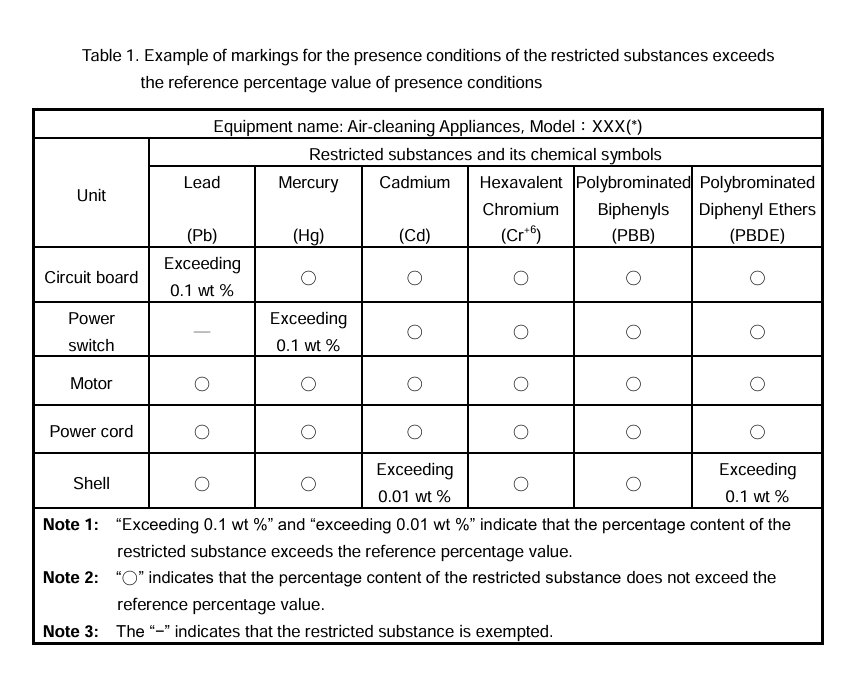
When the content exceeds the concentration limit, the “numerical value of percentage content (wt %)” shall be marked, i.e. “exceeding 0.1 wt%” or “exceeding 0.01 wt%”.
If corresponding to the exemption conditions specified in Annex D of CNS 15663, the “—” shall be marked. For example, mercury content in single capped (compact) fluorescent lamp is exempt from the limit standards of restricted substances.
When the content does not exceed the concentration limit, the symbol “O” or the wording “not exceeding the concentration limit shall be marked.
BSMI Commodity Inspection Mark (商品检验标识)
According to the Commodity Inspection Act, EEEs are subject to appropriate conformity assessment/inspection schemes as determined by the BSMI (announced along with the designation of EEEs).
EEEs inspection shall be conducted in the following three schemes:
1. RPC: Registration of Product Certification (验证登陆)
In applying for registration of product certification, manufacturers or importers shall submit an application form to the BSMI and annex thereto relevant information and technical documents written in traditional Chinese.
2. TABI: Type Approved Batch Inspection (型式认可逐批检验)
For EEES subject to batch-by-batch inspection, the manufacturer or importer shall file a batch-by-batch inspection application with the BSMI. EEEs included in the same inspection application shall be the EEEs of the same category, same type, or the same specifications, unless otherwise approved by the BSMI.
After the products have passed the inspection, they will be allowed to use the Commodity Inspection Mark with the letter ‘T’ and the identification number given by the BSMI. The application fee for a Type Approval is NT$3,500, and a Type Approval certificate is valid for 3 years. The fees for type testing vary by products and depend on the fee policies of the testing laboratories.
For EEEs that failed the inspection, the BSMI shall issue an unsatisfactory inspection notice to the manufacturer or importer, who shall in turn apply for a re-inspection at no cost within fifteen days after receiving the said notice.
3. DOC: Declaration of Confirmation (符合性声明)
The Declaration of Conformity (DoC) is a document executed and issued by the manufacturer or importer of a designated EEE to declare its compliance with the inspection standards.
For EEEs that passed the BSMI inspection, a certificate of "registration of product certification" (商品验证登录证书) will be issued. An inspection mark (see below) should be labeled on the products.
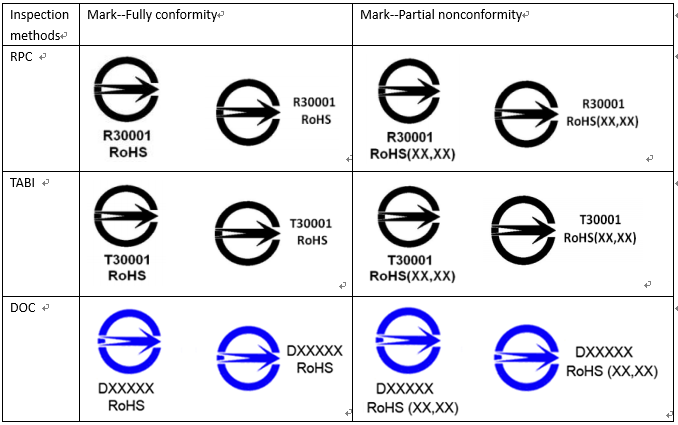
Each mark bears a 5-digit identification number starting with "R", "T" or "D". The identification number and “RoHS” shall be placed to the below or right of the graphic symbol;
“RoHS” means that all the six restricted substances do not exceed concentration limits;
“RoHS(XX, XX)” means that the product contains certain restricted substances exceeding concentration limits. For example, RoHS (Cd, PBB) indicates that Cd and PBB contained in product exceed concentration limits.
