

 Request a Demo
What is China GHS
China GHS, the localized “Globally Harmonized System of classification and labelling of chemicals” has been commenced since 2008 by adopting the UN GHS Rev.2. This initiative fulfils China’s international commitment made during the Johannesburg Conference on September 4, 2002. China fully implemented GHS for both substances and mixtures from 2011, following the enactment of the key legislation on management of hazardous chemicals, “Regulations on the Control over Safety of Hazardous Chemicals” (a.k.a. Decree 591). Decree 591 mandates the classification, safety data sheet and labeling of hazardous substances. With the publication of supporting standards GB 30000.2-2013 ~ GB 30000.29-2013, China adopted UN GHS Rev.4 in November 2014.
On July 24, 2024, China issued GB 30000.1-2024 to replace GB 13690-2009, adopting UN GHS Rev.8 for the general rules of chemical classification and labeling. It shall take effect from August 1, 2025. To further eliminate version differences among these national standards, the official reassures that the other 28 parts of GB 30000 series (currently adopt UN GHS Rev.4) are expected to be revised in due course. Moreover, the revision to the guide standard for GHS label preparation, GB 15258, is also in progress (Read more).
To achieve effective cooperation between the relevant enforcing authorities, China developed the inter-ministry conference system for GHS implementation, which involved 12 national departments including the Ministry of Ecology and Environment (MEE), the Ministry of Transport (MOT), the Ministry of Agriculture and Rural Affairs (MOA), the National Development Reform Commission (NDRC) and the General Administration of Customs of China (GACC), etc. China’s Ministry of Industry and Information Technology (MIIT) is the chief administrator for these integrations. Besides, the Ministry of Emergency and Management (MEM) and the Standardization Administration of China (SAC) are also actively engaged in the formulation of relevant China GHS standards.
Apart from providing better protection against chemical hazards for Chinese citizens, China GHS is also considered the technical basis for establishing environmentally sound management of chemicals within the country.
China GHS Standards System
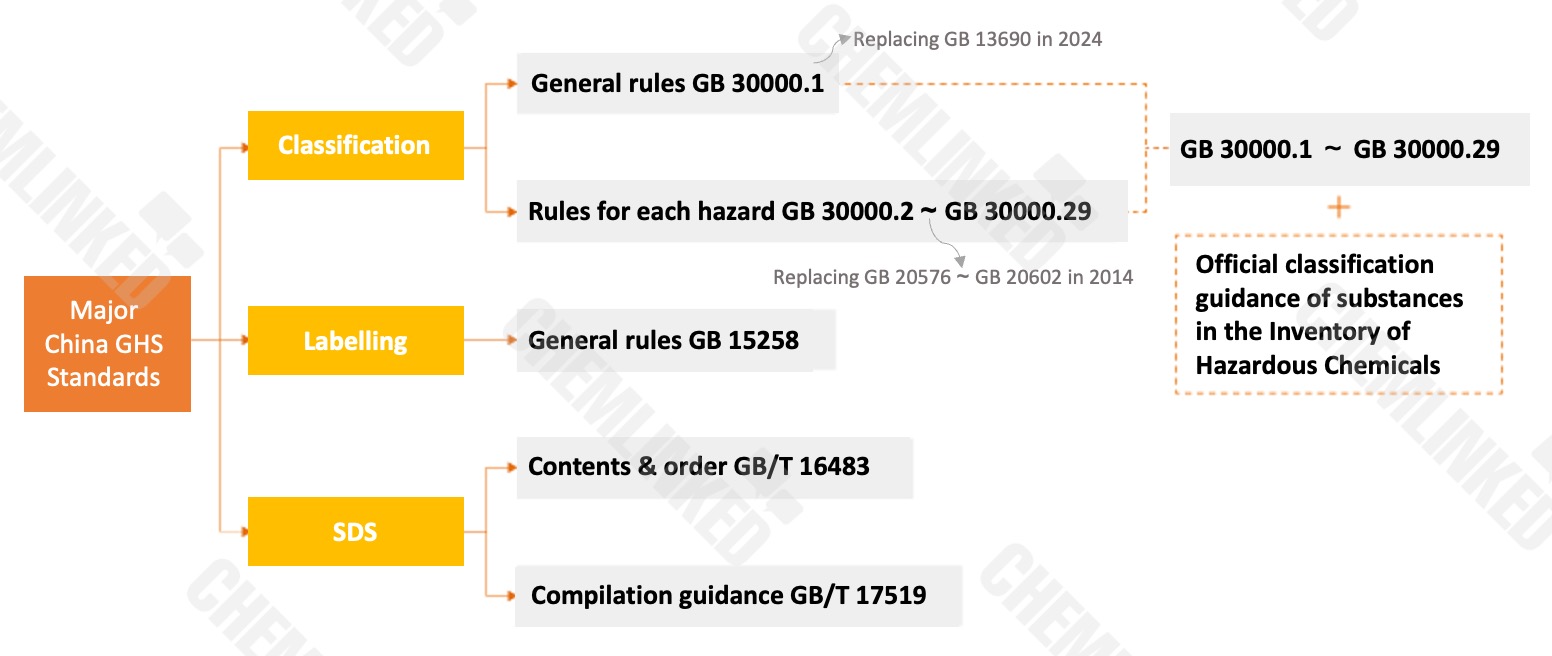
Fig. 1 - China GHS Standards System
Consisting of three parts – classification, labelling and SDS, China’s GHS criteria have been enacted since June 2006 with specific grace periods lasting until 2011. In 2008, 26 classification standards (GB 20576 ~ GB 20602) entered into force based on the 26 GHS chemical hazards of UN GHS Rev.2. More national standards (including the compulsory GBs and the recommended GB/Ts) were enacted in the following years to customize the UN GHS criteria for different usage scenarios in China, with all of their technical content cross-referenced. More specifically:
GB 13690-2009 General rules for the classification and hazard communication of chemicals
GB 15258-2009 General Rules for Preparation of Precautionary Label for Chemicals
GB/T 16483-2008 Safety data sheet for chemical products – Content and order of sections
GB/T 17519-2013 Guidance on the compilation of safety data sheet for chemical products
In 2013, China published 28 compulsory national standards (GB 30000.2 ~ GB 30000.29) that adopted hazard classes in the UN GHS Rev.4 to replace the 26 old classification standards from 2014. On July 24, 2024, the GB 30000.1-2024 Specification for classification and labelling of chemicals—Part 1:General rules was published to replace GB 13690-2009 for general specifications of GHS implementation in China. GB 30000.1-2024 adopts the UN GHS Rev.8 and shall take effect from August 1, 2025. To further eliminate revision differences, certain outdated technical standards will be revised to align with the latest GHS criteria. Although the revision work is underway, results will not be forthcoming soon. The major effective standards are shown in Fig 1.
This GHS standards system is designed exclusively for existing hazardous chemicals in China. The definition of "hazardous chemicals" is given in the State Council Decree 591, the supreme legislation on hazardous chemicals management and the primary legal base of China GHS enforcement. In practice, Decree 591 demands people to refer to the determination principles specified in the China Inventory of Hazardous Chemicals (2015) to determine whether a chemical substance falls under the group, thus requiring China GHS compliance.
Classification
Details of the China GHS classification criteria can be referred to the national compulsory standards, GB 30000.1-2024 and 29 GBs (GB 30000.2-2013 ~ GB 30000.29-2013, GB 30000.30-2025) on the classification, precautionary labelling and precautionary statements for specific chemical hazards.
SN. | Standard No. | Standard Tile | Replaced Standard |
1 | General rules | ||
| 2 | GB 30000.2-2013 | Explosives | GB 20576-2006 |
| 3 | GB 30000.3-2013 | Flammable gases | GB 20577-2006 |
| 4 | GB 30000.4-2013 | Aerosols | GB 20578-2006 |
| 5 | GB 30000.5-2013 | Oxidizing gases | GB 20579-2006 |
| 6 | GB 30000.6-2013 | Gases under pressure | GB 20580-2006 |
| 7 | GB 30000.7-2013 | Flammable Liquids | GB 20581-2006 |
| 8 | GB 30000.8-2013 | Flammable Solids | GB 20582-2006 |
| 9 | GB 30000.9-2013 | Self-reactive substances and mixtures | GB 20583-2006 |
| 10 | GB 30000.10-2013 | Pyrophoric liquids | GB 20585-2006 |
| 11 | GB 30000.11-2013 | Pyrophoric solids | GB 20586-2006 |
| 12 | GB 30000.12-2013 | Self-heating substances and mixtures | GB 20584-2006 |
| 13 | GB 30000.13-2013 | Substances and mixtures, which in contact with water, emit flammable gases | GB 20587-2006 |
| 14 | GB 30000.14-2013 | Oxidizing liquids | GB 20589-2006 |
| 15 | GB 30000.15-2013 | Oxidizing solids | GB 20590-2006 |
| 16 | GB 30000.16-2013 | Organic peroxides | GB 20591-2006 |
| 17 | GB 30000.17-2013 | Corrosive to metals | GB 20588-2006 |
| 18 | GB 30000.18-2013 | Acute toxicity | GB 20592-2006 |
| 19 | GB 30000.19-2013 | Skin corrosion/irritation | GB 20593-2006 |
| 20 | GB 30000.20-2013 | Serious eye damage/eye irritation | GB 20594-2006 |
| 21 | GB 30000.21-2013 | Respiratory or skin sensitization | GB 20595-2006 |
| 22 | GB 30000.22-2013 | Germ cell mutagenicity | GB 20596-2006 |
| 23 | GB 30000.23-2013 | Carcinogenicity | GB 20597-2006 |
| 24 | GB 30000.24-2013 | Reproductive toxicity | GB 20598-2006 |
| 25 | GB 30000.25-2013 | Specific target organ toxicity - Single exposure | GB 20599-2006 |
| 26 | GB 30000.26-2013 | Specific target organ toxicity - Repeated exposure | GB 20601-2006 |
| 27 | GB 30000.27-2013 | Aspiration hazard | |
| 28 | GB 30000.28-2013 | Hazardous to the aquatic environment | GB 20602-2006 |
| 29 | GB 30000.29-2013 | Hazardous to the ozone layer | |
| 30 | GB 30000.30-2025 | Desensitized explosives |
GB 30000.2-2013 ~ GB 30000.29-2013 took effect from November 1, 2014, and replaced the former 26 standards (GB 20576 ~ GB 20602). Compared with the old standards, these 28 parts of GB 30000 series incorporates two more categories namely "aspiration hazard" and "hazardous to the ozone layer". Notably, GB 30000.1-2024 introduces a new hazard class for desensitized explosives. The formulation of GB 30000.X-202X for desensitized explosives was initiated in 2019 and the draft has been consulted many times from 2020 to 2025. On June 30, 2025, GB 30000.30-2025 was issued, this mandatory national standard is expected to be assigned to GB 30000.30.
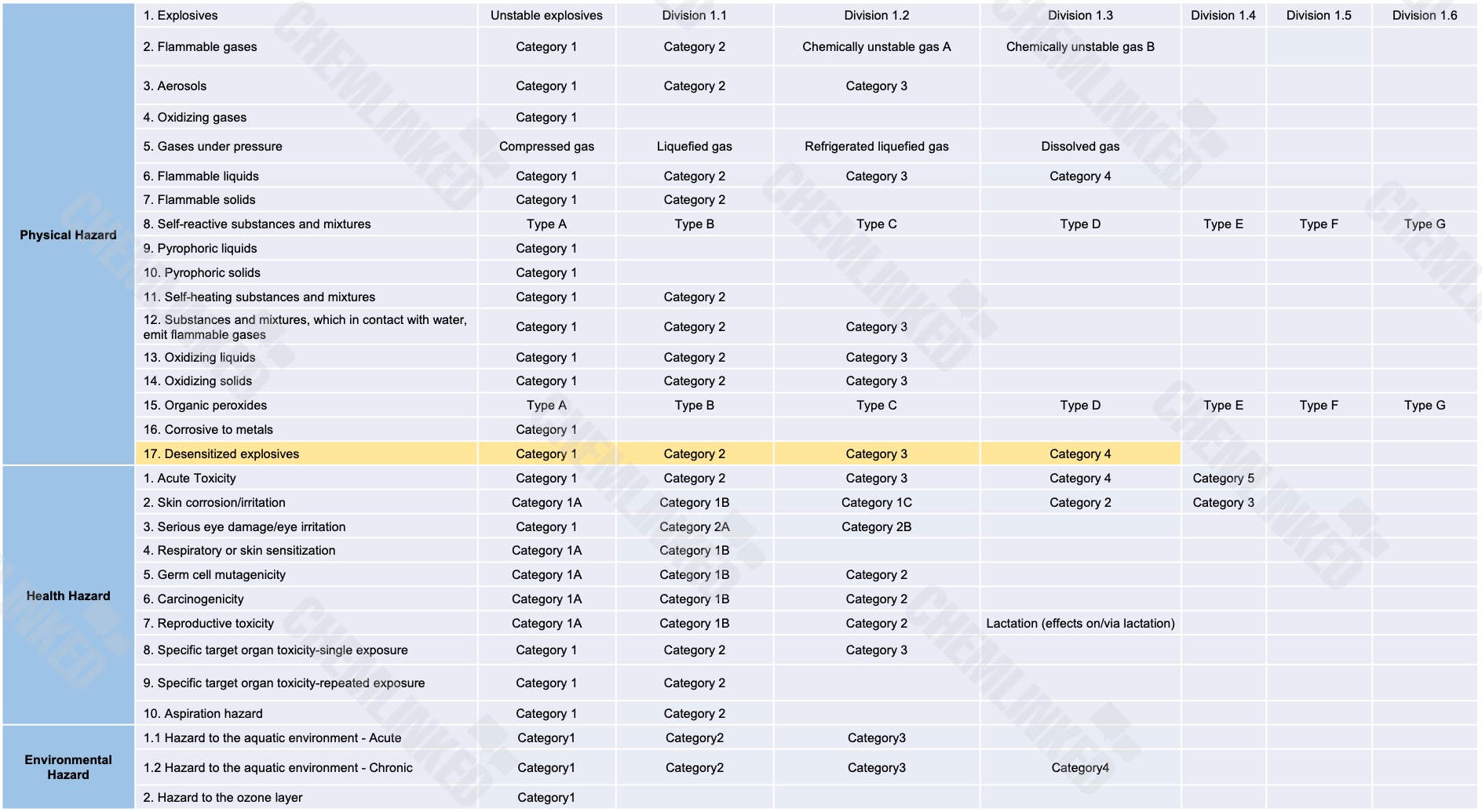
All the hazard classes and categories in UN GHS Rev.4 have been adopted by China, including 16 physical hazards, 10 health hazards, and 3 environmental hazards. Besides, the physical hazard class ‘desensitized explosives’ (marked in yellow), which was first incorporated as a new hazard class under UN GHS Rev.6, is also adopted by China GHS. The following table shows the “building blocks” adopted in China so far.
In addition, in the Guidance for the Implementation of China 2015 Inventory of Hazardous Chemicals (Trial) published on August 19, 2015 by SAWS, official classification results are provided for all the chemicals listed in the Inventory of Hazardous Chemicals (2015). While following these classification results are generally taken as a mandatory requirement, the "lowest classification" and "incomplete classification" principles allow the industry to make their own decisions to a certain extent.
Lowest Classification: only the lowest applicable hazard classification results are specified for the listed chemicals; Companies can assign higher sub-categories under the same hazard category based on the available and reliable data.
Incomplete Classification: The guidance does not include the complete hazard categories of the chemicals; companies should supplement other hazard categories by consulting the data of their own, without changing the hazard categories listed in the guidance.
In case there is any disagreement with the official classification and which is not applicable to the principles stated above, companies can submit their opinions and source data to NRCC for expert review.
Labelling
Labeling is one of the foremost GHS hazard communication elements. A GHS label presents essential hazard data of a chemical product with the following major components:
Product identifier
Signal words
Pictograms
Hazard statements (H-phrases)
Precautionary statements (P-phrases)
Supplier identification
The GHS label is usually affixed/attached to the immediate container of a hazardous chemical product or printed on the outer packing of the product.
The primary China GHS label standard, GB 15258-2009, which has been implemented since 1 May 2010, illustrates essential label elements in a precautionary label (including the precedence of pictograms and hazard information) and other important issues relating to the content, color, size, format, printing, placement and use of the label. Compared to the UN GHS, China GHS labelling system has a distinct feature of requiring the provision of a 24-hour emergency telephone number. The emergency telephone must be a Chinese domestic land-line (rather than cell phone) with professional support available 24 /7.
A sample China GHS label is shown below:

Fig. 2 - A sample China GHS label
 Fig. 3 - English translation of the sample label
The label has six different sizes depending on the volume of the container or package of the chemical. A simplified label size for chemical vessel ≤0.1 L is designed as below:
 Fig. 4 - Chinese of the simplified label
 Fig. 5 - English translation of the simplified label
Workplace labelling
In regard to precautionary labels for workplaces of chemicals, an industrial standard AQ 3047-2013 The Rule of Precautionary Label for Chemicals in Workplace was issued and implemented in 2013. It has been ten years since then, the relevant requirements may be outdated. To keep pace with recent version of UN GHS, GB/T 30000.31-2023 Specification for classification and labelling of chemicals - Part 31: Precautionary label for workplace of chemicals is formulated. It specifies the requirements, preparation, and application of precautionary labels for workplaces of chemicals.
Precautionary labels can alert people to hazards and take appropriate preventive and protective measures, ensuring the safety in workplace. Required label elements should be written in Chinese and be consistent with the content in the SDS. The figure below is a sample given in the GB/T 30000.31-2023.
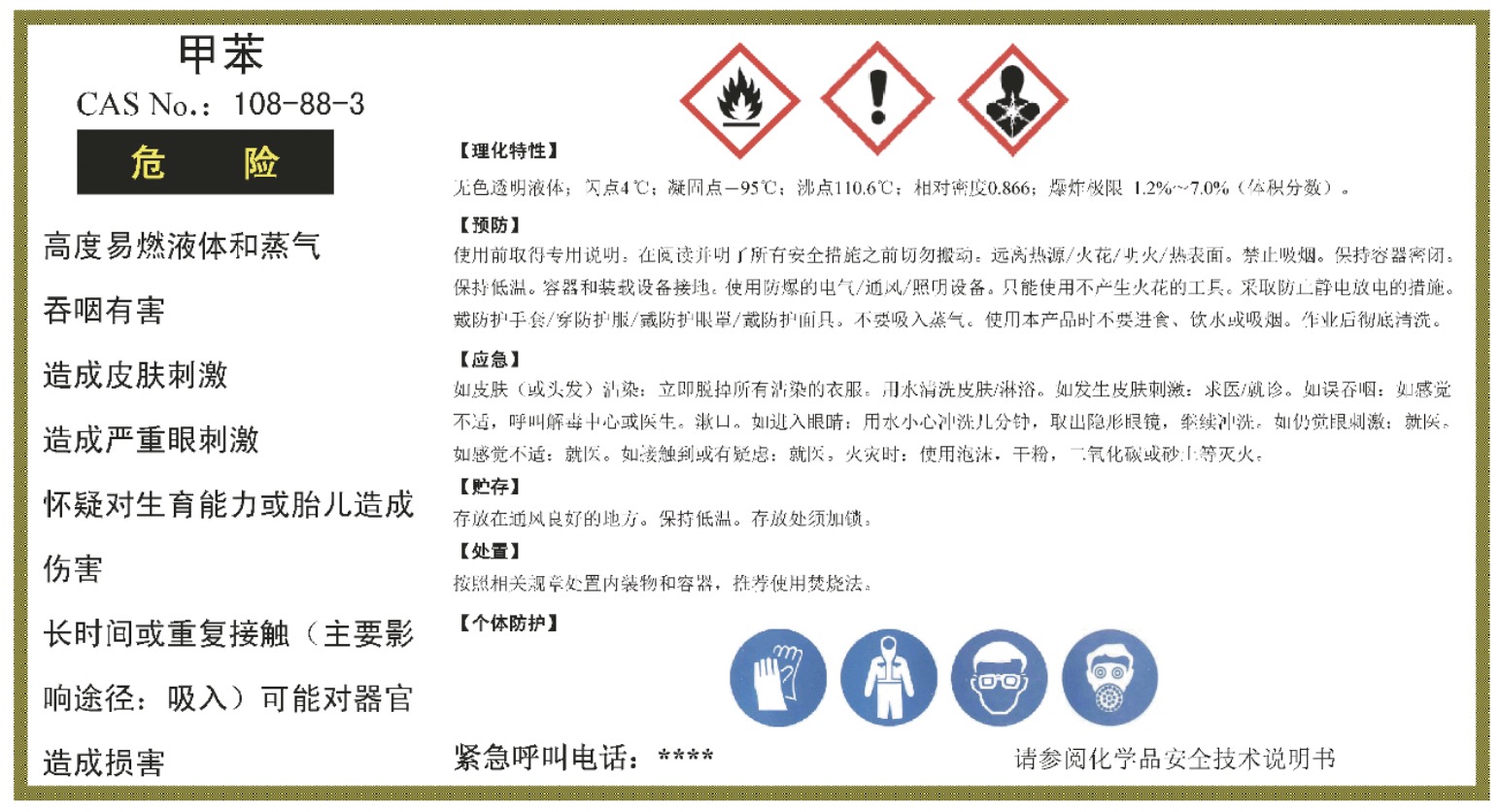
Fig. 6 - Precautionary label for workplace of chemicals in GB/T 30000.31-2023
Transport labelling
China requires that the GHS label used during transportation be affixed to the shipping package if the chemicals are listed in GB 12268-2012 List of Dangerous Goods. The transport packaging and labelling should be in compliance with the “UN Recommendations on the Transport of Dangerous Goods (UNRTDG), Model Regulations”. Either the label for combination packaging or the label for single packaging should be applied, depending on actual transporting demands.

Fig. 7 - A sample label for combination packaging
 Fig. 8 - Transport labelling for single packaging
Safety Data Sheet (SDS)
The SDS is an essential hazard communication component, which the suppliers of chemical products use to transfer basic hazardous information (including information on the transportation, handling, disposal, storage and emergency action) to their downstream recipients, public institutions, service providers and other recipients of the chemicals.
China published its primary SDS standard, GB/T 16483-2008 “Safety data sheet for chemical products – Content and order of sections” in June 2008 and put it into force in February 2009. This recommendatory national standard has replaced GB/T 17519.1-1999 and GB 16483-2000. It sets the structure, content and generic layout of SDS for companies that are obliged to prepare a standard SDS for chemical products sold in China. The format and content of the China GHS SDS are almost identical to the SDS required under the EU CLP, both maintaining 16 headings to keep consistent with the UN GHS, listed as follows:
1. Identification
2. Hazard identification
3. Composition/information on ingredients
4. First-aid measures
5. Fire-fighting measures
6. Accidental release measures
7. Handling and storage
8. Exposure controls/personal protection
9. Physical and chemical properties
10. Stability and reactivity
11. Toxicological information
12. Ecological information
13. Disposal considerations
14. Transport information
15. Regulatory information
16. Other information
GB/T 17519-2013 "Guidance on the compilation of safety data sheet for chemical products" is an essential supplementary document namely to implement GB/T 16483-2008. It took effect on January 31, 2014, which specifies key points of the 16 sections in SDS, the format and style, language requirements and units of measurement. A completed model SDS is provided in the annex of the standard, as well as some recommended data sources for each section. Chemical suppliers exporting products to China are strongly advised to be aware of the following Dos& Don’ts when compiling a China GHS SDS:
Adopt settled Chinese SDS framework;
Be familiar with basic knowledge of Chinese SDS rules;
Ensure consistency and completeness of hazard data in the SDS;
Timely update the emerging information in your SDS;
Emergency telephone information in China GHS SDS is compulsory;
No online translation when preparing SDS in Chinese.
Administrative Legislation Relating to China GHS Implementation
China has prescribed a number of administrative rules and measures to advance the GHS implementation. Most of these regulations specify that China GHS classification, labelling and SDS need to be supplied by HazChem manufacturers, importers & exporters, and transport companies. The most significant of them is the State Council Decree 591, “Regulations on the Control over Safety of Hazardous Chemicals”. This overarching regulation outlines general requirements of hazchem enterprises to fulfill the GHS obligations in China along the supply chain. Other ministerial ordinances underneath include:
Provisions on the Road Transport of Dangerous Goods (MOT Order 2 of 2013)
Measures for the Administration of Hazardous Chemicals Registration (SAWS Order 53)
In Decree 591, penalties for the violation of China GHS compliance are severe. Violating companies can be imposed fines ranging from a minimum of 50,000 CNY to a maximum of 100,000 CNY. Some of the possible misconducts specified in the Regulation are listed below:
Failing to provide appropriate China GHS label or SDS during the production, importation or operation of HazChem products;
Providing inconsistent hazard data between the label and the SDS, or between inside package and outer package, or hazard data inconsistent with that specified in the Catalogue of Hazardous Chemicals;
Failing to update in time GHS classification information on the label, or SDS when new hazardous properties of the chemical product arise.
HazChem importers and exporters are strongly advised to take special notice of the customs inspection conducted on HazChems imported and exported. In particular, China GHS labels and SDSs are checked routinely during the entry-exit inspection.
