


 Request a Demo
1 What is CLP?
The Classification, Labelling and Packaging (CLP) Regulation ((EC) No. 1272/2008) implements the United Nations’ Globally Harmonised System (GHS) since 20 January 2009.
It requires manufacturers, importers or downstream users of substances or mixtures to classify, label and package their hazardous chemicals appropriately before placing them on the market. The information is provided on the label to allow identification of hazardous chemicals and safe use of products. CLP is also the basis for safety data sheets (SDS), managed through the REACH Regulation, and sets requirements for hazardous chemicals’ packaging of which design depends on the hazards of the product it contains.
2 Scope of CLP
CLP is legally binding across the 27 EU Member States, plus Norway, Iceland and Liechtenstein as members of the European Economic Area (EEA). It is directly applicable to all industrial sectors.
2.1 Chemicals Covered by EU CLP
The following fall under the scope of CLP:
The vast majority of substances and mixtures imported into Europe, regardless of the tonnage;
All substances which must be registered under EU REACH;
Less than 1 ton/year of hazardous substances and mixtures of raw materials;
Hazardous polymers, pesticides, etc.
This Regulation shall not apply to the following:
Radioactive substances and mixtures;
Substances and mixtures subject to customs supervision;
Non-isolated intermediates;
Substances and mixtures for scientific research and development;
Waste;
Exemptions in the interests of defence;
Substances and mixtures in medicinal and veterinary medicinal products, cosmetic products, medical devices, food or feeding stuffs which are in the finished state, intended for the final user.
2.2 Who are Affected by EU CLP?
CLP places a general obligation for all suppliers of substances and mixtures in the supply chain to cooperate, so as to meet the requirements for classification, labelling and packaging set out in this Regulation. Such as:
Manufacturers or importers of substances or mixtures placing on the market;
Downstream users, including formulators and re-importers;
Distributors, including retailers; and
Producers or importers of a certain specific explosive article.
3 General Obligations
In general, CLP deals with:
Classification;
Hazard communication through labelling;
Packaging; and
Notification to the Classification and Labelling (C&L) Inventory and Poison Center Notification (PCN).
3.1 Classification
3.1.1 CLP Hazard Classes and Categories
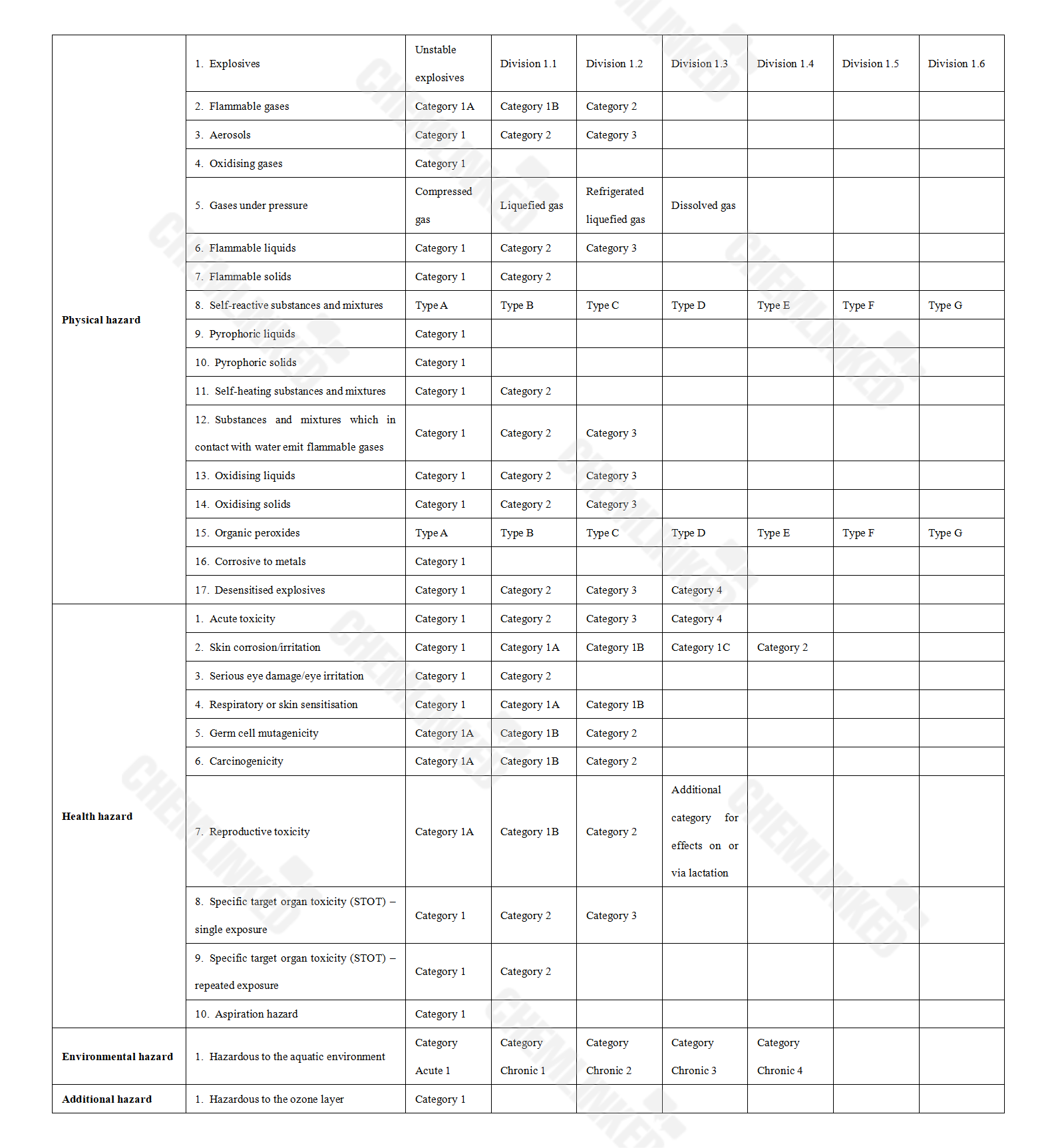
The EU has taken up in the CLP all the hazard classes from the GHS Rev 6/7. However, within the hazard classes, some of the hazard categories were not taken up.
The table below shows the hazard classes included in the CLP. Each class includes one or more hazard categories.
Besides, the revised CLP adopted the following new hazard classes and came into force on April 20, 2023 (read more).
Endocrine disruption for human health in Category 1 and Category 2;
Endocrine disruption for the environment in Category 1 and Category 2;
PBT (persistent, bioaccumulative, toxic), vPvB (very persistent, very bioaccumulative);
PMT (persistent, mobile, toxic), vPvM (very persistent, very mobile).
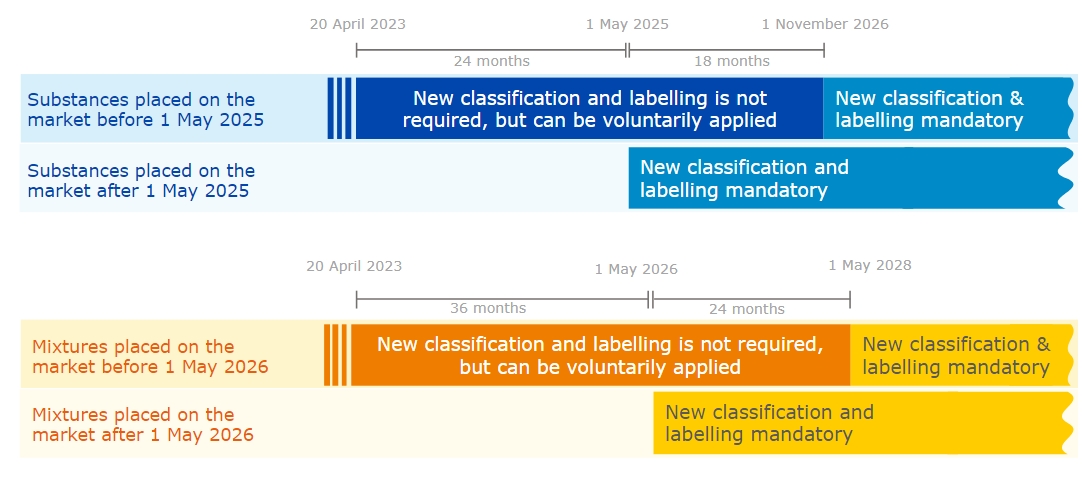
Note: Transitional periods are given during which the new hazard classes can be applied on a voluntary basis as follows:
Source: ECHA website
After the transitional periods, it will be mandatory for all manufacturers, importers, downstream users and distributors to apply the new hazard classes and update the classification and labeling for their products accordingly.
3.1.2 Self-classification and Harmonised Classification
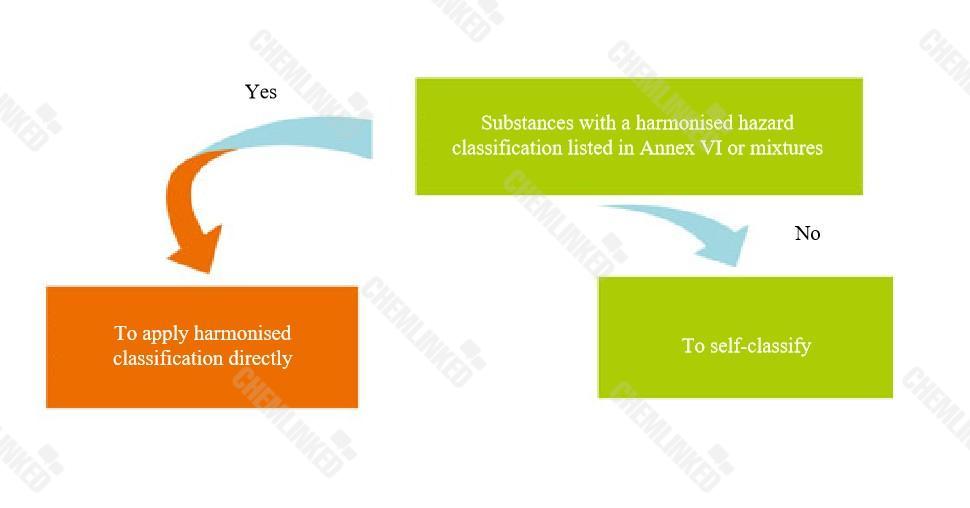
CLP includes provisions for two types of classification: harmonised classification and self-classification.
Harmonised Classification
CLP includes provisions for harmonised classification of substances to be applied directly. All harmonised classifications are now listed in Table 3 of Part 3 of Annex VI to CLP. The requirement is briefly described below.
| Applicable Scope | Who's Affected |
|
|
Self-classification
In addition to harmonised classification, CLP also includes self-classification, aiming to determine whether a chemical substance or mixture has physical, health and/or environmental hazards, regardless of the volume of the substance or mixture produced. The requirement to self-classify is briefly described below.
| Applicable Scope | Who's Affected |
| All substances without a harmonised hazard classification |
|
| Mixtures |
|
3.2 Labelling
Suppliers must communicate the identified hazards to the other actors in the supply chain by labelling the substance or mixture before placing it on the market. Labels must be written in the official language(s) of the Member State(s) where the substance or mixture is placed on the market.
Elements of Label
CLP defines the content of the label and the organisation of the various label elements. The label should be firmly attached to one or more of the packaging’s surfaces and has to include the following:
The name, address and telephone number of the supplier(s) of the substance or mixture (24-hour emergency number is not required);
The nominal quantity of the substance or mixture in the packages made available to the general public, unless this quantity is specified elsewhere on the package;
Product identifiers: for a mixture, include hazardous ingredients that contribute to the classification of acute toxicity, skin corrosion or serious eye damage, germ cell mutagenicity, carcinogenicity, reproductive toxicity, respiratory or skin sensitisation, specific target organ toxicity (STOT) or aspiration hazard.
Hazard pictograms:
For physical hazards, if the label carries the pictogram GHS01 (exploding bomb), then GHS02 (flame) and GHS03 (flame over circle) are optional;
For physical and health hazards, if the label carries the pictogram GHS02 (flame) or GHS06 (skull and crossbones), then GHS04 (gas cylinder) is optional;
For health hazards, if the label carries the pictogram GHS06 (skull and crossbones), then GHS07 (exclamation mark) must not appear;
For health hazards, if the label carries the pictogram GHS05 (corrosion), then GHS07 (exclamation mark) must not be used for skin or eye irritation;
For health hazards, if the label carries the pictogram GHS08 (health hazard) for respiratory sensitisation, then GHS07 (exclamation mark) must not be used for skin sensitisation or for skin or eye irritation but still has to be used for other hazards.
Signal words: “Danger”or “Warning” or none; the signal word “Danger” takes precedence and the signal word “Warning” must not appear;
Hazard statements: All hazard statements resulting from the classification must appear on the label, unless there is evident duplication or redundancy;
Precautionary statements: Not more than six precautionary statements must appear on the label, unless necessary to reflect the nature and the severity of the hazards;
Supplemental information required by other legislation.
Note: Manufacturers, importers and downstream users based in the EU wishing to protecting confidential business information (CBI) during hazardous communication by the label can submit a request for the use of an alternative chemical name to ECHA by using REACH-IT.
Size of Label
CLP sets out minimum dimensions for the label, pictogram and font size (see the table below). Nevertheless, the label should be large enough to contain all the label elements set out in 3.2.1 while remaining legible. As a result, the label may need to be larger than the minimum area specified.
| Capacity of the package | Dimensions of the label (in millimetres) | Dimensions of the pictogram (in millimetres) | Minimum font size (x-height in millimetres) |
| ≤ 0.5 litres | If possible, at least 52 x 74 | Not smaller than 10 x 10 If possible, at least 16 x 16 | 1.2 |
| > 0.5 litres but ≤ 3 litres | 1.4 | ||
| > 3 litres but ≤ 50 litres | At least 74 x 105 | At least 23 x 23 | 1.8 |
| > 50 litres but ≤ 500 litres | At least 105 x 148 | At least 32 x 32 | 2.0 |
| > 500 litres | At least 148 x 210 | At least 46 x 46 | 2.0 |
Fold-out labeling
CLP allows the regular use of fold-out labels. The front page of fold-out label should include at least the following elements:
name, address and phone number of suppliers;
nominal quantity
product identifiers
hazard pictorgams, if applicable;
signal words, if applicable;
unique formula identifier, if applicable;
a reference to the full safety information;
an abbreviation of the language for all the languages used in the inside pages.
The inner pages shall contain all the required label elements except for those mentioned on the front page. The back page should contain all the information provided on the front page. The Revision also includes a minimal font size and a mandatory font color.
Digital labeling
CLP Regulation allows for voluntary digital labeling of chemical products. A data carrier linking to a digital label shall be affixed or printed on the physical label so that it can be processed automatically by digital devices.
The digital label should include all information as provided in physical label. Supplemental information may be omitted on a digital label with an accompanying statement “More hazard information available online” or a similar indication. The digital label should be accessible for at least 10 years to all EU users free of charge.
Updating of CLP Hazard Labels
Following any changes to the classification and labelling where the revised classification is more severe or where new supplemental label elements are required, a supplier is required to update this information on the label as soon as reasonably practicable;
Where labelling changes other than those described above are required, the supplier has 18 months to update the label.
3.3 Safety Data Sheet (SDS)
In addition to the label, another key tool for hazard communication in the supply chain, intended for professional/industrial users only, is the SDS.
The SDS format and content as an integral part of the EU REACH is fully in line with CLP, both maintaining 16 sections to keep consistent with the UN GHS, listed as follows:
Identification of the substance/mixture and of the company/undertaking;
Hazard identifications;
Composition/information on ingredients;
First-aid measures;
Firefighting measures;
Accidental release measures;
Handling and storage;
Exposure controls/personal protection;
Physical and chemical properties;
Stability and reactivity;
Toxicological information;
Ecological information;
Disposal considerations;
Transport information;
Regulatory information;
Other information.
Note: The information that is required to appear in an SDS cannot be claimed as confidential.
The SDS must be supplied in an official language of the Member State(s) where the substance or mixture is placed on the market, unless the Member State(s) concerned provide(s) otherwise. As for mixtures, the concentration limits for substances to be listed in section 3 are the following:
| Hazard class and category | Concentration limit % |
| Acute toxicity, category 1, 2 and 3 | ≥ 0.1 |
| Acute toxicity, category 4 | ≥ 1 |
| Skin corrosion/irritation, category 1, categories 1A, 1B, 1C and category 2 | ≥ 1 |
| Serious damage to eyes/eye irritation, category 1 and 2 | ≥ 1 |
| Respiratory sensitiser category 1 or category 1B | ≥ 0.1 |
| Respiratory sensitiser category 1A | ≥ 0.01 |
| Skin sensitiser category 1 or category 1B | ≥ 0.1 |
| Skin sensitiser category 1A | ≥ 0.01 |
| Germ cell mutagenicity category 1A and 1B | ≥ 0.1 |
| Germ cell mutagenicity category 2 | ≥ 1 |
| Carcinogenicity category 1A, 1B and 2 | ≥ 0.1 |
| Reproductive toxicity, category 1A, 1B, 2 and effects on or via lactation | ≥ 0.1 |
| Specific target organ toxicity (STOT) - single exposure, category 1, 2 and 3 | ≥ 1 |
| Specific target organ toxicity (STOT) – repeated exposure, category 1 and 2 | ≥ 1 |
| Aspiration toxicity | ≥ 1 |
| Hazardous to the aquatic environment – Acute, category 1 | ≥ 0.1 |
| Hazardous to the aquatic environment – Chronic, category 1 | ≥ 0.1 |
| Hazardous to the aquatic environment – Chronic, category 2, 3 and 4 | ≥ 1 |
| Hazardous for the ozone layer | ≥ 0.1 |
Need to update SDSs
Suppliers of substances or mixtures shall update the SDS without delay on the following occasions:
Once new information which affects risk management measures by downstream users, or new information on hazards becomes available;
Once an authorisation has been granted or refused;
Once a restriction has been imposed.
Products for which an SDS is not required
Certain general exemptions from the need to supply information shall apply to the following mixtures in the finished state, intended for the final user:
Medicinal products for human or veterinary use;
Cosmetic products;
Medical devices which are invasive or used in direct physical contact with the human body;
Food or feedingstuffs;
As a food additive or flavouring in foodstuffs;
As an additive in feedingstuffs;
In animal nutrition.
3.4 Notification to the Classification and Labelling (C&L) Inventory
Any company who place a substance on the market must notify information on substance identity and classification and labelling of a substance to the European Chemicals Agency (ECHA). The Agency will include this information in a particular database, called the Classification and Labelling (C&L) Inventory. The details are shown in the table below.
| Information included in a notification |
|
| Notification deadline |
|
Note: In case of a change of the classification and labelling of a substance for which notification had been previously submitted to the C&L inventory, the manufacturer or importer must notify the Agency of any such change.
3.5 Poison Center Notification (PCN)
Basically, companies who place mixtures classified as hazardous on the basis of their health and physical effects on the EU market should be subject to PCN requirements. Here is some useful information about the obligation (click here for more details).
| Who's affected | Importers, downstream users and distributors placing hazardous chemical mixtures on the EU market. |
| Applicable scope | Mixtures placed on the EU market and classified as hazardous on the basis of their health and physical effects. Note: Products exempt from the PCN requirements majorly include:
|
| Information included in a notification | Companies must provide the required information using the harmonised PCN format. The required information includes:
|
Latest updates: On March 25, 2024, ECHA Enforcement Forum announced that it will initiate a 6-month inspection project on poison center notifications (PCN) beginning in January 2025 (read more).
4 Resources
News
Nov 20, 2024 EU Revises CLP Regulation on Substances and Mixtures
Sep 6, 2024 Latest Updates in European Chemicals Management
Mar 28, 2024 ECHA's Enforcement Authorities to Check Poison Center Notification in 2025
Apr 27, 2023 EU Introduces New Hazard Classes under CLP Regulation
Chempedia

