

 Request a Demo
1 Overview
The Industrial Chemicals Environmental Management Standard (IChEMS) is a national approach to managing the import, use and disposal of chemicals, which aims to manage environmental risks from industrial chemicals across Australia. It was established in 2021 by the Industrial Chemicals Environmental Management (Register) Act 2021 (ICEMR Act). All Australian governments (Commonwealth, States and Territories) are collaborating to implement the IChEMS, ensuring consistent, transparent, practical and enforceable standards for managing environmental risks. Implementing IChEMS will help Australia meet internationally recognized standards for managing high-risk industrial chemicals, including those POPs specified in the Stockholm Convention.
2 IChEMS Framework
Under the ICEMR Act, the following legislative instruments were made to establish the IChEMS framework:
IChEMS Register: Industrial Chemicals Environmental Management (Register) Instrument 2022
IChEMS Register is a record of scheduling decisions for industrial chemicals made under the ICEMR Act. It includes control measures to manage the environmental risks of listed chemicals.
IChEMS Rules: Industrial Chemicals Environmental Management (Register) Rules 2022
The Rules lay out additional matters the Minister must consider when making scheduling decisions.
IChEMS Principles: Industrial Chemicals Environmental Management (Register) Principles 2022
The Principles prescribe risk characteristics that must be met for a chemical to be listed in a particular schedule on the IChEMS Register.
3 IChEMS Scheduling Strategy
3.1 Scheduling Decisions
Standards set under the IChEMS are made as scheduling decisions, which will be recorded on the IChEMS Register (Schedules 1-7) and detail the required controls that manufacturers, importers, exporters and users must meet. Under IChEMS, industrial chemicals will be assigned to one of the 7 schedules according to their environmental risk levels, applying appropriate risk management measures (see figure below).
 Source: IChEMS website
Chemicals of highest environmental risks will be categorized in Schedule 6 or 7, which are likely to pose serious or irreversible harm to the environment. Chemicals of lower environmental risks will be categorized in Schedule 1 to 5. Chemicals in Schedule 1 are considered lowest risk concern. For all chemicals on the IChEMS Register, regardless of listing in which schedule, they shall meet the baseline requirements – IChEMS Minimum Standards. Stricter standards are enforced for activities involving higher-risk chemicals, which may include prohibitions and restrictions where necessary.
3.2 Scheduling Priorities
Chemicals that are regulated under international conventions and are not consistently controlled in Australia will be given priority for scheduling. These include:
Chemicals currently listed on the Stockholm Convention on Persistent Organic Pollutants
Chemicals newly listed on the Stockholm Convention
Chemicals subject to an international prohibition or restriction
Chemicals where there is a reputable risk assessment
Chemicals of lower concern.
From 2022 to Dec 2024, IChEMS has made scheduling decisions for twenty-seven groups of industrial chemicals. Fourteen chemicals (PFOA, PFOS, PFHxS, PCN, SCCPs, PCBs, HCBs, etc.) are listed in Schedule 7 and three chemicals (i.e., decaBDE, Dechlorane Plus, UV-328) are listed in Schedule 6, most of which are POPs under the Stockholm Convention. Five chemicals are listed in Schedule 3, four chemicals are listed in schedule 2, and one group of chemicals is listed in Schedule 1. Currently, no chemicals are categorized in Schedule 4 or 5 on the IChEMS Register.
The IChEMS Online Register allows stakeholders to easily check if a chemical is listed on the IChEMS Register and provides information on the environmental risk management measures associated with those chemicals. Stakeholders including importers, manufacturers, exporters and users of industrial chemicals have the opportunity to give input into the scheduling decisions proposed under IChEMS. To contribute, visit the IChEMS consultation hub.
4 IChEMS Responsibilities
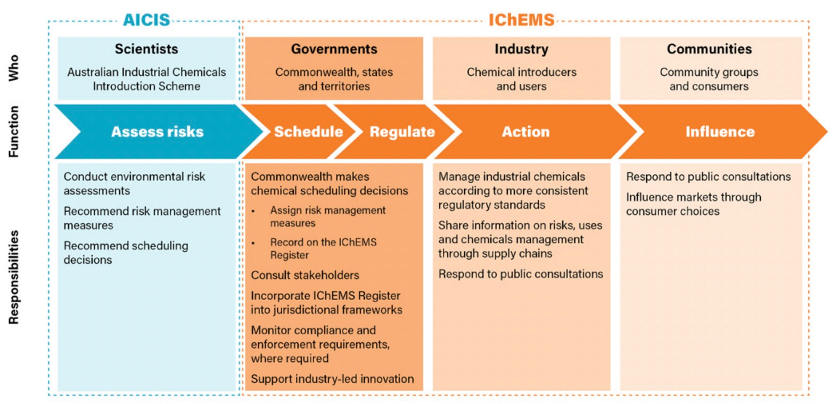
IChEMS operates in conjunction with the Australian Industrial Chemicals Introduction Shceme (AICIS). AICIS is responsible for regulating the import and manufacture of industrial chemicals in Australia and assessing risks to human health and the environment across their lifecycle. IChEMS uses AICIS risk assessment results to categorize industrial chemicals on the IChEMS Register and recommend risk management measures needed to protect the environment from different end uses.
 Source: IChEMS website
IChEMS will inform governments, industry (chemical manufacturers, importers, users) and communities on how they can better protect humans and the environment from harmful industrial chemicals. Under IChEMS, preventing environmental risks is a shared responsibility among governments, industry, and communities. More specifically:
Commonwealth government makes chemical scheduling decisions and assigns risk management measures, and then records on the IChEMS Register. Governments in States and Territories incorporate the IChEMS Register into jurisdictional frameworks, leading to more consistent regulatory standards nationwide. Governments at all levels shall monitor compliance and enforcement requirements.
Chemical manufacturers, importers and users support IChEMS by incorporating environmental risk management practices into daily operations, responding to public consultations and sharing information on risks, uses and chemical management of industrial chemicals through supply chains.
Communities (the public) shall actively participate in public consultations and exercise their influence to promote the design and manufacture of products that use lower concern industrial chemicals.
